

ABUJA, Nigeria — President Bola Tinubu swept the All Progressives Congress presidential primary on Saturday, collecting votes across Nigeria’s 36 states and the Federal Capital Territory in numbers so lopsided that his sole challenger, Stanley Osifo, recorded zero votes in most states where results were declared — securing the ruling party’s ticket for the 2027 general election before the final national tally was even complete.
Tinubu was set to receive his certificate of return and the APC party flag Sunday at the Bola Ahmed Tinubu International Conference Centre in Abuja, where governors, National Executive Committee members, National Assembly lawmakers, and senior party officials were expected to attend the formal presentation.
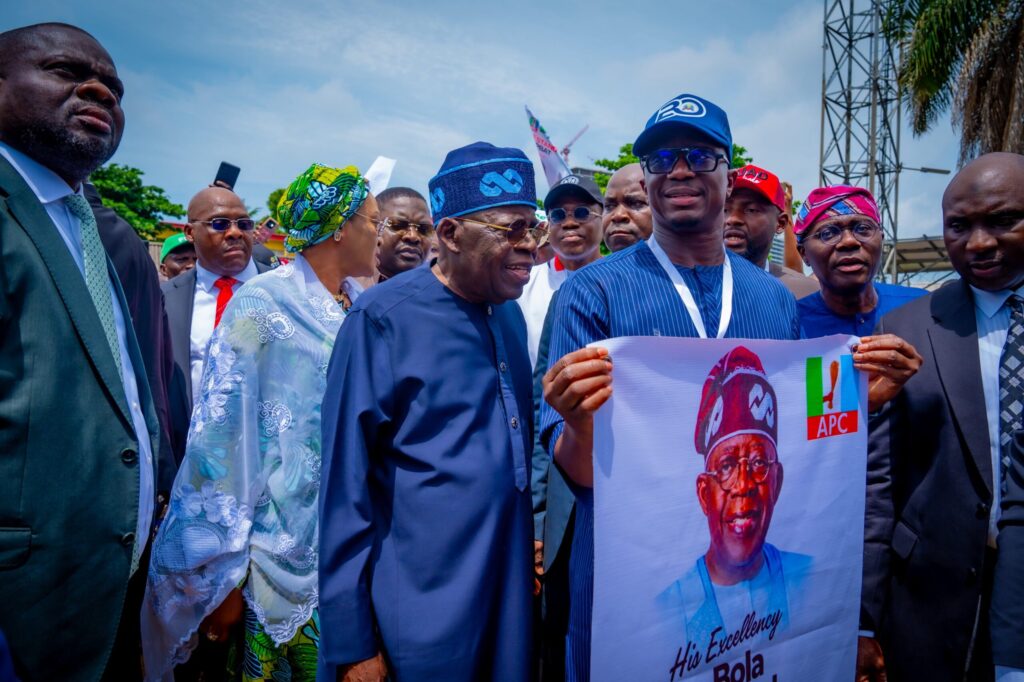
The primary was conducted simultaneously across 8,809 wards nationwide under a direct primary format. APC governors served as collation and returning officers in their respective states, and Independent National Electoral Commission officials monitored the exercise to ensure compliance with electoral procedures.
The numbers tell the story plainly. In Rivers State, Tinubu polled 280,468 votes while Osifo registered zero across all 23 local government areas. In Gombe State, Tinubu received 450,516 votes against Osifo’s zero, with Governor Muhammadu Yahaya noting the state had 550,516 registered APC members. In Ebonyi, Tinubu swept all 207,579 valid votes cast across 13 local government areas, again against zero for Osifo. In Kwara, the final count gave Tinubu 310,990 votes to Osifo’s zero. In Edo, Tinubu collected 131,096 votes against Osifo’s one. In Osun, Tinubu took 100,880 votes and Osifo received none across 332 wards. Bayelsa gave Tinubu 277,192 votes and Osifo five. Zamfara gave Tinubu 321,579 against Osifo’s 42.
The president cast his vote at his polling unit in Ward L2, Ikoyi, Lagos, accompanied by First Lady Senator Oluremi Tinubu. He described the primary as the expression of grassroots democratic participation.
“This is a demonstration of internal democracy,” Tinubu said after voting. “This is politics — grassroots politics, where every member of the party has a right to participate and be involved. It’s to ensure that we have internal democracy, and it’s peaceful and well-organised.”
APC National Secretary Ajibola Basiru confirmed results had been collated across all 774 wards and across all states, with some state-level collation still ongoing at the time he spoke. He described what he had seen as evidence of a landslide and said the formal declaration would follow Sunday’s national presentation of state results to the presidential primary election committee.
The ground-level scenes reinforced the numerical picture. In Kaduna, party members across all 255 wards unanimously endorsed Tinubu, with Governor Uba Sani commending the exercise as peaceful, orderly, and transparent. In Plateau State, APC members formed queues from early morning at collation venues across the Central and Southern zones, with Jos North LGA Chairman J.K. Chris describing the turnout as evidence of unified resolve.
In Abia State, former Governor Orji Kalu, now a senator representing Abia North, led more than 4,000 registered APC members at Igbere Ward A in Bende Local Government Area. At Bende itself, the hometown of Deputy House Speaker Benjamin Kalu, over 13,000 party members reportedly lined up for Tinubu while Osifo received no votes.
In Bayelsa, Governor Douye Diri, who served as state collation and returning officer, certified the results after aggregating numbers from all eight local government areas. “I hereby certify that the results announced represent the true, correct, and accurate collation of votes from all local government areas in Bayelsa State,” Diri said. “The process was conducted peacefully and in accordance with party guidelines.”
Imo State Governor Hope Uzodimma drew applause with a declaration that captured the mood of the day. “If only our party members vote for President Tinubu, he has already won the election,” Uzodimma said, commending the electronic membership registration process.
As the APC consolidated around Tinubu with orderly if predictable uniformity, the African Democratic Congress found itself in the opposite position heading into its own presidential primary scheduled for Monday.
The ADC had initially pursued a consensus arrangement to produce its 2027 candidate, but disagreements among three significant aspirants have complicated that path. Former Vice President Atiku Abubakar, ex-Rivers State Governor Rotimi Amaechi, and businessman Mohammed Hayatu-Deen have each refused to step aside despite pressure from party figures seeking to avoid a contested primary.
John Oyegun, former APC national chairman and now chairman of the ADC’s 50-member Policy and Manifesto Committee, said the party preferred consensus but was prepared to hold a direct primary if the aspirants could not reach an agreement.
“Consensus will save us valuable time. This would have been better for all of us, but if the aspirants fail to agree, we will follow what the law says. The law says where there is no agreement on consensus, we must conduct a direct primary. If that is what we have to do, we will do it,” Oyegun said in an interview with Sunday Punch.
Amaechi has made his position clear repeatedly and without softening. “I am not stepping down for anyone,” he declared in Kano. “Let the people decide who they want to lead.”
Hayatu-Deen has taken a less confrontational tone while still rejecting calls to withdraw, saying he would support whoever emerged from a credible and transparent process. Atiku, the most experienced of the three in national presidential contests, has not publicly commented in recent days on the internal negotiations.
ADC chieftain Timothy Osadolor urged Atiku specifically to pursue a negotiated outcome rather than a floor fight. “No one is in doubt as to the capacity and competence of the Wazirin Adamawa in every party primary he has been engaged in,” Osadolor said. “However, times have changed significantly, and perceptions have too. He will be making a mistake in thinking that Rotimi Amaechi can be wished away or run over in today’s politics or within the ADC.”
Media entrepreneur and ADC figure Dele Momodu acknowledged that the combination of strong personalities and the financial investments each aspirant had already committed to their campaigns made consensus genuinely difficult to achieve, while arguing that a competitive process was not inherently damaging to the party provided it remained credible.
Saturday’s APC primary was not a contest in any meaningful electoral sense. The outcome was settled long before polling units opened. Every major APC organ, including the National Executive Committee, the National Working Committee, the Progressive Governors Forum, and state party structures across all 36 states, had endorsed Tinubu before Saturday. His challenger, Stanley Osifo, was not a figure with an organizational base, a political network, or a history of national political engagement capable of mounting a genuine challenge.
What Saturday’s exercise provided was not drama or uncertainty. It provided legitimacy — a formal record that the incumbent president sought his party’s second-term ticket through a direct primary involving party members rather than simply receiving it through a backroom arrangement among party elites. Whether that distinction matters to Nigerian voters in 2027 will depend on what the next two years of governance look like, how the cost of living pressure evolves, and whether the security situation in the north and southwest shows measurable improvement.
The ADC primary scheduled for Monday carries more genuine uncertainty, though that uncertainty may itself be the problem. A deeply fractured opposition entering the 2027 cycle against a unified ruling party with incumbency advantages, federal resources, and a just-ratified candidate will need more than internal drama to build a credible challenge. Atiku has run for president multiple times without success. Amaechi has significant northern political capital but no clear national coalition. Hayatu-Deen brings business credibility and a fresh face but limited political infrastructure.
If the ADC cannot achieve consensus and a bruising primary produces a candidate who enters the general election with unhealed internal wounds, the practical advantage that Tinubu’s clean Saturday sweep provides grows considerably larger. The certificate Tinubu receives Sunday morning represents more than a party ticket. In the context of Nigerian opposition politics as it currently stands, it represents something approaching a running start.
Punchng/PremiumTimesng





