

Crowds estimated in the millions gathered Saturday across the United States and in multiple foreign nations for the third installment of “No Kings” rallies protesting President Donald Trump’s policies, with Minnesota taking center stage as organizers designated the state capitol as the flagship event headlined by Bruce Springsteen in what demonstrators hope will constitute the largest single-day protest in American history.
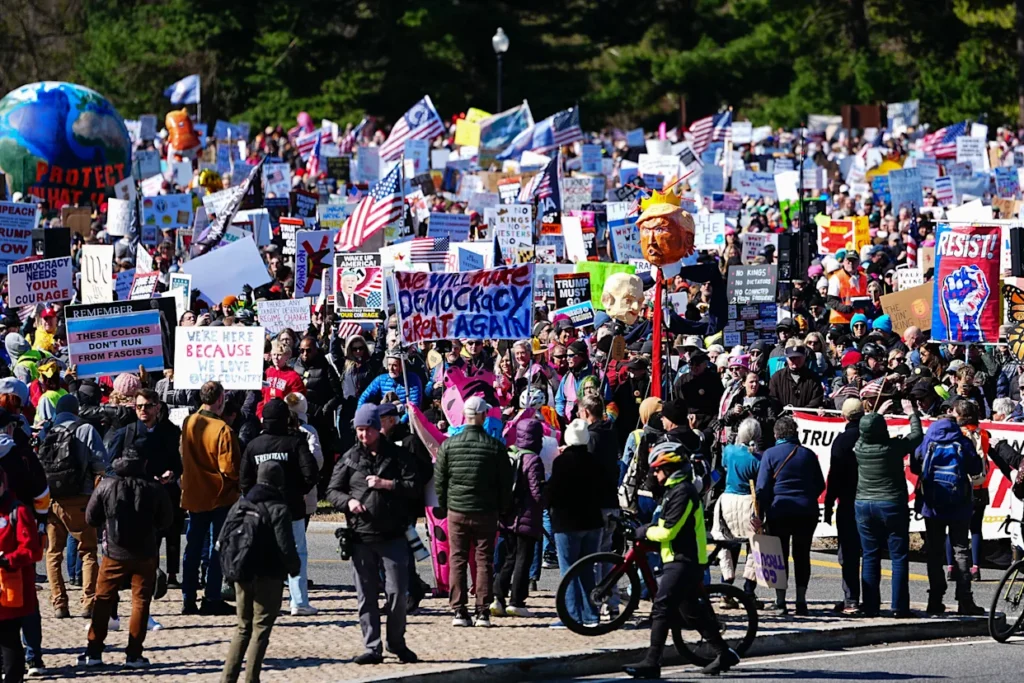
Thousands of people stood shoulder-to-shoulder on the Minnesota Capitol lawn and surrounding streets in St. Paul, many holding upside-down American flags—historically a distress signal indicating grave threats to the nation. The massive turnout reflected sustained grassroots opposition to Trump administration actions that protesters characterize as authoritarian overreach threatening constitutional democracy.
The event’s headliner was Springsteen, who performed “Streets of Minneapolis”—a composition he wrote responding to the fatal shootings of Renee Good and Alex Pretti by federal immigration agents and paying tribute to thousands of Minnesotans who took to the streets throughout winter protesting the Trump administration’s aggressive immigration enforcement tactics that culminated in those deaths.
Before launching into the song, Springsteen lamented Good and Pretti’s deaths while emphasizing that continued pushback against U.S. Customs and Immigration Enforcement has provided hope to Americans nationwide watching Minnesota’s resistance. “Your strength and your commitment told us that this was still America,” he declared from the Capitol steps. “And this reactionary nightmare, and these invasions of American cities, will not stand.”
People rallied from New York City—with nearly 8.5 million residents in a solidly Democratic state—to Driggs, a town of fewer than 2,000 people in eastern Idaho, a state Trump carried with 66 percent of the vote in 2024. The geographic breadth of protests spanning deep blue urban centers and conservative rural communities illustrated the movement’s expanding reach beyond traditional progressive strongholds.
U.S. organizers estimated that the first two rounds of No Kings rallies drew more than 5 million people in June and 7 million in October. This week they told journalists they expected 9 million participants Saturday, though determining whether those projections were met would require days of crowd-sourcing analysis across more than 3,100 registered events—500 more than in October—spanning all 50 states.
In Topeka, Kansas, a rally outside the Statehouse featured people impersonating a frog king and Trump as a baby in satirical demonstrations mocking what protesters view as childish authoritarianism. Wendy Wyatt drove with a “Cats Against Trump” sign from Lawrence, 20 miles to the east, and planned returning to her hometown for a subsequent rally there.
Wyatt acknowledged “there are so many things” about the Trump administration that upset her, adding that participating in protests felt “very hopeful to me” as an antidote to feelings of powerlessness confronting governmental actions she opposes.
White House spokesperson Abigail Jackson dismissed the nationwide demonstrations as products of “leftist funding networks” with minimal genuine public support. “The only people who care about these Trump Derangement Therapy Sessions are the reporters who are paid to cover them,” Jackson declared in a statement employing language designed to delegitimize mass civic engagement as mental illness rather than legitimate political expression.
The National Republican Congressional Committee offered similarly harsh criticism of the protests. “These Hate America Rallies are where the far-left’s most violent, deranged fantasies get a microphone,” NRCC spokesperson Maureen O’Toole charged, characterizing peaceful demonstrations as venues for extremism rather than constitutionally protected assembly and speech.
Trump’s immigration enforcement push—particularly in Minnesota where Good and Pretti were killed—represented just one item on protesters’ extensive grievance list that also encompassed the Iran war, transgender rights rollbacks, and broader concerns about democratic backsliding under what demonstrators characterize as increasingly authoritarian governance.
In Washington, hundreds marched past the Lincoln Memorial into the National Mall, hoisting signs proclaiming “Put down the crown, clown” and “Regime change begins at home.” Demonstrators rang bells, played drums, and chanted “No kings” in explicit rejection of what they view as Trump’s monarchical pretensions incompatible with republican government.
Bill Jarcho traveled from Seattle alongside six people costumed as insects wearing tactical vests labeled “LICE”—spoofing ICE as part of what he termed a “mock and awe” tour. “What we provide is mockery to the king,” Jarcho explained. “It’s about taking authoritarianism and making fun of it, which they hate.”
Police in San Diego estimated approximately 40,000 people marched through that city in one of numerous large-scale West Coast demonstrations. In New York, Donna Lieberman, executive director of the New York Civil Liberties Union, declared during a news conference that Trump and his supporters want people afraid to protest.
“They want us to be afraid that there’s nothing we can do to stop them,” Lieberman asserted. “But you know what? They are wrong — dead wrong.” Her defiant rhetoric reflected protesters’ determination to maintain resistance despite what they perceive as governmental efforts to intimidate dissent through harsh rhetoric and potential legal retaliation.
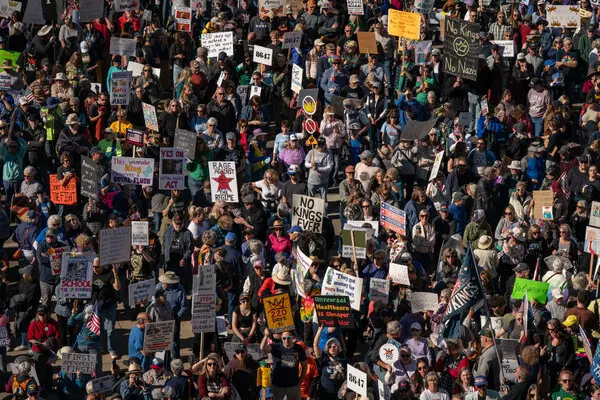
Organizers disclosed that two-thirds of RSVPs for the rallies originated from outside major urban centers, including communities in conservative-leaning states like Idaho, Wyoming, Montana, Utah, South Dakota, and Louisiana, as well as electorally competitive suburbs in Pennsylvania, Georgia, and Arizona. The geographic distribution suggests the movement has penetrated territories where opposition to Trump might prove politically consequential in upcoming midterm elections.
Before Springsteen took the Minnesota stage, organizers screened a video featuring actor Robert De Niro confessing he wakes every morning depressed because of Trump but felt happier Saturday knowing millions were protesting. He also congratulated Minnesotans for running ICE out of town following sustained resistance that temporarily forced federal immigration agents to suspend operations in the Twin Cities metropolitan area.
The program also included singer Joan Baez, actor Jane Fonda, Vermont U.S. Senator Bernie Sanders, and an extensive roster of activists, labor leaders, and elected officials representing the broad coalition opposing Trump administration policies. Protesters held a massive sign on Capitol steps proclaiming, “We had whistles, they had guns. The revolution starts in Minneapolis.”
Demonstrations were planned in more than a dozen other countries spanning Europe to Latin America to Australia, Ezra Levin, co-executive director of Indivisible—a group spearheading the events—disclosed in an interview. In nations with constitutional monarchies, people termed the protests “No Tyrants” to avoid offending monarchs who lack the executive powers protesters oppose in Trump.
In Rome, thousands marched with defiant chants targeting Premier Giorgia Meloni, whose conservative government witnessed its referendum for streamlining Italy’s judiciary fail badly this week amid criticism threatening courts’ independence. Protesters also waved banners protesting Israeli and U.S. attacks on Iran, demanding “A world free from wars.”
In London, demonstrators against the war held banners with slogans including “Stop the far right” and “Stand up to Racism,” linking Trump administration policies to broader global patterns of authoritarian nationalism and xenophobic politics that protesters view as interconnected threats to democracy and human rights.
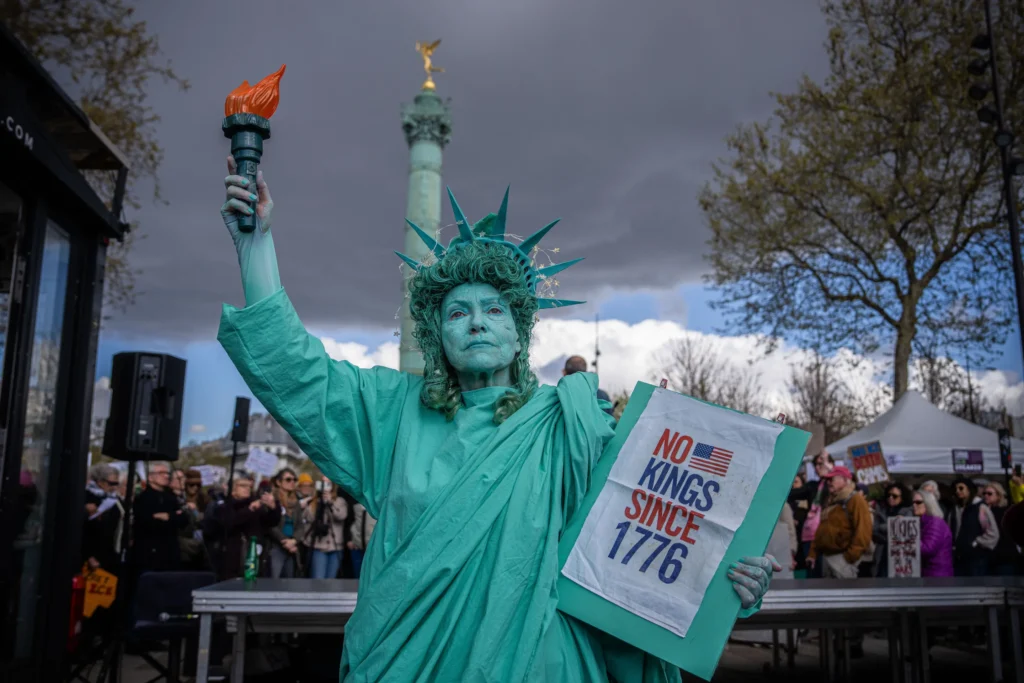
In Paris, several hundred people—mostly Americans living in France alongside labor unions and human rights organizations—gathered at the Bastille, the historic revolutionary site symbolizing popular resistance to tyranny. “I protest all of Trump’s illegal, immoral, reckless, and feckless, endless wars,” rally organizer Ada Shen declared.
According to Reuters, demonstrators decrying Trump’s policies took to city streets nationwide Saturday in the third edition of “No Kings” rallies which organizers hope will constitute the largest single-day protest in U.S. history. More than 3,200 events were planned in all 50 states and several cities outside the U.S., with the two previous No Kings events attracting millions of participants.
Singers Springsteen and Baez headlined the Minnesota state capitol rally where upward of 100,000 people were expected to gather in an area that became a flashpoint over Trump’s immigration crackdown and federal agents’ incursion into Democratic-led urban centers. Other large rallies occurred in New York, Los Angeles, and Washington, though two-thirds of events happened outside major city centers—a nearly 40 percent jump for smaller communities from the movement’s first mobilization last June, organizers confirmed.
On the National Mall in Washington, crowds chanted pro-democracy slogans and held anti-Trump signs. Outside one high-rise assisted-living center in Chevy Chase, Maryland, elderly people in wheelchairs held signs encouraging passing cars to “Resist tyranny,” “Honk if you want democracy,” and “Dump Trump”—demonstrating that opposition spans age demographics.
In Austin, Texas, a brass band provided soundtrack as protesters gathered outside City Hall before marching through downtown. Thousands assembled in midtown Manhattan where De Niro—one of the organizers—declared that “there have been other presidents who have tested the constitutional limits of their power, but none have been such an existential threat to our freedoms and security.”
“The defining story of this Saturday’s mobilization is not just how many people are protesting, but where they are protesting,” said Leah Greenberg, co-founder of Indivisible, which initiated the No Kings movement last year and led planning for Saturday’s events. The emphasis on geographic distribution rather than raw numbers reflected strategic focus on building political power in electorally competitive regions.
The rallies transpired as Trump’s approval rating has plummeted to 36 percent—its lowest point since his return to the White House—according to a Reuters/Ipsos poll suggesting his policies have alienated substantial portions of the electorate including some who supported him in 2024 elections.
A spokesperson for the National Republican Congressional Committee criticized Democratic politicians and candidates for supporting the rallies. “These Hate America Rallies are where the far-left’s most violent, deranged fantasies get a microphone and House Democrats get their marching orders,” spokesperson Mike Marinella charged in a statement.
With midterm elections approaching later this year, organizers documented surges in people organizing anti-Trump events and registering to participate in deeply Republican states like Idaho, Wyoming, Montana, and Utah. Competitive suburban areas that help decide national elections are witnessing “huge” interest increases, Greenberg noted, citing Pennsylvania’s Bucks and Delaware counties, East Cobb and Forsyth in Georgia, and Scottsdale and Chandler in Arizona.
“Voters who decide elections, the people who do the door-knocking and the voter registration and all of the work of turning protests into power, they are taking to the streets right now, and they are furious,” she emphasized, framing demonstrations as electoral organizing rather than mere symbolic expression.
In northern Virginia outside Washington, several hundred people gathered near Arlington National Cemetery before a planned march across the Potomac River to the National Mall. Some passing drivers honked horns in support while others slowed to berate protesters. “You’re all idiots,” one man shouted from his vehicle, illustrating the polarization defining contemporary American politics.
John Ale, 57, a retired air-conditioning and heating contractor, explained he drove 20 minutes from his Virginia home to join the march. “What’s happening in this country is unsustainable,” he asserted. “The middle class, the little people, can’t afford to live anymore. And he (Trump) is breaking the norms, the things that made us function as a country.”
The No Kings movement launched last year on Trump’s birthday, June 14, drawing an estimated 4 to 6 million people across roughly 2,100 sites nationwide. The second mobilization in October involved an estimated 7 million participants in more than 2,700 cities, according to crowd-sourcing analysis published by prominent data journalist G. Elliott Morris.
That October event was largely fueled by backlash against a government shutdown, aggressive federal immigration enforcement, and National Guard troop deployments to major cities. Saturday’s events arrived amid what organizers characterized as a call to action against bombardment of Iran by the U.S. and Israel—a conflict now four weeks old with mounting American casualties and no clear conclusion despite administration promises of swift victory.
Morgan Taylor, 45, attended the Washington protest with her 12-year-old son, expressing outrage at Trump’s military action in Iran which she termed a “stupid war.” “Nobody’s attacking us,” Taylor emphasized. “We don’t need to be there.” Her sentiment captured widespread skepticism about the conflict’s justification and necessity among protesters who view it as contradicting Trump’s campaign promises to avoid foreign military entanglements.
As demonstrators dispersed Saturday evening across hundreds of cities, the fundamental question persisted about whether mass protests can translate into electoral power capable of constraining Trump’s agenda or whether they represent cathartic expressions of frustration without meaningful political consequences. The answer will emerge during November’s midterm elections when voters either reward or punish the Republican Party for Trump’s governance.





