

President Donald Trump is reviewing a proposal to purchase the Chagos Islands from Mauritius, a move that could reshape control over a key military base in the Indian Ocean as uncertainty surrounds a planned transfer of sovereignty by the United Kingdom.
The idea, first detailed by The Telegraph and cited by The Guardian and The Independent, has been presented as one of several options under discussion within the administration. U.S. Treasury Secretary Scott Bessent is said to have raised the concept with the president, though it is not currently viewed as the leading course of action.
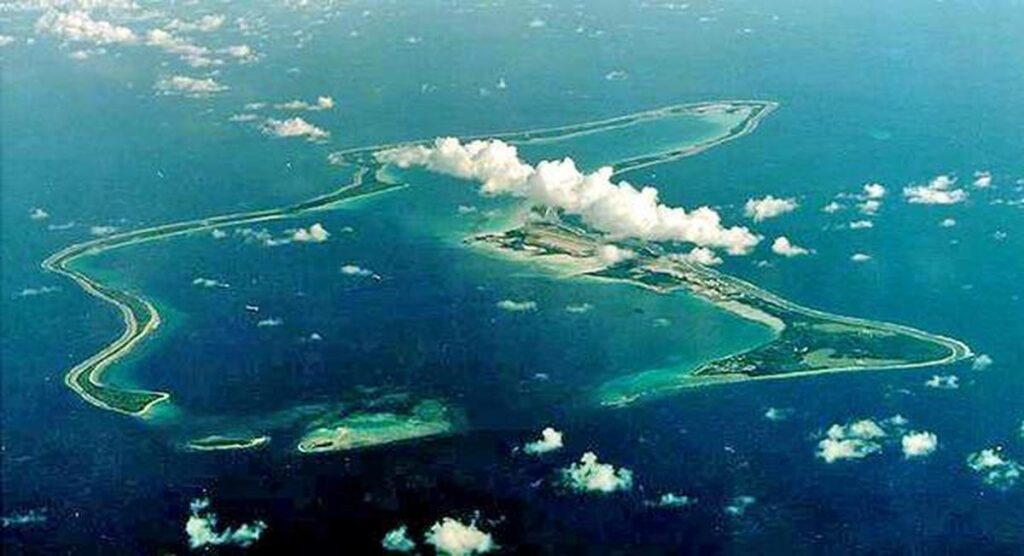
At the center of the deliberations is the Diego Garcia base, a long standing joint U.S. and U.K. military installation located on one of the islands. The base plays a critical role in projecting military power across the Middle East, Africa and parts of Asia.
Under the reported plan, Washington could seek to negotiate directly with Mauritius if sovereignty over the islands is formally transferred. Efforts by the United Kingdom to hand control of the territory to Mauritius have stalled in recent months after the United States withdrew support for the arrangement earlier this year.
Officials within the administration have voiced concerns about Mauritius’ ties to China, raising fears that a change in control could create vulnerabilities for intelligence gathering and military operations. A U.S. official cited by The Independent emphasized that the strategic value of Diego Garcia makes it indispensable to national security, adding that Washington remains engaged with British counterparts to safeguard its long term viability.
The White House has not issued a formal response to the reports.
The islands have taken on renewed importance amid heightened tensions involving Iran. Diego Garcia lies within striking distance for long range military operations and has been used in recent months as part of ongoing U.S. and allied activity in the region. Iran’s foreign minister Abbas Araghchi has previously warned that the use of regional bases for military action could escalate risks for allied nations.
British officials have maintained that any final decision regarding sovereignty would require U.S. backing. A government spokesperson reiterated that the primary objective is to protect the operational integrity of the base, describing it as essential to shared security interests between Washington and London.
The debate has also drawn attention from displaced islanders. Representatives of the Chagos refugee community visiting the United Kingdom recently urged leaders to prioritize their right to return, arguing that geopolitical maneuvering has overshadowed long standing human concerns.
The proposal reflects a broader pattern in President Trump’s foreign policy approach, which has included interest in territorial acquisitions such as Greenland and heightened rhetoric around expanding U.S. influence abroad. While those earlier efforts did not materialize, the renewed focus on strategically located territories signals continued emphasis on geographic leverage in defense planning.
The consideration of purchasing the Chagos Islands highlights the intersection of military strategy, global rivalry and unresolved colonial legacies. Control of Diego Garcia offers not only logistical advantages but also a forward operating position in a region where competition among major powers is intensifying. Any attempt to acquire the islands outright would likely face diplomatic resistance from both Mauritius and international bodies, particularly given ongoing disputes over sovereignty and the rights of displaced residents.
At the same time, hesitation within Washington suggests competing priorities. While direct control could eliminate uncertainties tied to allied agreements, it may also complicate relations with partners and fuel perceptions of expansionism. The situation underscores a larger question shaping U.S. foreign policy: whether strategic security is best maintained through alliances or through direct territorial control.
TheIndependent/TheGuardian





