

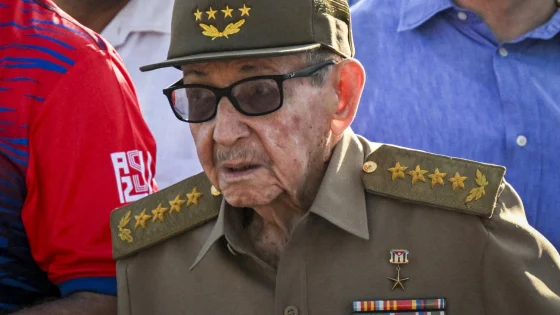
The United States charged former Cuban President Raúl Castro with murder on Wednesday over the 1996 shootdown of two civilian planes operated by Miami-based Cuban exiles, a dramatic escalation of the Trump administration’s campaign against the island’s communist government that drew immediate condemnation from Havana and raised the specter of military action against a country already reeling from an American-imposed fuel blockade.
A federal grand jury in Miami returned the indictment in late April, Acting Attorney General Todd Blanche announced at a ceremony in the city honoring the four men killed nearly three decades ago. The indictment was unsealed Wednesday.
Castro, now 94, faces one count of conspiracy to kill U.S. nationals, four counts of murder, and two counts of destruction of aircraft. The charges carry a maximum sentence of death or life in prison. Five other defendants were charged alongside him, including three Cuban military pilots who fired the missiles that destroyed the planes.
Castro appeared publicly in Cuba earlier this month. There is no evidence he has left the island, and no mechanism for his immediate extradition exists. Blanche, speaking to a packed auditorium of government officials and Cuban Americans in Miami, was asked directly what the United States would do to bring Castro before an American court.
“There was a warrant issued for his arrest,” Blanche said to applause. “So we expect that he will show up here, by his own will or by another way.”
What Happened on February 24, 1996
Brothers to the Rescue was a Miami-based Cuban exile organization that flew small planes over the Florida Straits, searching for Cuban rafters trying to reach the United States. Starting in 1995, some of those flights had pushed further, buzzing over Havana and dropping leaflets urging Cubans to rise up against the Castro government.
Cuba protested repeatedly to Washington. The Federal Aviation Administration opened an investigation and met with the group’s leaders to urge them to stop. Those warnings went unheeded.
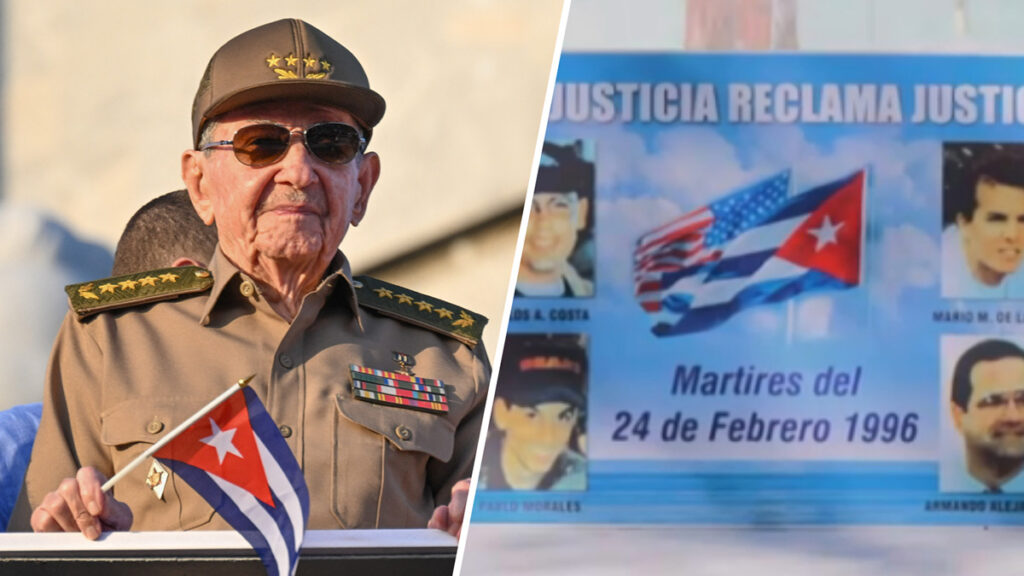
On February 24, 1996, missiles fired from Russian-made MiG-29 fighter jets destroyed two unarmed civilian Cessna planes a short distance north of Havana, just beyond Cuban territorial airspace. The International Civil Aviation Organization later concluded the shootdown occurred over international waters. All four men aboard the planes were killed: Carlos Costa, Armando Alejandre Jr., Mario de la Peña, and Pablo Morales. Their portraits were displayed at Wednesday’s ceremony as officials spoke.
Castro was Cuba’s defense minister at the time. Fidel Castro subsequently said Cuba’s military had acted on standing orders to down planes violating Cuban airspace, and said Raúl had not given a specific order for the February 24 shootdown. Federal prosecutors concluded otherwise.
“For nearly 30 years, the families of four murdered Americans have waited for justice,” Blanche said. “They were unarmed civilians and were flying humanitarian missions for the rescue and protection of people fleeing oppression across the Florida Straits.”
Marlene Alejandre-Triana, whose father Armando Alejandre Jr. was among the dead, called the charges “long overdue.” She described Castro as “one of the main architects of the crime” and said her father had simply wanted to bring freedom to his Cuban homeland.
The Co-Defendants and One Already in Custody
The five other defendants charged alongside Castro include Lt. Col. Lorenzo Alberto Pérez-Pérez of Las Tunas, José Fidel Gual Barzaga, Emilio José Palacio Blanco, and Raul Simance Cárdenas. One defendant, Lt. Col. Luis Raúl González-Pardo Rodríguez, is already in U.S. custody. He was previously indicted in November 2025 on charges including fraud and misuse of immigration documents, specifically for allegedly falsely claiming on a permanent residence application that he had never received weapons or military training. He is awaiting sentencing later this month.
Cuba’s Response
Cuban President Miguel Díaz-Canel rejected the indictment in blunt terms, characterizing it as a fabrication designed to provide legal cover for a military attack on Cuba.
“It is a political maneuver, devoid of any legal foundation,” Díaz-Canel wrote on X. He said Cuba had acted in “legitimate self-defense within its territorial waters after repeated and dangerous violations of its airspace by notorious terrorists.” He added that U.S. officials had been warned about the violations before the shootdown and chose to allow the flights to continue.
Cuban Foreign Minister Bruno Rodriguez called Secretary of State Marco Rubio’s simultaneous offer of $100 million in U.S. aid to Cuba cynical, pointing to what he described as the devastating effect of the American economic blockade on ordinary Cubans.
The Maduro Template
The indictment carries a weight beyond legal procedure because the Trump administration has already shown it is willing to act on exactly this kind of charge against a Latin American leader. In January, U.S. special forces seized then-Venezuelan President Nicolás Maduro in the Venezuelan capital and transported him to New York, where he faces drug trafficking charges and has pleaded not guilty. Trump’s first administration had indicted Maduro before using that indictment to justify his removal.
Peter Kornbluh, a senior analyst and Cuba specialist at the National Security Archive at George Washington University, said Castro would have no choice but to take the threat seriously. “He’s going to have to keep his head pretty low from now on,” Kornbluh said. “They’re going to have no choice but to take this threat extremely seriously.”
In Miami’s Little Havana neighborhood, the reaction among Cuban Americans was direct. Peter Hernandez, whose family owns a fruit and vegetable market and whose parents moved from Cuba to South Florida before he was born, said he would support American military action to bring Castro in. “He’s a criminal,” Hernandez said. “I think we should do that with all criminals, especially if they’re hiding behind a country that consistently has been proven that they are on the wrong side of our national security efforts and ideology.”
When asked what comes next for Cuba, Trump said: “We’re going to see.” He added that the United States was ready to provide humanitarian assistance to what he called a “failing nation.”
The Political Architecture Behind the Charges
Wednesday’s announcement is the most visible piece of a sustained American pressure campaign against Cuba that has intensified since Maduro’s capture. The Trump administration imposed an effective fuel blockade on Cuba by threatening sanctions on countries supplying it with oil, triggering severe power outages and accelerating what Cubans describe as the worst economic crisis the island has faced in decades.
Secretary of State Marco Rubio, the son of Cuban immigrants and a figure widely seen as a potential 2028 Republican presidential contender, has been the architect of much of that pressure. He released a Spanish-language video Wednesday urging Cubans to demand new leadership and a free-market economy. “Currently, the only thing standing in the way of a better future are those who control your country,” Rubio said.
The CIA Director John Ratcliffe traveled to Havana last week for meetings with Cuban officials, including Castro’s grandson, Raúl Guillermo Rodríguez Castro, who had previously met secretly with Rubio. Two senior State Department officials held a separate meeting with the grandson in April. The diplomatic back-channel activity, combined with Wednesday’s indictment, suggests a coordinated strategy aimed at fracturing the Cuban leadership from within while applying maximum external legal and economic pressure.
Trump, speaking at a Coast Guard Academy event in Connecticut, framed the broader regional posture in sweeping terms. “From the shores of Havana to the banks of the Panama Canal, we will drive out the forces of lawlessness and crime and foreign encroachment,” he said.
A 29-Year-Old Case as a Weapon for Regime Change
The Raúl Castro indictment is a remarkable document on multiple levels, and understanding what it is requires understanding what it is not.
It is not primarily a legal instrument designed to produce a trial. Castro is 94 years old, in poor health by most accounts, and living in a country that will not extradite him. The probability that he will appear in a Miami courtroom to answer these charges is, in any realistic assessment, extremely low. The investigation into his role in the 1996 shootdown is nearly three decades old — the Clinton administration pursued it and then deliberately chose not to indict Castro himself, prioritizing diplomatic calculations over prosecution.
What the indictment is, with clarity, is a political instrument. It serves the same function that the Maduro drug trafficking indictment served before January’s raid: it establishes a legal framework that the Trump administration can point to when justifying further action. It says to the world, and particularly to Cuba’s military and political establishment, that the United States has formally declared Raúl Castro a criminal, issued an arrest warrant, and reserved the right to act on it by any available means.
The phrase Blanche used — “by his own will or by another way” — is not accidental legal boilerplate. It is a deliberate echo of the language and logic that preceded the Maduro operation. The Trump administration is telling Cuba’s leadership that the playbook exists, that it has been used before, and that it is available again.
Whether it gets used will depend on military and diplomatic calculations that extend well beyond the courtroom. Cuba is not Venezuela. It sits 90 miles from Florida. A military operation on the island would carry consequences of a different order of magnitude from the Caracas raid. Cuban officials are aware of this. American military planners are aware of this. And the Trump administration, which has shown a consistent willingness to push the boundaries of what previous administrations treated as unthinkable, is presumably aware of it too.
For the families of Carlos Costa, Armando Alejandre Jr., Mario de la Peña, and Pablo Morales, Wednesday’s ceremony and the names on the indictment represent something real and long sought, whatever its ultimate legal outcome. For the broader region and the world watching Washington’s behavior in Latin America, it represents something else: evidence that the United States under Trump is prepared to use the full weight of its legal, economic, and military apparatus to reshape the Western Hemisphere on its own terms, on its own timeline, and without the constraints that previously governed American conduct toward sovereign governments in the region.
AP/Reuters





