

Russia launched one of its heaviest overnight assaults on Kyiv in months early Monday, killing at least 12 people, wounding more than 60, and exposing a deepening crisis in Ukraine’s ability to intercept ballistic missiles as every one of the ballistic projectiles Russia fired struck its intended target.
The attack came days after a separate Russian strike killed 31 people in the capital last Thursday, the deadliest assault on Kyiv this year, and arrived on the eve of a NATO summit in Ankara, Turkey, where Ukrainian President Volodymyr Zelenskyy is expected to make an urgent plea for more Patriot interceptor missiles.
What We Know So Far
Ukraine’s Air Force confirmed Russia fired 68 missiles and 351 drones overnight, targeting primarily Kyiv. Air defenses intercepted 37 missiles and more than 90 percent of the drones, but none of the 23 ballistic missiles were stopped, Reuters confirmed. Super and hypersonic missiles also struck their targets without being intercepted.
Kyiv Mayor Vitali Klitschko confirmed at least 12 deaths and more than 50 wounded across the city. An entire family, two parents and their child, was pulled from the rubble in one district, Ukrainian Foreign Minister Andrii Sybiha said.
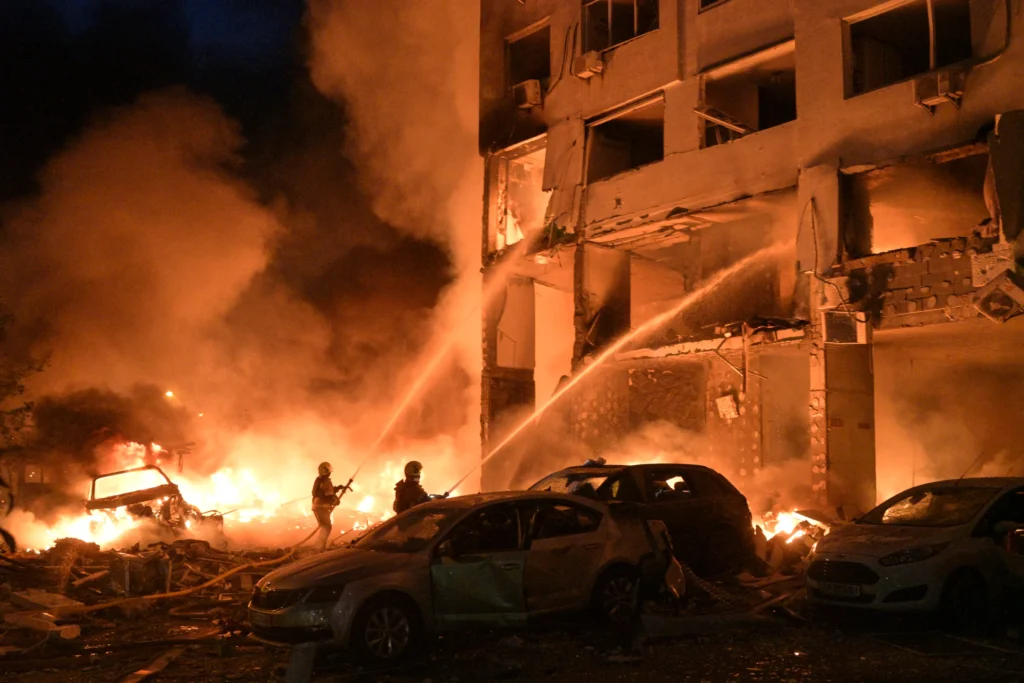
Close to 30 residential buildings were significantly damaged. A nine-story apartment block in the historic Podilskyi district was largely destroyed from the fifth floor upward, officials confirmed. The Darnytsia district also sustained severe damage, with several multistory buildings struck and residents believed trapped beneath the rubble.
Reuters television footage showed what appeared to be human remains trapped under concrete debris on an upper floor of a Podilskyi building as emergency workers used ladder trucks to reach upper floors and firefighters battled lingering flames.
Five additional people were killed and 26 injured in the surrounding Kyiv region. The southern port city of Odessa also came under attack, with at least one person wounded there, local officials said.
Poland scrambled fighter jets briefly as a precautionary measure before standing them down with no airspace violation recorded.
Ukraine launched its own drone attacks against Russia overnight. Ukrainian strikes damaged the Baltic Sea ports of Vysotsk and Ust-Luga, a major Russian oil export facility, Russian authorities confirmed.
A power blackout struck Sevastopol in Russian-occupied Crimea, home to Russia’s Black Sea Fleet, with the Moscow-appointed city head acknowledging that Ukrainian strikes had cut power supplies before backup systems restored them. Russia’s Defense Ministry separately said its air defenses downed 519 Ukrainian drones overnight.
Russia’s Yaroslavl region governor confirmed two people were wounded in a separate Ukrainian drone attack on the city there, with an online news outlet reporting the strike targeted an oil refinery and caused a fire.
What Authorities Are Saying
Zelenskyy had warned on Sunday that a large-scale Russian attack was imminent. After the strikes, he addressed the global community directly and with urgency.
“As long as Patriot missiles remain in our allies’ stockpiles, Russia is only encouraged to keep destroying residential buildings,” he wrote on X. “The United States and Europe have enough strength to stop this terror.”
Ahead of the NATO summit, Zelenskyy called on allies to leave Ankara with concrete commitments to bolster Ukraine’s air defense capacity and protect civilian lives. He acknowledged that Ukrainian forces had performed adequately against cruise missiles and drones but were powerless against ballistic missiles without sufficient interceptors.
Air Force spokesman Yurii Ihnat was direct about the underlying cause of Monday’s failures. “To intercept ballistics, we need the means for interception,” he said on national television. “Russians are certainly using the fact that there is a serious deficit of interceptor missiles now, in Ukraine and the world.”
Tymur Tkachenko, head of Kyiv’s Military Administration, described the human reality of the strikes in a Telegram post. “These are residential buildings. Places where people slept and lived their ordinary lives,” he said, confirming that a building in the Podilskyi district had partially collapsed and that people were believed trapped in the Darnytsia district.
Russia’s Defense Ministry maintained that its forces had targeted weapons factories in Kyiv, including facilities producing drones, armored vehicles, and missiles, as well as fuel and energy infrastructure. Those claims could not be independently verified, the Associated Press noted.
Witnesses Recount The Night’s Terror
Khrystyna Piatetska, 20, described being jolted awake by the first explosion, followed immediately by a second blast that blew out the windows in her apartment. The lights failed, smoke filled the stairwell, and the smell of burning hung in the air as residents scrambled to evacuate.
“When we were leaving the building, bodies were lying there,” Piatetska told reporters. “When we got downstairs, cars started exploding, and we came out from under the rubble straight into the fire.”
Halina Ivanivna, 61, said she was woken at around 2 a.m. by the first strike and watched her building begin to collapse around her before a second strike hit approximately five minutes later. “Everything was falling down,” she said.
A 22-year-old woman named Alyona waited at a playground near one of the damaged buildings for news of her 19-year-old friend Vika, who was missing after the attack. “We’re sitting here and waiting until they retrieve them,” she told Reuters, holding back tears. “She’s so kind, only 19 years old. She’s such a kind girl.”
Why This Matters
Monday’s attack crystallizes a strategic reality that has been building for months. Russia has recognized that Ukraine’s most critical vulnerability is no longer on the battlefield but in the air, specifically in the finite and increasingly depleted supply of Patriot interceptor missiles that represent Kyiv’s only reliable defense against ballistic projectiles.
The war in the Middle East has strained the global supply of Patriot interceptors, which are manufactured in limited quantities and have been drawn down by competing demands across multiple conflict zones.
Ukraine’s reliance on a weapons system that its allies cannot readily replenish has created an exploitable gap that Russia is now deliberately widening with each successive ballistic missile barrage.
The timing is also diplomatically pointed. By launching its most comprehensive assault in recent weeks on the eve of a NATO summit where Ukraine’s survival needs will be at the center of debate, Russia is sending a clear signal about the consequences of Western hesitation.
Zelenskyy arrives in Ankara with fresh photographs of collapsed buildings and a death toll that has now crossed 40 in Kyiv in less than a week, a context that he will use to press allies for the interceptors his air force acknowledges it cannot otherwise provide.
More than 16,000 Ukrainian civilians have been killed since Russia’s full-scale invasion began in February 2022, according to the United Nations. Monday’s attack adds to that toll and to the body of evidence that Russia’s aerial campaign continues to target residential areas regardless of its stated military justifications.
Ukraine’s own offensive drone campaign has delivered measurable results in recent months, slowing Russian advances along the 1,200-kilometer front line by targeting supply routes and logistics infrastructure behind Russian positions. Strikes on oil facilities at Ust-Luga and Vysotsk on Monday continued that campaign.
But the asymmetry between Ukraine’s drone effectiveness and its air defense vulnerability reflects a war that is being fought simultaneously in the air, on the ground, and in the logistics chains of governments thousands of kilometers away.
What Happens Next
Zelenskyy heads to Ankara for the NATO summit beginning Tuesday, where Trump is also expected, with the two leaders set to meet for discussions on renewed efforts to end the war. The overnight attack will define the political atmosphere of those conversations in ways that no diplomatic briefing could replicate.
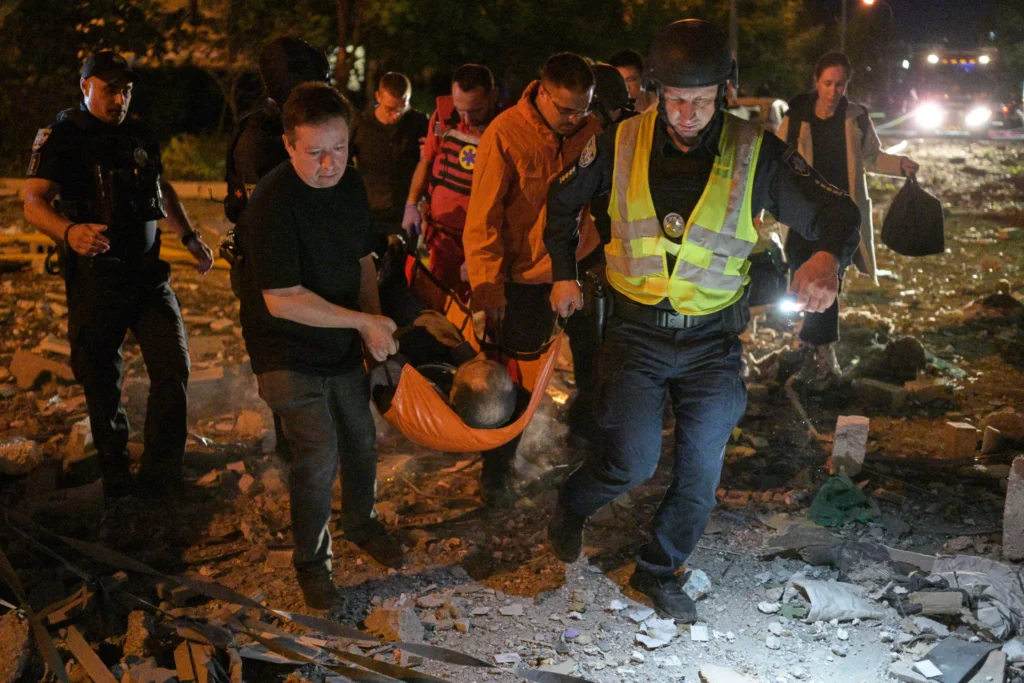
Rescue operations were continuing across Kyiv Monday morning as emergency workers searched rubble for survivors in the Podilskyi and Darnytsia districts. The full casualty count was expected to rise as crews reached areas still inaccessible in the immediate aftermath.
Ukraine’s air force has made clear that without a significant resupply of Patriot interceptors, the country’s ability to defend its capital against Russian ballistic missiles will remain critically limited.
Whether NATO allies leave Ankara with the commitments Zelenskyy is demanding will determine whether Monday’s scenes are repeated in the weeks ahead.
Reuters/AP/TheMoscowTimes





