

Two vessels came under fire Wednesday in the Strait of Hormuz, heightening tensions in one of the world’s most critical shipping lanes and complicating fragile diplomatic efforts aimed at restarting talks between the United States and Iran.
British military officials monitoring maritime security in the region said the first incident occurred early in the day when a container ship was struck by gunfire. The vessel sustained damage but reported no injuries among its crew. A second cargo ship later indicated it had also been fired upon and was forced to halt in the water, though it reported no visible damage and all crew members were accounted for.
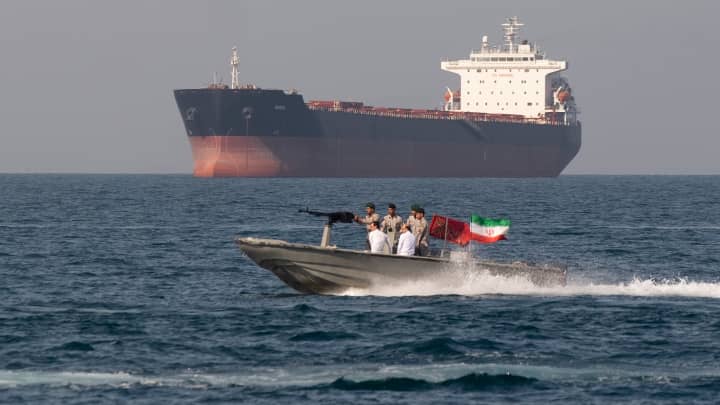
Authorities did not immediately assign responsibility for the second incident. However, suspicion quickly centered on Iran following confirmation that the country’s Revolutionary Guard targeted the first vessel.
Accounts of the initial attack differed. The United Kingdom Maritime Trade Operations center, which tracks threats to commercial shipping, indicated that the vessel was fired upon without prior warning. Iranian state media, however, maintained that the ship had ignored instructions from Iranian forces before the engagement took place.
The developments come at a critical moment as international efforts intensify to bring Washington and Tehran back to the negotiating table. Pakistan has been working to host a new round of talks in Islamabad, though Iran has yet to confirm its participation. A previous meeting earlier this month concluded without a breakthrough, leaving key issues unresolved, including Iran’s nuclear program and control over regional waterways.
President Donald Trump announced late Tuesday that the United States would extend its ceasefire with Iran beyond its original deadline, offering additional time for diplomatic efforts. The truce had been set to expire Wednesday. Trump said the extension would allow Iranian leadership to present a unified negotiating position, though Iran has not publicly acknowledged the move.
Pakistan’s Prime Minister Shehbaz Sharif welcomed the extension, describing it as an opportunity to advance negotiations. He indicated that his government would continue efforts to facilitate dialogue between the two sides.
Despite the ceasefire extension, the United States has maintained a naval blockade of Iranian ports, a measure that Tehran has repeatedly condemned. Iranian officials have cited the blockade as a major obstacle to renewed talks, arguing that it undermines the spirit of diplomacy.
In a statement carried by state media, Iran’s Revolutionary Guard warned that it would respond forcefully to any perceived threats in the region, signaling the potential for further escalation.
The Strait of Hormuz remains a focal point in the conflict. The narrow waterway serves as a vital corridor for global energy supplies, with roughly one-fifth of the world’s oil and natural gas shipments passing through it during normal conditions. Since the outbreak of hostilities earlier this year, shipping traffic has been severely disrupted, contributing to sharp increases in energy prices.
Market reactions reflected the ongoing uncertainty. Brent crude, the international benchmark for oil prices, hovered near $98 per barrel in early trading Wednesday, representing a significant increase since the conflict began.
The attacks also follow a series of recent confrontations at sea. In recent days, U.S. forces intercepted and seized vessels linked to Iran, actions described by Washington as part of its enforcement of sanctions and maritime restrictions. Tehran has denounced those operations and warned of retaliation.
The broader conflict, now entering its eighth week, has resulted in significant casualties across the region. Iranian authorities have reported thousands of deaths, while additional casualties have been recorded in Lebanon, Israel and neighboring Gulf states. Military personnel from both the United States and Israel have also been among those killed.
Diplomatic observers say the latest incidents underscore the fragile nature of the ceasefire and the challenges facing negotiators. Even as both sides signal openness to talks, actions on the ground continue to raise the risk of miscalculation.
United Nations Secretary-General António Guterres expressed hope that the extended ceasefire would create an opening for renewed diplomacy. His office indicated that the additional time could help build trust and reduce tensions, though it acknowledged the situation remains volatile.
For now, uncertainty dominates the region. Shipping companies are navigating heightened risks, energy markets remain on edge and diplomatic channels face increasing strain. Whether the latest attacks will derail efforts to resume negotiations or serve as a catalyst for renewed urgency remains unclear.
What is certain is that the Strait of Hormuz continues to stand at the center of a conflict with global implications, where even isolated incidents can reverberate far beyond the region.
AP/Skynews





