

President Trump branded Pope Leo XIV as “WEAK” on crime and “terrible” on foreign policy in a late-night Truth Social blitz that also saw him uploading an AI-generated image of himself dressed as Jesus, drawing immediate rebuke from Catholic leaders who characterized the attacks as unprecedented in modern history.
Last week, Pope Leo declared Trump’s warning that an “entire civilisation will die tonight”—in reference to Iran—was “unacceptable.” The pope has also suggested that a “delusion of omnipotence” is fueling the war between the United States and Iran, directly criticizing Trump’s apocalyptic rhetoric and maximalist approach to the conflict.
In his lengthy Truth Social post, the president claimed that the Catholic Church’s leadership had been “arresting priests, ministers, and everybody else” in the midst of the COVID-19 pandemic and suggested that he preferred the pope’s brother. “I like his brother Louis much better than I like him, because Louis is all MAGA,” the president declared. “He gets it, and Leo doesn’t! I don’t want a Pope who thinks it’s OK for Iran to have a Nuclear Weapon.”
The president went on to suggest that his own election played a role in the Catholic Church’s choice of pope in May 2025—an extraordinary claim that the Vatican’s internal deliberations were influenced by American political considerations. “Leo should be thankful because, as everyone knows, he was a shocking surprise,” the president wrote. “He wasn’t on any list to be Pope, and was only put there by the Church because he was an American, and they thought that would be the best way to deal with President Donald J. Trump.”
“If I wasn’t in the White House, Leo wouldn’t be in the Vatican,” Trump continued, suggesting the 1.4-billion-member Catholic Church selected its spiritual leader specifically to manage relations with the American president rather than for religious qualifications.
Trump added: “Leo should get his act together as Pope, use Common Sense, stop catering to the Radical Left, and focus on being a Great Pope, not a Politician”—language treating the spiritual leader of the world’s largest Christian denomination as subordinate requiring presidential instruction.
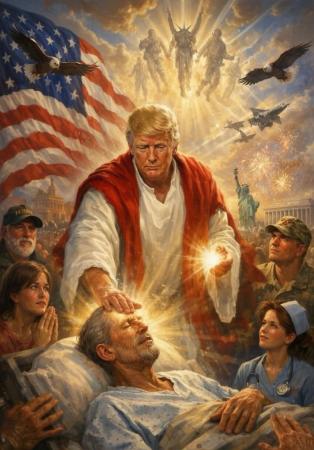
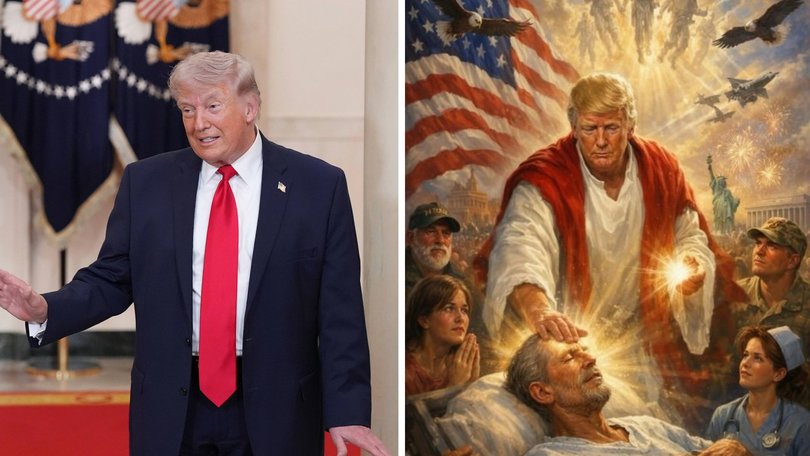
Around 40 minutes after unloading on the pope, Trump uploaded an AI-generated image of himself dressed as Jesus. In the picture, the president is bathed in golden light as he places a shining hand on a sleeping man’s forehead—imagery directly appropriating Christian religious iconography to portray Trump as divine healer.
A nurse and a praying woman are both kneeling around the patient in the image, while a man in camouflage uniform looks on. A fourth individual, dressed in a green uniform, is also by the patient’s bedside. In the background, a huge U.S. flag, a pair of bald eagles, and a trio of military planes can be seen flying through the air—combining religious and nationalist symbolism.
Former Trump loyalist Marjorie Taylor Greene shredded the president’s post, declaring she was “praying against it.” “On Orthodox Easter, President Trump attacked the Pope because the Pope is rightly against Trump’s war in Iran and then he posted this picture of himself as if he is replacing Jesus,” Greene wrote on X. “This comes after last week’s post of his evil tirade on Easter and then threatening to kill an entire civilization.”
“I completely denounce this and I’m praying against it!!!” Greene continued, employing language suggesting Trump’s actions constituted spiritual transgression requiring divine intervention to counteract.
Archbishop Paul S. Coakley, president of the U.S. Conference of Catholic Bishops, also issued a statement in response to Trump’s post. “I am disheartened that the President chose to write such disparaging words about the Holy Father,” he wrote. “Pope Leo is not his rival; nor is the Pope a politician. He is the Vicar of Christ who speaks from the truth of the Gospel and for the care of souls.”
Italian historian Massimo Faggioli told Reuters that he believes there is “no ambiguity about the situation now.” “Not even Hitler or Mussolini attacked the pope so directly and publicly,” he stated, drawing comparison to 20th-century dictators whose relationships with the Vatican were strained but who avoided such direct public attacks on papal authority.
Reuters confirmed that U.S. President Trump forcefully criticized Pope Leo late Sunday in an unusual, direct attack on the leader of the 1.4-billion-member Catholic Church that drew immediate rebuke from believers worldwide. The president, in apparent response to the pope’s growing criticisms of the U.S.-Israeli war on Iran and the Trump administration’s hard-line immigration policies, characterized Leo as “terrible.”
“Pope Leo is WEAK on Crime, and terrible for Foreign Policy,” Trump wrote in a post on Truth Social, employing language typically reserved for political opponents rather than spiritual leaders commanding global respect.
Catholics on social media quickly lambasted Trump for attacking the leader of their Church, whom they believe is the successor of St. Peter, one of Jesus’ 12 apostles. “There is no ambiguity about the situation now,” Faggioli, an expert on the papacy, told Reuters.
He compared the comments to efforts by the leaders of Germany and Italy during World War Two to draw the late Pope Pius XII to support their causes. “Not even Hitler or Mussolini attacked the pope so directly and publicly,” Faggioli repeated, emphasizing the unprecedented nature of Trump’s assault on papal authority.
Archbishop Coakley, president of the U.S. Conference of Catholic Bishops, disclosed he was disheartened by Trump’s comments. “Pope Leo is not his rival; nor is the Pope a politician. He is the Vicar of Christ who speaks from the truth of the Gospel and for the care of souls,” he emphasized in a statement defending the pope’s spiritual role.
Leo, originally from Chicago, is the first U.S. pope. Known for choosing his words carefully, he has emerged as an outspoken critic of the Iran war in recent weeks and decried the “madness of war” in a peace appeal on Saturday. Last year, he questioned whether the Trump administration’s hard-line immigration policies were in line with the Church’s pro-life teachings.
“Someone who says, ‘I am against abortion but I am in agreement with the inhuman treatment of immigrants in the United States’, I don’t know if that’s pro-life,” the pontiff declared in September, challenging the consistency of those who claim pro-life credentials while supporting policies separating families and deporting longtime residents.
Trump wrote in his post Sunday that “Leo should get his act together as Pope,” later telling journalists he was “not a big fan” of the pontiff—language treating the spiritual leader of over one billion Catholics as celebrity requiring Trump’s approval.
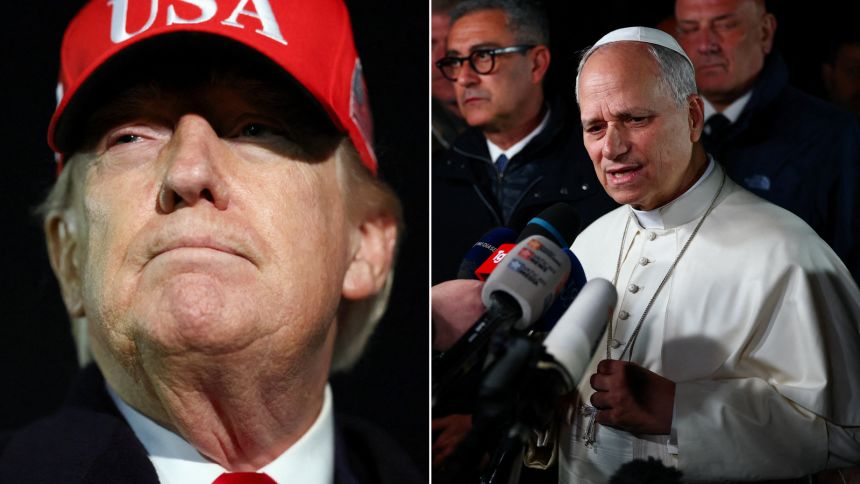
Trump’s broadside against Leo also accused him of being “weak on nuclear weapons,” several days after the pope characterized the U.S. president’s threat to destroy Iranian civilization as “truly unacceptable.” In a speech on Palm Sunday last month in St. Peter’s Square in the Vatican, the pope declared God rejects the prayers of leaders who start wars and have their “hands full of blood,” calling the conflict in Iran “atrocious.”
Leo has also called on Trump to find an “off-ramp” to end the conflict and “decrease the amount of violence”—diplomatic language urging de-escalation that apparently infuriated Trump who views such appeals as weakness rather than moral leadership.
In his post, Trump suggested that Leo was only elected to lead the Catholic Church last year “because he was an American, and they thought that would be the best way to deal with President Donald J. Trump”—an assertion with no basis in how papal conclaves function and insulting to the cardinals who selected him.
The Vatican did not immediately respond to a request for comment. The pope is scheduled to leave Monday for an ambitious 10-day tour of four countries in Africa—diplomatic travel that will prevent immediate response to Trump’s attacks.
Leo has called for “deep reflection” about the way migrants are being treated in the United States. The pope’s call for a more compassionate approach to immigration—a sentiment expressed by several of Leo’s predecessors—stands in contrast to the stance of Trump, who has argued that the United States must curtail immigration from developing countries to reduce crime.
“He’s a very liberal person and he’s a man who doesn’t believe in stopping crime,” Trump told journalists Sunday night, characterizing the pope’s humanitarian concerns as soft-on-crime liberalism rather than Christian compassion.
Trump also had a rocky relationship with Leo’s predecessor Pope Francis, who criticized Trump’s immigration policy proposals when he first ran for president and suggested Trump was “not a Christian” based on his policy positions. Trump had called Francis “disgraceful” in early 2016, establishing a pattern of conflicts with papal authority.
The attacks on Pope Leo and the posting of an image depicting Trump as Jesus raised profound questions about the president’s relationship with Christianity and his understanding of religious authority. For Catholics who view the pope as Christ’s representative on Earth, Trump’s attacks constitute not merely political disagreement but assault on their faith’s foundational structures.
The AI-generated image of Trump as Jesus proved particularly offensive to many Christians who view such depictions as blasphemous appropriation of religious imagery for political purposes. The image’s combination of religious iconography with nationalist symbols—American flags, bald eagles, and military aircraft—suggested fusion of Christianity with American imperialism that many theologians reject.
For evangelicals like Marjorie Taylor Greene who have been among Trump’s most loyal supporters, the Jesus image apparently crossed a line that his policies and rhetoric had not. Her public denunciation suggested even Trump’s most devoted followers have limits regarding acceptable religious appropriation.
As Trump’s conflict with the Catholic Church intensifies alongside his war with Iran, the president appears increasingly isolated from traditional sources of moral authority who might counsel restraint. Whether such isolation will produce policy moderation or further radicalization as Trump lashes out at critics remains uncertain.
For now, the unprecedented spectacle of an American president attacking the pope while posting images of himself as Jesus illustrates how thoroughly Trump has shattered norms governing presidential conduct and relationships with religious institutions that previous administrations—regardless of party—treated with respect even amid policy disagreements.
theindependent/Reuters





