

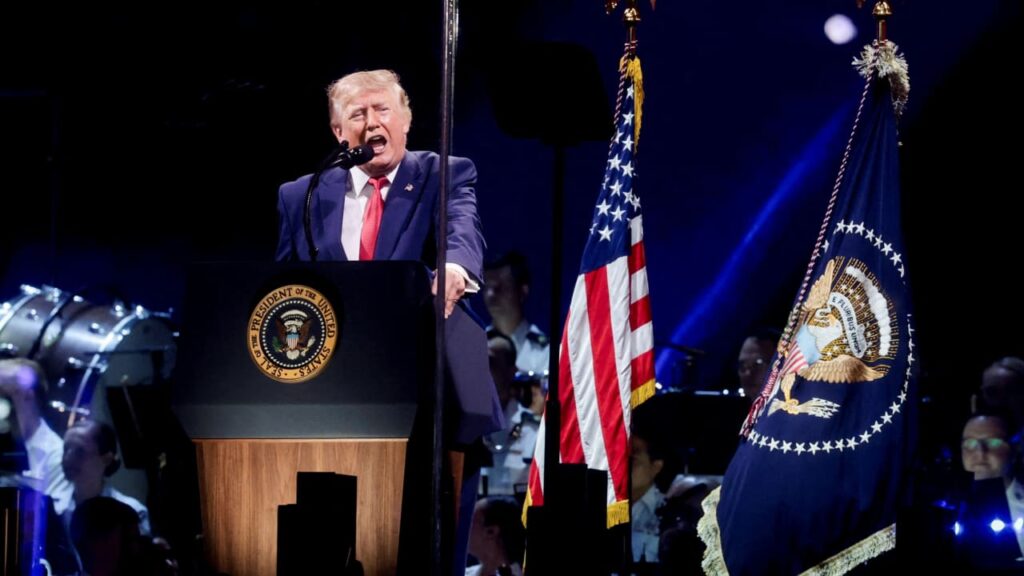
President Donald Trump marked the 250th anniversary of American independence Saturday with a politically charged speech before more than 150,000 people on the National Mall, mixing patriotic tribute with campaign-style rhetoric, calls for voting restrictions, and repeated warnings about what he described as the threat of communism taking root inside the United States.
The address, delayed nearly two hours by a severe thunderstorm that forced a mass evacuation of the Mall, came at the culmination of a week-long celebration that Trump has shaped aggressively to his own political tastes, drawing both enormous crowds and pointed criticism over its partisan character.
What We Know So Far
Trump took the stage shortly before 11 p.m. after organizers cleared the Mall around 7 p.m. as a line of thunderstorms swept through the capital. Spectators sheltered in nearby museums, subway stations, and federal buildings before returning through security in a chaotic rush, with crowds chanting “U-S-A, open the gates” as they pushed through magnetometers to reclaim their places.
Trump acknowledged the delay with characteristic humor. “One of my very brilliant people backstage said, ‘Don’t worry about it, sir, we can do it maybe next week,'” he told the crowd. “I said, ‘It doesn’t work next week.’ This is the big day.”
The speech lasted less than 40 minutes, far shorter than Trump had suggested earlier in the week when he promised to deliver a “really long speech just to show that I can do anything,” Reuters confirmed.
Trump honored 11 Gold Star families, acknowledged World War II veterans watching from the National World War II Memorial, and presented flags that had marked significant moments in American history, including the flag draped over Abraham Lincoln’s casket and the one that flew aboard the Wright Brothers’ pioneering aircraft, the Associated Press confirmed.
He declared the United States “the crowning achievement of human history” and told the crowd: “For 250 years, the United States of America has been the hope, the promise, the light and the glory among all of the nations of the world. Nobody can be like us. And with God’s help, we will always be this or even better,” Fox News confirmed.
Trump also called on Congress to pass the SAVE America Act, an elections bill that would require proof of citizenship to register to vote and photo identification when casting ballots, legislation that has encountered resistance even among some Republicans. He highlighted his administration’s military posture, claiming he had “wiped out” Iran’s military, and returned to themes of economic strength and national pride that have defined his political messaging.
His anti-communist rhetoric was among the evening’s most emphatic themes. “America will never be a communist country,” Trump said. “Communism is a loser, and it always will be. Our warriors did not fight communism on battlefields across the world only to have that menace rear its ugly head right back here in America. We’re not going to let it happen.”
He compared communism to cancer, using the same language he had deployed the previous day at Mount Rushmore. “You’ve got to cut it out and you’ve got to cut it out fast,” he said, the New York Post confirmed.
The remarks appeared directed at Democratic Socialist-backed candidates who have won a series of Democratic primary elections in the current election cycle, though Trump did not name them or their party explicitly in his Saturday address.
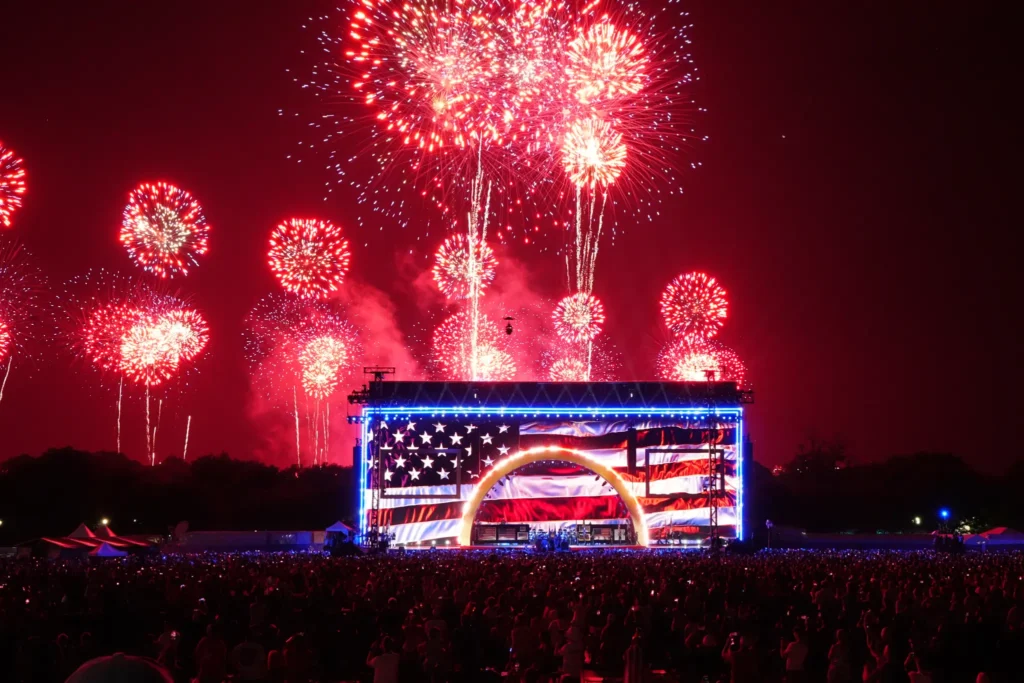
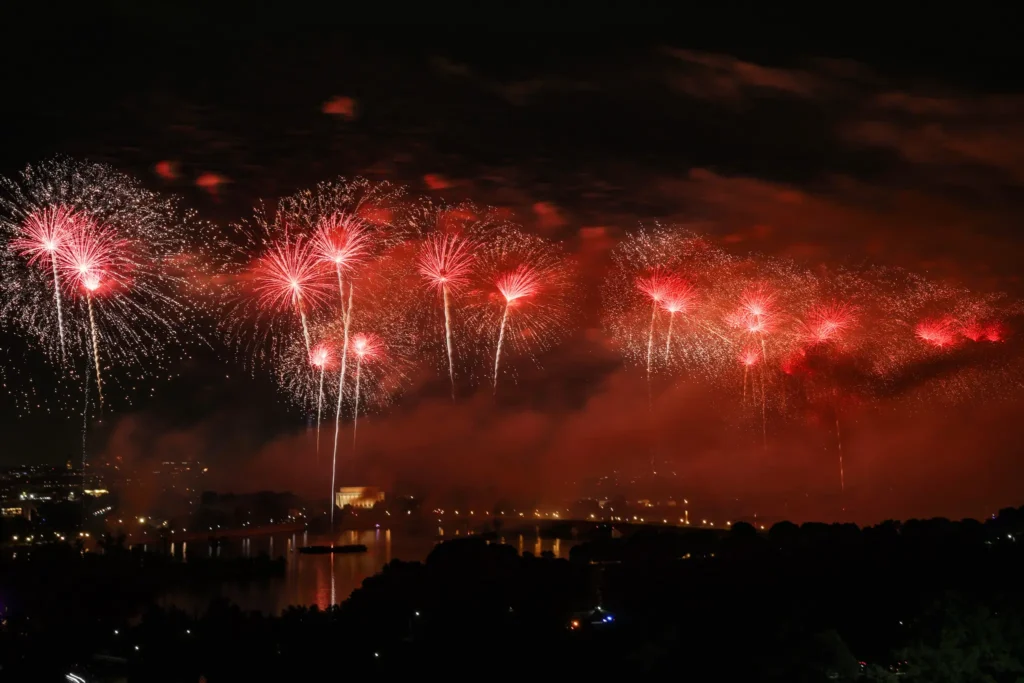
The speech concluded with a record-breaking fireworks display of more than 800,000 fireworks launched from the Potomac River and other sites across Washington, with lightning flickering in the background as military musicians performed selections spanning six decades of popular music, including Trump’s signature “YMCA,” the New York Post reported. Trump and First Lady Melania Trump remained at the site to watch the display, joined by Cabinet members, his son Donald Trump Jr. and new wife Bettina, and several of his grandchildren.
What The Event Looked Like Across America
The extreme heat that gripped much of the East Coast shaped celebrations across the country as much as any official program. Temperatures in Washington reached 103 degrees Fahrenheit, forcing the cancellation of several parades and outdoor events in the region, the Associated Press reported.
In Philadelphia, festivities coincided with the France-Paraguay World Cup knockout game at the city’s stadium, creating what one attendee described to the Associated Press as “one big party.” Carlos Alban, who traveled from Chicago for the match, said he spotted a fan in the parking lot dressed as one of the Founding Fathers.
In New York, a procession of 43 tall ships sailed around the Statue of Liberty and up the Hudson River, followed by aerial displays from a stealth bomber, the Navy’s Blue Angels, and the French Air Force’s Patrouille de France aerobatic team, whose red, white, and blue trails drew crowds along the harbor in a gesture that evoked the Franco-American alliance at the heart of the nation’s founding.
At George Washington’s Mount Vernon, new Americans took the Oath of Allegiance in a naturalization ceremony conducted against the backdrop of the revolutionary era estate, their eyes closed and hands over hearts during the national anthem.
Severe weather prompted the cancellation of celebrations in Hartford, Connecticut, as well as Harrisburg and Wilkes-Barre, Pennsylvania. Boston’s fireworks and concert were briefly interrupted before resuming. Philadelphia ordered its own temporary evacuation. New York and Pittsburgh shifted their fireworks timing to accommodate the shifting weather patterns, the Associated Press confirmed.
What Authorities And Critics Are Saying
The political character of the celebrations drew significant commentary before and during the event. A Reuters and Ipsos poll found that a majority of Americans, including three-quarters of Democrats and half of Republicans, believed the events marking the 250th anniversary had become too political.
Several Democratic-led states declined to send official delegations to Washington’s festivities. Many performers originally scheduled to appear withdrew, citing concerns about the event’s partisan nature. The Trump administration’s Freedom 250 organization had largely displaced a nonpartisan body established by Congress in 2016 to oversee the 250th anniversary planning, fencing off much of the National Mall for a “Great American State Fair” featuring a Ferris wheel alongside displays by conservative organizations and defense contractors.
Critics also took aim at Freedom 250-sponsored “Freedom Trucks” that they said presented an overly religious version of American history while glossing over the legacy of slavery and racial injustice.
The white nationalist organization Patriot Front marched through Washington earlier in the day and used Metro trains serving the region. Police said they received no reports of violence connected to the group’s presence.
Trump has pushed to reshape significant portions of the capital city ahead of the anniversary celebration. Many fountains and statues have been renovated, but a much-publicized $15 million renovation of the Lincoln Memorial’s Reflecting Pool has been beset by problems, with security cameras and soldiers standing guard over peeling paint and algae-covered water, Reuters confirmed.
A Smithsonian Institution executive told Reuters that gift shops and restaurants at museums near the event reported near-record sales on Friday as crowds swelled in the days leading up to the anniversary.
Why This Matters
Saturday’s address was only the second time a sitting American president has delivered a July 4 speech on the National Mall since 1951, the previous occasion being Trump’s own 2019 address. Most presidents have historically avoided in-person appearances at July 4 commemorations, treating the date as a moment for national unity rather than political advocacy.
Trump’s decision to use the 250th anniversary as a platform for campaign-style messaging on voting laws, communist threats, and his administration’s achievements reflects a deliberate strategy heading into November’s midterm elections, where his party’s congressional majorities will be tested.
The anti-communist framing, previewed at Mount Rushmore the day before and repeated with emphasis on the National Mall, signals that the theme will be a recurring element of his political messaging through the election season.
The choice to centralize the national celebration around his administration’s political priorities, rather than delegating it to the bipartisan body Congress established for precisely this purpose, also marks a significant departure from how previous American presidents have handled major national milestones.
The moment itself, 250 years of American independence marked by a president whose relationship with constitutional norms has been the defining controversy of his political career, was not lost on observers across the political spectrum.
What the anniversary meant, and who it was being celebrated for, remained deeply contested even as fireworks lit the sky above the Mall and tall ships sailed past the Statue of Liberty.
What Happens Next
Trump signaled that the anti-communist messaging will intensify as the November midterms approach, treating Saturday’s address as the opening of what is expected to be an aggressive campaign period. The SAVE America Act, which he again urged Congress to pass, faces uncertain prospects given resistance from some Republicans in addition to unified Democratic opposition.
The Freedom 250 events on the Mall are expected to continue in the days following Independence Day, with an IndyCar race scheduled for Washington in August as part of the broader celebration calendar.
For the millions of Americans who marked the day in their own ways, from naturalization ceremonies at Mount Vernon to family cookouts in Phoenix to World Cup crowds in Philadelphia, the 250th anniversary offered a moment of reflection that was simultaneously personal, local, and nationally contested in ways that past anniversaries were not.
Trump closed his remarks with an optimistic flourish that cut through the partisan themes of the evening. “At 250 years, we may be the oldest constitutional republic on earth, but our country is just getting started, because the best is yet to come,” he said. “This is only the dawn of the Golden Age of America.”
AP/Reuters/Foxnews/NYPost





