

WASHINGTON — President Trump announced Sunday that the United States will begin a sweeping blockade of the Strait of Hormuz, vowing to fight back against what he characterized as “WORLD EXTORTION” and ensure that no vessels paying tolls to Iran will transit the critical oil chokepoint that once handled one-fifth of global petroleum supplies.
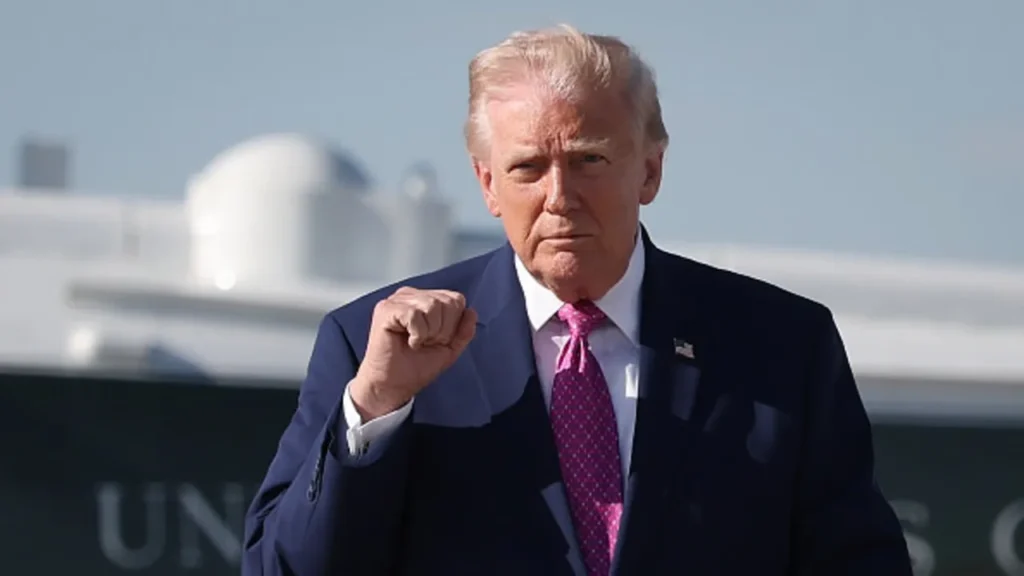
Trump claimed that negotiations with Iran that concluded Saturday without agreement “went well,” but faulted the Islamic Republic for refusing to budge on its nuclear program, which he described as “the only point that really mattered.” The claim that talks proceeded positively contradicted the evident failure to reach any understanding after 21 hours of negotiations.
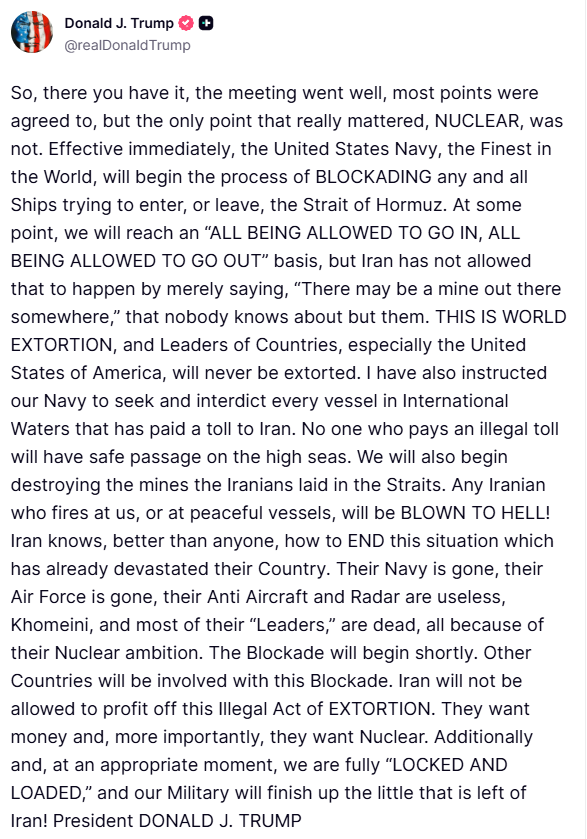
“Effective immediately, the United States Navy, the Finest in the World, will begin the process of BLOCKADING any and all Ships trying to enter, or leave, the Strait of Hormuz,” Trump declared on Truth Social Sunday, employing capital letters for emphasis while announcing a dramatic escalation that will likely further destabilize global energy markets.
“At some point, we will reach an ‘ALL BEING ALLOWED TO GO IN, ALL BEING ALLOWED TO GO OUT’ basis, but Iran has not allowed that to happen by merely saying, ‘There may be a mine out there somewhere,’ that nobody knows about but them,” Trump continued, characterizing Iran’s strait closure as arbitrary obstruction rather than legitimate response to American and Israeli attacks.
“THIS IS WORLD EXTORTION, and Leaders of Countries, especially the United States of America, will never be extorted,” he proclaimed, framing the conflict as resistance to Iranian blackmail rather than acknowledging American military aggression precipitated the strait’s closure.
Over one-fifth of the world’s seaborne oil supply once traversed through the Strait of Hormuz before Iran used drones and missiles to deter petroleum vessels from traveling through the critical chokepoint. Recently, Iran claimed to have deployed mines in the strait but has lost track of their locations—an assertion that may be deliberate ambiguity designed to create uncertainty among ship operators or genuine operational failure reflecting chaos from weeks of warfare.
Iran has attempted to charge a toll of $1 per barrel of oil for ships to transit safely—a fee that would generate substantial revenue while establishing Iranian sovereignty over international waters that the United States insists must remain open without tolls or restrictions.
According to New York Post, Iran disclosed it has no plans for further peace talks with the United States after the marathon summit with Vice President JD Vance collapsed Saturday with no agreement reached. “No plan has yet been announced for the time, place, or next round of negotiations,” Iranian state news agency Nour conveyed Saturday, citing the country’s Supreme National Security Council.
The Iranian regime will also maintain its stranglehold over the Strait of Hormuz—the vital chokepoint in the Persian Gulf through which flows one-fifth of the world’s oil supplies—according to state media. “Iran is not in a hurry, and until the US agrees to a reasonable deal, there will be no change in the situation of the Strait of Hormuz,” Fars News Agency documented, quoting an unnamed Iranian official.
The statements followed grueling 21 hours of talks in the Pakistani capital Islamabad between U.S. and Iranian delegations that ended Sunday morning local time with no agreement reached and no clarity about next steps. Vance told a press conference that Iran’s refusal to abandon its nuclear program had been the main sticking point preventing any understanding.
The vice president characterized the failure to reach agreement as “bad news” for Iran, while Iran’s former Vice President Ataollah Mohajerani countered it was “worse news … for the United States,” speaking to Fars. The competing claims about who faces greater consequences from negotiations’ collapse reflected each side’s effort to project strength despite evident failure to achieve objectives.
“We leave here with a very simple proposal, a method of understanding that is our final and best offer. We’ll see if the Iranians accept it,” Vance told journalists as he prepared to board Air Force Two and return to the United States. None of the American delegation—which included special envoy Steve Witkoff and the President’s son-in-law Jared Kushner—remained behind in Islamabad, suggesting zero expectation that productive talks could resume.
Iranian state media blamed “US overreach and ambitions” for blocking “a common framework and agreement” to bring about war termination, which started February 28. As talks broke down in Pakistan, President Trump was photographed at a UFC fight in Miami with Secretary of State Marco Rubio—imagery suggesting the president was unconcerned about negotiations’ failure while enjoying entertainment during the diplomatic crisis.
The president earlier declared it “makes no difference to me” whether the United States and Iran reached agreement—language conveying indifference to diplomatic solutions and preference for military approaches to resolving the conflict.
The Associated Press confirmed that Trump in his first public comments after the 21 hours of talks sought to exert strategic control over the waterway that was responsible for shipping 20 percent of global oil supplies before the war, hoping to eliminate Iran’s key source of leverage.
The prospect of a U.S. blockade will likely further rattle global energy markets and prices for oil, natural gas, and related products. It was not immediately clear how the blockade might be executed or when operations would commence given the massive naval resources required to enforce complete interdiction of a waterway 21 miles wide at its narrowest point.
Trump disclosed he has “instructed our Navy to seek and interdict every vessel in International Waters that has paid a toll to Iran. No one who pays an illegal toll will have safe passage on the high seas.” Other nations would participate in the planned blockade, he indicated, but did not identify them—raising questions about whether any allies have actually agreed to join American operations.
Trump emphasized that Tehran’s nuclear ambitions were at the core of the failure to end the war, and declared the United States was ready to “finish up” Iran at the “appropriate moment”—threatening language suggesting potential military escalation beyond current operations.
Face-to-face talks ended earlier Sunday, representing the highest-level negotiations between the longtime rivals since the 1979 Islamic Revolution that severed diplomatic relations for nearly five decades. Iranian officials blamed the United States for negotiations’ breakdown without specifying sticking points. Both delegations subsequently departed Islamabad.
Neither side indicated what will happen after the 14-day ceasefire expires April 22. Pakistani mediators urged all parties to maintain the pause in hostilities. Both sides proclaimed their positions were clear and placed responsibility on the other, underscoring how little the gap had narrowed throughout extensive negotiations.
“We need to see an affirmative commitment that they will not seek a nuclear weapon, and they will not seek the tools that would enable them to quickly achieve a nuclear weapon,” Vance, leading the U.S. side, stated afterward, articulating demands that Iran abandon even civilian nuclear capabilities.
Iran’s parliament speaker Mohammad Bagher Qalibaf, who led Iran’s delegation, declared it was time for the United States “to decide whether it can gain our trust or not.” Iranian officials earlier indicated talks fell apart over two or three key issues, blaming what they characterized as U.S. overreach and unreasonable demands.
Pakistani Foreign Minister Ishaq Dar confirmed his country will attempt to facilitate new dialogue between Iran and the United States in coming days despite the breakdown. Iran indicated openness to continuing dialogue, Iran’s state-run IRNA news agency documented. The European Union urged further diplomatic efforts to prevent resumed warfare.
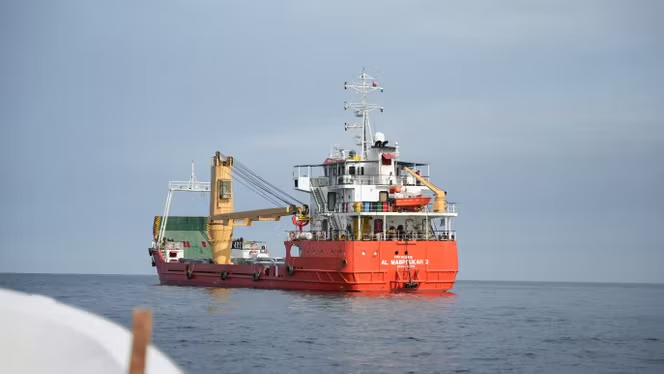
Since the United States and Israel launched the war February 28, fighting has killed at least 3,000 people in Iran, 2,020 in Lebanon, 23 in Israel, and more than a dozen in Gulf Arab states, while causing lasting damage to infrastructure in half a dozen Middle Eastern countries. Iran’s grip on the Strait of Hormuz has largely severed the Persian Gulf and its oil and gas exports from the global economy, sending energy prices soaring to recession-inducing levels.
Tensions have long centered on Iran’s nuclear program. Tehran has consistently denied seeking nuclear weapons but insisted on its right to a civilian nuclear program under international treaties. Iran has offered “affirmative commitments” in the past in writing, including in the landmark 2015 nuclear deal that took well over a year of negotiations to complete and from which Trump withdrew during his first presidency.
Experts confirm Iran’s stockpile of enriched uranium, though not weapons-grade, is only a short technical step away from levels required for nuclear weapons—creating what analysts call “breakout capability” measured in weeks rather than months.
The current deadlock—and Vance’s take-it-or-leave-it proposal that Iran terminate its nuclear program—mirrored February’s nuclear talks in Switzerland that preceded the war’s launch. An Iranian diplomatic official, speaking on condition of anonymity because of the sensitivity of closed-door talks, denied that negotiations had failed over Iran’s nuclear ambitions.
“Iran is not seeking to acquire nuclear weapons, but it has the right to nuclear energy for peaceful purposes,” the official emphasized, articulating Iran’s longstanding position that civilian nuclear power represents sovereign right that cannot be surrendered to foreign pressure.
In Iran, there was fresh exhaustion and anger after months of unrest that began with nationwide protests against economic issues and political grievances, then weeks of sheltering from U.S. and Israeli bombardment. “We have never sought war. But if they try to win what they failed to win on the battlefield through talks, that’s absolutely unacceptable,” 60-year-old Mohammad Bagher Karami declared in Tehran.
During the talks, the U.S. military announced two destroyers transited the critical strait ahead of mine-clearing work—a first since the war began and signal of American determination to reopen the waterway regardless of Iranian consent. Iran’s state media disclosed the country’s joint military command denied the transit occurred, creating uncertainty about whose account was accurate.
“We’re sweeping the strait. Whether we make a deal or not makes no difference to me,” Trump stated during the talks, conveying that military solutions were equally acceptable as diplomatic agreements.
Before talks commenced, the ceasefire was already threatened by deep disagreements and Israel’s continued attacks against Iranian-backed Hezbollah in Lebanon. Iran’s 10-point proposal had called for guaranteed war termination and sought control over the Strait of Hormuz. It demanded ending fighting against Iran’s “regional allies,” explicitly calling for halting Israeli strikes on Hezbollah.
Pakistani officials earlier told The Associated Press that the U.S. 15-point proposal included rollback of Iran’s nuclear program. Speaking on condition of anonymity as they lacked authorization to discuss details, they disclosed it also covered reopening the Strait of Hormuz—the economic pressure point causing global concern.
The impasse raises new questions about Lebanon where Israel has continued operations. Israel has maintained the agreement did not apply there, but Iran and Pakistan claimed otherwise. Negotiations between Israel and Lebanon are expected to begin Tuesday in Washington after Israel’s surprise announcement authorizing talks despite lack of official relations between the countries.
The day the Iran ceasefire deal was announced, Israel pounded Beirut with airstrikes, killing more than 300 people in the deadliest day in Lebanon since the war began, according to the country’s Health Ministry. Though Israel’s strikes over Beirut have calmed, its attacks on southern Lebanon have intensified alongside the ground invasion it renewed after Hezbollah launched rockets toward Israel in the war’s opening days.
Lebanon’s state-run National News Agency confirmed six people were killed Sunday in an Israeli strike in Maaroub village near the coastal city of Tyre—demonstrating continued violence despite ceasefire claims.
Israel wants Lebanon’s government to assume responsibility for disarming Hezbollah, but the militant group has survived efforts to curb its strength for decades through popular support among Shiite communities and integration into Lebanese political structures.
As Trump’s blockade announcement reverberated through global capitals and energy markets, fundamental questions remained about whether the United States Navy possesses sufficient resources to enforce complete interdiction of the strait, whether other nations will participate as Trump claimed, and whether such operations will provoke Iranian military responses that escalate the conflict beyond current parameters.
For global oil markets already stressed by the strait’s partial closure, complete American blockade preventing even Iranian-authorized traffic could send prices to unprecedented levels that trigger worldwide recession. Whether Trump has considered these economic consequences or views them as acceptable costs for asserting American control over the waterway remains unclear.





