

President Donald Trump made a historic visit to the U.S. Supreme Court on Wednesday to attend oral arguments over the legality of a policy he considers crucial to his hardline immigration approach—a directive he signed last year on his first day back in office that would dramatically limit birthright citizenship guaranteed by the Fourteenth Amendment to the Constitution.
The Republican president became the first sitting president to attend Supreme Court oral arguments, according to Clare Cushman, resident historian at the Supreme Court Historical Society.
Trump sat in the first row of the public seating section in the ornate courtroom but departed not long after the lawyer arguing for his administration completed his presentation and the attorney representing challengers began hers.
Trump was driven by motorcade from the White House and arrived before arguments commenced, wearing a red tie and dark suit. Trump and other attendees rose to their feet as the court marshal made the customary announcement beginning with “Oyez! Oyez! Oyez!”—meaning “Hear ye!”—marking the beginning of the court session that would determine the fate of one of his signature immigration policies.
The president was seated directly beside White House Counsel David Warrington and in the same row as Commerce Secretary Howard Lutnick and Attorney General Pamela Bondi. He remained at the courthouse for slightly more than an hour and a half before departing quietly, accompanied by Secret Service personnel.
During the arguments, which lasted more than two hours, members of the court signaled skepticism toward Trump’s directive restricting citizenship for children born on U.S. soil when neither parent is an American citizen or legal permanent resident.
The court is expected to issue its ruling by the end of June—a decision that will determine whether Trump’s executive order survives or joins a growing list of presidential actions struck down by the judiciary.
“We are the only Country in the World STUPID enough to allow ‘Birthright’ Citizenship,” Trump wrote in a post on his Truth Social platform after arriving back at the White House, employing capital letters for emphasis and making a factually inaccurate claim about American exceptionalism on the issue.
The United States is among 33 countries with automatic birthright citizenship policies, according to the Pew Research Center—contradicting Trump’s assertion that America uniquely grants citizenship to all children born on its soil.
Countries including Canada, Mexico, Brazil, Argentina, and numerous others similarly recognize birthright citizenship as fundamental to their national identities.
Critics characterize Trump’s directive as plainly unconstitutional action rooted in racially discriminatory anti-immigrant views. The executive order challenges settled constitutional interpretation dating to ratification of the Fourteenth Amendment following the Civil War, when the citizenship clause was adopted specifically to overturn the Supreme Court’s infamous 1857 Dred Scott decision.
That ruling declared that enslaved people were not citizens of the United States and therefore were not entitled to protection from the federal government—a decision that helped precipitate the Civil War and prompted the constitutional amendment Trump’s order now seeks to reinterpret. The historical context underscores how Trump’s policy confronts legal precedents established to remedy one of American history’s gravest constitutional injustices.
In the case known as Trump v. Barbara, challengers argue that the president’s efforts violate the citizenship clause of the Fourteenth Amendment, which declares that “all persons born or naturalized in the United States, and subject to the jurisdiction thereof, are citizens of the United States and of the State wherein they reside.” The plain language appears to contradict Trump’s attempt to exclude children of non-citizens from automatic citizenship.
According to The Guardian, the Trump administration argues it is not attempting to eliminate birthright citizenship entirely but rather returning to the original meaning of the citizenship clause, which it contends should not apply to “the children of aliens who are temporarily present in the United States.” This interpretive approach challenges more than a century of legal understanding and immigration practice.
Trump’s motorcade drove from the White House along Constitution Avenue and then Independence Avenue, passing the Washington Monument and the National Mall as crowds watched from sidewalks.
The symbolic route traversed the heart of American constitutional government as Trump traveled to challenge one of the Constitution’s most fundamental protections.
There exist examples of 19th century presidents arguing cases before the court—though not while in office—including John Quincy Adams, Grover Cleveland, and Benjamin Harrison.
William Howard Taft, who served as president from 1909 to 1913, later became Chief Justice on the Supreme Court. However, no sitting president had previously attended oral arguments as an observer until Trump’s Wednesday appearance.
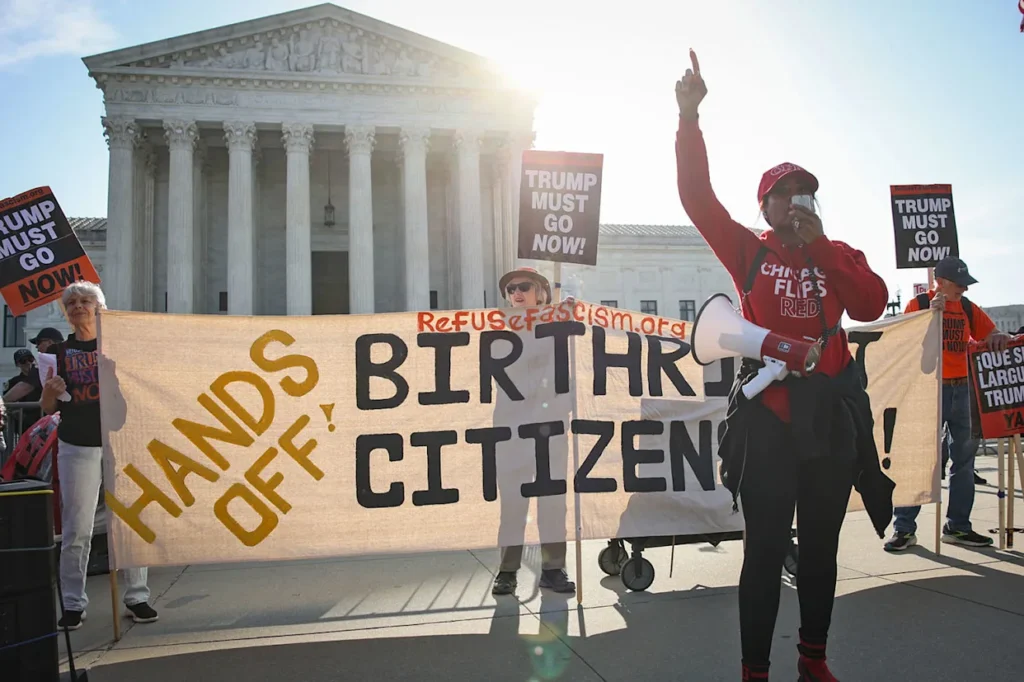
Outside the neoclassical courthouse on Capitol Hill, demonstrators gathered ahead of arguments, some holding anti-Trump signs including ones reading “Trump must go now.” The protests reflected broader opposition to the president’s immigration policies and concerns about constitutional governance.
Chief Justice John Roberts did not acknowledge Trump’s presence before announcing the beginning of arguments in the case, maintaining the court’s traditional separation from political pressures.
Above Trump in the courtroom were friezes featuring symbols and personages of law and order, from the biblical figure Moses bearing the Ten Commandments to the Chinese philosopher Confucius through former Chief Justice John Marshall, whose opinion in Marbury v. Madison established the Supreme Court’s power of judicial review over executive actions.
There appeared to be more security personnel than usual in the courtroom, reflecting both the president’s presence and the sensitive nature of the case being argued. The heightened security illustrated how Trump’s attendance transformed routine judicial proceedings into an extraordinary political event.
The Supreme Court has backed Trump in a series of rulings issued on an emergency basis since he returned to the presidency last year. Those decisions came on matters including immigration, mass federal layoffs, cutting foreign aid, dismantling the Education Department, banning transgender people from the military, and other areas—establishing a pattern of judicial deference to executive authority that emboldened Trump’s increasingly aggressive policy agenda.
However, the court on February 20 ruled against Trump in a major case testing the legality of sweeping global tariffs he imposed last year under a law intended for use in national emergencies. Since the tariffs ruling, Trump has lashed out repeatedly at the Supreme Court and the six justices who ruled against him in that case, attacking judges he appointed in extraordinarily harsh personal terms.
The Supreme Court’s 6-3 conservative majority includes three justices appointed by Trump during his first term—Neil Gorsuch in 2017, Brett Kavanaugh in 2018, and Amy Coney Barrett in 2020.
Trump clearly expected loyalty from these appointees and has expressed fury when they have ruled against his policies based on constitutional principles rather than political allegiance.
Three of the court’s six conservative justices—Chief Justice Roberts as well as Gorsuch and Barrett—joined with the court’s three liberal members in ruling that Trump had overstepped his authority in imposing tariffs. Trump was incensed at Gorsuch and Barrett in particular, calling them on the day of that ruling “an embarrassment to their families.”
Last week, Trump maintained his condemnation of his two appointees, declaring that “they sicken me because they’re bad for our country.” The extraordinary attacks on justices he personally selected for the nation’s highest court illustrated his transactional view of the judiciary as political operatives rather than independent constitutional interpreters.
After the tariffs ruling, Trump proclaimed he was “ashamed” of the three conservative justices who ruled against him, calling them “fools and lapdogs for the RINOs and the radical-left Democrats.” RINO—meaning “Republican in name only”—is a term sometimes employed by conservative Republicans to insult fellow Republicans viewed as disloyal to the party’s most ideological positions.
A lower court blocked Trump’s executive order directing U.S. agencies not to recognize the citizenship of children born in the United States if neither parent is an American citizen or legal permanent resident, also called a “green card” holder.
The preliminary injunction forced the administration to continue recognizing birthright citizenship while the case proceeds through the judicial system.
Trump wrote on social media last year: “Birthright Citizenship was not meant for people taking vacations to become permanent Citizens of the United States of America, and bringing their families with them, all the time laughing at the ‘SUCKERS’ that we are!”
The inflammatory language characterized immigrants as deliberately exploiting American generosity—a narrative central to his political appeal among supporters who view immigration as threatening national identity.
The historic nature of Trump’s Supreme Court attendance overshadowed the substantive constitutional questions at stake in the case. Legal scholars across the ideological spectrum have expressed skepticism that Trump’s executive order can survive scrutiny, given the Fourteenth Amendment’s clear language and the historical context establishing its intended broad application.
However, the conservative supermajority on the court—including Trump’s three appointees—creates uncertainty about whether traditional constitutional interpretation will prevail or whether political alignment might influence judicial reasoning. Trump’s willingness to personally attend arguments suggested he hoped his presence might remind justices of the political stakes and his expectations of loyalty.
Whether Trump’s appearance will influence the justices remains doubtful, as Supreme Court members typically resist overt political pressure and maintain institutional independence even when facing criticism from presidents who appointed them.
The tariffs decision demonstrated that at least some conservative justices will rule against Trump when they conclude he has exceeded constitutional authority.
As oral arguments concluded and Trump departed the courthouse, the fundamental question remained unresolved: whether birthright citizenship guaranteed by the Fourteenth Amendment can be restricted by presidential executive order or whether such changes require constitutional amendment.
The court’s decision—expected by June—will determine whether one of the Constitution’s most important post-Civil War protections survives or whether executive power can override clear constitutional text through reinterpretation of historical intent.
For the millions of children born annually in the United States to non-citizen parents, the stakes could not be higher. The court’s ruling will either confirm their status as American citizens entitled to all constitutional protections or render them stateless individuals lacking the fundamental rights that citizenship confers—a distinction with lifelong consequences for their opportunities, security, and belonging in the only country they have ever known.
TheGuardian/Reuters





