

President Donald Trump said the United States will begin guiding commercial vessels out of the Strait of Hormuz starting Monday, outlining a new effort to assist ships stranded in one of the world’s most critical shipping lanes amid ongoing tensions with Iran.
In a message posted Sunday, Trump said the operation—described as “Project Freedom”—is aimed at helping vessels from what he called “neutral and innocent” nations safely leave the restricted waters and resume trade.
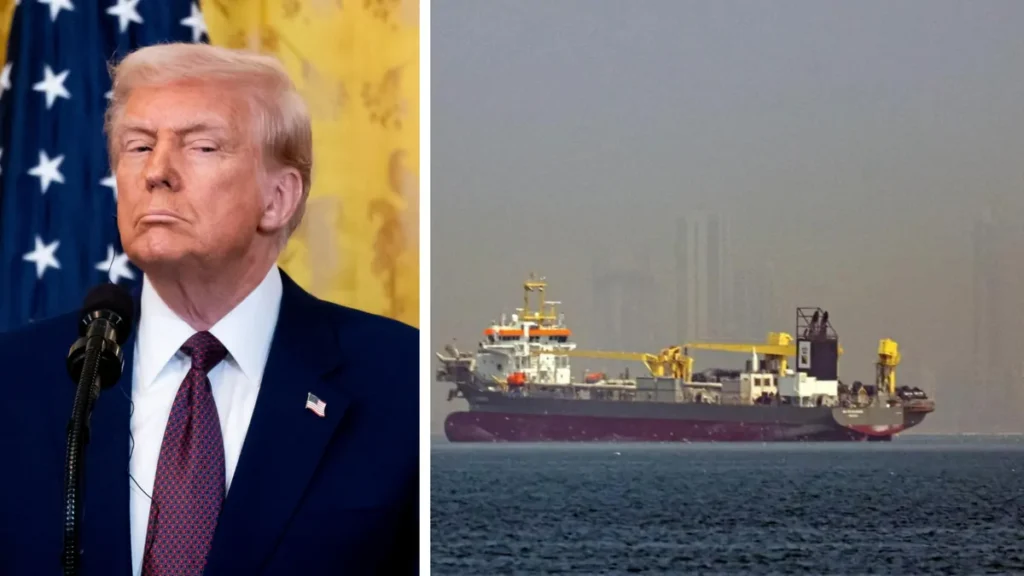
He offered few operational details but indicated the plan would involve direct U.S. support in escorting ships through the narrow passage, where traffic has been disrupted since fighting began earlier this year.
“Those ships will be guided safely out so they can get back to business,” Trump said, adding that talks with Iranian officials were ongoing and could lead to a positive outcome.
The announcement comes as hundreds of vessels remain stuck in the Persian Gulf region, with crews facing growing shortages of food, water and supplies. Many sailors, including workers from Asia, have spent weeks waiting for safe passage as the security situation remains uncertain.
Shipping through the Strait of Hormuz, a route that carries roughly one-fifth of the world’s oil and gas supply, has been sharply reduced after Iran moved to restrict access following the outbreak of war on Feb. 28 involving U.S. and Israeli forces.
Trump framed the planned escort mission as a humanitarian step, but he also issued a warning. Any attempt to disrupt the operation, he said, would be met with force.
His comments were quickly picked up by Iranian media, which cast doubt on the plan and described it as an unverified claim.
The situation in the region remains volatile. Earlier Sunday, a cargo vessel traveling near the strait reported being approached by several small boats, in what British military monitors described as a possible attack. The incident occurred near the Iranian coast, east of the main shipping channel.
All crew members aboard the vessel were reported safe. Iranian officials later denied any hostile action, saying the ship had been stopped briefly for routine checks.
Still, the encounter underscored the risks facing commercial shipping. Since the conflict began, at least two dozen similar incidents have been recorded in and around the strait.
Small patrol boats used in the area are fast and difficult to track, raising concerns among shipping companies and military planners. U.S. forces have already been authorized to respond aggressively to threats, including boats suspected of laying naval mines.
Elsewhere in the region, ships near the United Arab Emirates reported receiving radio messages instructing them to move from anchorage points, though it was unclear who issued the warnings.
At the same time, Iran signaled it is reviewing a recent U.S. response to a proposal aimed at ending the conflict. A spokesperson for Iran’s foreign ministry said there are no active negotiations on nuclear issues at this stage, suggesting talks are focused instead on halting hostilities.
Iran’s plan reportedly calls for sanctions relief, an end to the U.S. naval blockade and a withdrawal of foreign forces from the region. Trump has expressed skepticism that the proposal will lead to a breakthrough.
Despite a fragile ceasefire now in place for several weeks, Iran has made clear it does not intend to return the Strait of Hormuz to prewar conditions. Officials in Tehran say control of the waterway remains a strategic priority.
The United States, meanwhile, has warned shipping firms against making payments to Iran for safe passage, saying such actions could trigger sanctions.
U.S. officials say the naval blockade imposed in April has already cut deeply into Iran’s oil revenue. Treasury Secretary Scott Bessent said the country’s oil storage facilities are nearing capacity, which could soon force production cuts.
The planned escort operation marks a significant shift in how the United States is handling the crisis in the Gulf. Rather than relying solely on military deterrence, Washington is now moving to directly manage commercial traffic through a contested zone.
That carries both opportunity and risk.
On one hand, helping ships move again could ease pressure on global energy markets. Oil prices have surged since the strait effectively closed, and any sign of restored flow could bring some relief to consumers and industries worldwide.
On the other hand, escorting vessels through a high-risk area increases the chance of direct confrontation. Even a minor incident involving U.S. forces and Iranian patrols could quickly escalate.
There is also a political dimension. By presenting the move as humanitarian, Trump is attempting to frame the operation as support for global trade rather than a military escalation. But the warning of force suggests the line between those roles remains thin.
For Iran, maintaining leverage over the strait is a powerful tool. It allows Tehran to influence global markets and apply pressure without engaging in full-scale conflict. Any effort to weaken that control is likely to face resistance.
The coming days will test whether the U.S. plan can move ships safely without triggering new clashes. Much will depend on communication between both sides and the willingness to avoid miscalculation.
For now, thousands of sailors and hundreds of vessels remain caught in the middle, waiting to see if the world’s most important shipping route can reopen without further conflict.
AP





