

U.S. President Donald Trump issued an online statement Thursday insisting that his surge of warships and troops will remain deployed around Iran “until such time as the REAL AGREEMENT reached is fully complied with,” applying pressure on Tehran as uncertainty hangs over the tentative two-week ceasefire that appears increasingly fragile just days after being announced.
Trump’s comments on his Truth Social platform appear designed to pressure Iran as questions mount about whether the truce will hold given contradictory interpretations of its scope, minimal evidence of Strait of Hormuz reopening, and continued Israeli military operations in Lebanon that have killed hundreds since the ceasefire was supposedly implemented.
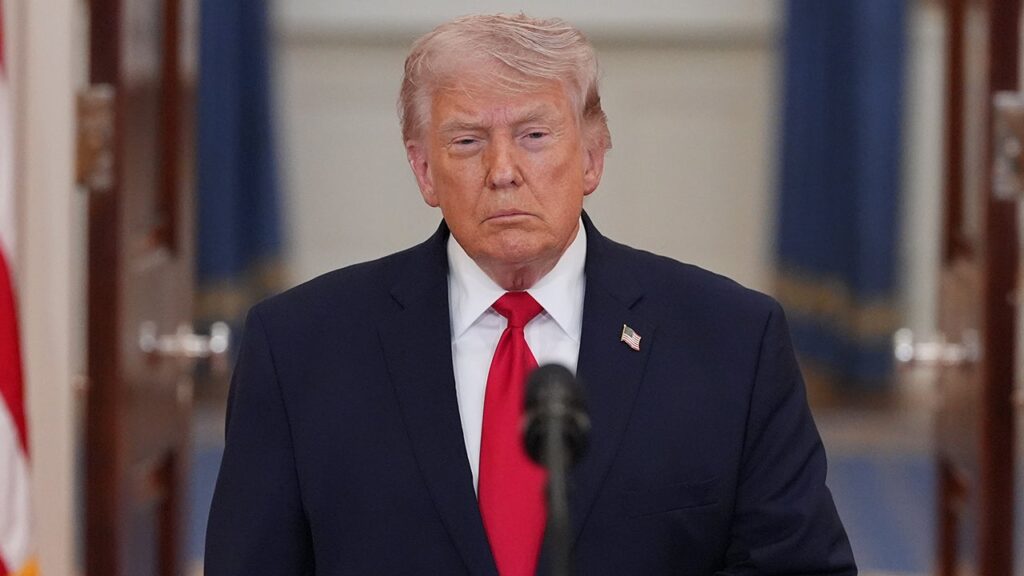
“If for any reason it is not, which is highly unlikely, then the ‘Shootin’ Starts,’ bigger, and better, and stronger than anyone has ever seen before,” Trump wrote, employing threatening language and capital letters for emphasis while characterizing potential military escalation as exceeding anything in modern warfare.
Trump also insisted Iran would not be able to build nuclear weapons and “the Strait of Hormuz WILL BE OPEN & SAFE”—claims contradicted by observable reality as vessels are not moving through that waterway in any meaningful numbers. The strait represents the narrow mouth of the Persian Gulf through which 20 percent of all oil and natural gas traded globally once passed before Iran closed it in response to American and Israeli attacks.
According to Reuters, Trump vowed to retain military assets in the Middle East until a peace deal with Iran is reached and warned of major escalation in fighting if Tehran failed to comply, as oil prices rose on concerns over supply and restrictions in the Strait of Hormuz that show no signs of genuine easing despite ceasefire proclamations.
Trump disclosed in a social media post that U.S. ships, aircraft, and personnel with additional ammunition and weaponry would remain in place to destroy, if necessary, “a substantially degraded enemy”—though he expressed confidence that a lasting deal would be agreed upon and followed despite mounting evidence suggesting otherwise.
“If for any reason it is not, which is highly unlikely, then the ‘Shootin’ Starts,’ bigger, and better, and stronger than anyone has ever seen before,” Trump reiterated, adding that contrary to “fake rhetoric,” Iran had agreed not to pursue nuclear weapons and to reopen the Strait of Hormuz—assertions not supported by Iranian statements or maritime traffic data.
“In the meantime our great Military is Loading Up and Resting, looking forward, actually, to its next Conquest. AMERICA IS BACK!” Trump continued, employing triumphalist language suggesting the military views the ceasefire as temporary pause before resuming operations rather than genuine peace agreement.
Though both the United States and Iran declared victory in a five-week war that has killed thousands and devastated regional economies, their core disputes remained unresolved, with each side maintaining competing demands for a deal that could shape the Middle East for generations. The fundamental contradictions between American and Iranian positions suggest the two-week ceasefire may represent diplomatic theater rather than pathway to sustainable peace.
Trump’s latest post followed the largest coordinated strike of the war by Israel on Wednesday that killed more than 250 people in Lebanon, prompting a warning from Iran’s lead negotiator that Israel’s ramping up its parallel war and Washington’s insistence on Tehran abandoning its nuclear ambitions could jeopardize talks to forge a permanent peace deal.
“In such a situation, a bilateral ceasefire or negotiations were unreasonable,” Iran’s parliament speaker Mohammed Bager Qalibaf declared in a statement Wednesday, suggesting Tehran viewed continued Israeli strikes on Lebanon as ceasefire violations that undermined diplomatic efforts.
Oil prices climbed Thursday with investors concerned about the fragility of the truce and elevated geopolitical risks over Middle East supply, with doubts that restrictions in the Strait of Hormuz would soon ease despite American and Iranian claims about reopening the vital waterway.
Brent crude futures were up $1.96, or 2.07 percent, at $96.71 a barrel at 0325 GMT, while U.S. West Texas Intermediate crude rose $2.6, or 2.75 percent, to $97.01 a barrel—a day after both benchmarks had fallen sharply on the ceasefire announcement before reality about its limitations set in.
Brent crude and West Texas Intermediate remain far above the $70.75 and $65 per barrel levels that prevailed before the joint U.S.-Israel military campaign began, reflecting how the conflict has permanently altered global energy market dynamics and increased risk premiums for Persian Gulf petroleum supplies.
Asian share markets were in a sober mood Thursday amid unease about the ceasefire, with Japan’s Nikkei lingering either side of flat having jumped 5.4 percent the previous session on optimistic ceasefire news that subsequent developments undermined. The MSCI’s broadest index of Asia-Pacific shares outside Japan eased 0.7 percent as investors reconsidered initial enthusiasm.
On Wall Street, S&P 500 futures and Nasdaq futures were both off 0.2 percent as Wednesday’s surge ended and reality set in about the ceasefire’s fragility. In Europe, the EUROSTOXX 50 futures eased 0.1 percent, DAX futures fell 0.5 percent while FTSE futures were up 0.4 percent—reflecting mixed assessments about whether peace would hold.
Israel’s blitz of air strikes Wednesday raised fundamental questions about regional truce efforts, with conflicting messages on the ceasefire’s scope and sharply contrasting agendas for peace talks scheduled to commence Saturday in Pakistan. The United States and Israel maintain Lebanon is not included in the agreement, while Iranian President Masoud Pezeshkian has emphasized that halting hostilities in Lebanon was an essential condition of Tehran’s deal with Washington.
The Iran-backed Hezbollah disclosed it fired rockets early Thursday at the small kibbutz of Manara, citing what it characterized as Israel’s ceasefire violations and warning of more attacks until there was a halt in “Israeli-American aggression.” The retaliation demonstrated how quickly the ceasefire could unravel if parties continue military operations while claiming compliance with agreements.
Pakistan’s foreign ministry condemned the Israeli operations Thursday, declaring they “undermine international efforts to establish peace and stability” in a region where multiple conflicts now threaten to merge into broader warfare involving numerous nations.
French President Emmanuel Macron earlier emphasized Lebanon “must be fully covered” by the ceasefire, directly contradicting American and Israeli interpretations and exposing European frustration with what they view as bad-faith negotiating by Washington and Tel Aviv.
Iran’s delegation for the talks was scheduled to arrive in Islamabad Thursday night for negotiations that both sides acknowledge face enormous obstacles. “Despite scepticism of Iranian public opinion due to repeated ceasefire violations by Israeli regime … Iranian delegation arrives tonight in Islamabad for serious talks based on 10 points proposed by Iran,” Ambassador Reza Amiri Moghadam disclosed in a post on X Thursday before deleting it without explanation.
There was scant evidence that the Strait of Hormuz was open in any meaningful way since the truce agreement, with Iran still asserting control over the vital artery—a conduit for one-fifth of the world’s oil and liquefied natural gas supply—and demanding tolls for safe passage that shipping companies view as unacceptable.
Tehran’s newly demonstrated ability to cut off Gulf energy supplies through its grip on the strait, despite decades of massive U.S. military investment in the region, shows how the conflict has already altered power dynamics in the Gulf in ways that may prove permanent regardless of ceasefire outcomes.
Las Vegas Sun documented that semiofficial news agencies in Iran published a chart Thursday suggesting the country’s paramilitary Revolutionary Guard deployed sea mines into the Strait of Hormuz during the war—a likely pressure tactic as Iran, Israel, and the United States navigate an uneasy two-week ceasefire ahead of possible negotiations in Islamabad.
Meanwhile, in unusually strong language, U.N. Secretary-General António Guterres “unequivocally” condemned Israeli strikes in Lebanon that killed and injured hundreds Wednesday after the ceasefire was announced, according to a statement by his spokesperson Stéphane Dujarric. The rare use of such emphatic language reflected international frustration with violations occurring immediately after agreements are reached.
Israel has maintained the ceasefire agreement does not extend to its war in Lebanon with the Iran-backed Hezbollah militant group, although Iran and mediator Pakistan insisted it does—creating fundamental disagreement about what was actually agreed upon. Sirens sounded in northern Israel early Thursday as Hezbollah claimed it was attacking with rocket fire in retaliation for Israeli ceasefire violations.
Iran closed the Strait of Hormuz again Wednesday in response to Israeli attacks against Hezbollah in Lebanon, demonstrating how quickly Tehran can weaponize energy supplies when it perceives Western violations of agreements.
Mourners across Iran began ceremonies Thursday marking the 40th day after the death of Supreme Leader Ali Khamenei, who was killed at the war’s start. In Iran’s capital Tehran, mourners wearing black began their rally from major squares to the neighborhood of Khamenei’s office.
Iranian state television aired similar commemorations in other cities, confirming the ceremonies will continue into the night. Khamenei’s body has yet to be buried since his death February 28—an unusual delay reflecting both the chaos from ongoing conflict and uncertainty about succession dynamics. His son, Mojtaba Khamenei, now serves as Iran’s supreme leader despite lacking the religious credentials traditionally required for the position.
An Israeli strike killed at least seven people in the southern Lebanese village of Abbasiyeh Thursday morning, wounding others in what the National News Agency characterized as a preliminary toll. The Israeli military did not immediately acknowledge the strike, maintaining silence about operations it insists are outside ceasefire scope.
Israel intensified its strikes in Lebanon Wednesday, declaring that its fight with the Iran-backed Hezbollah militant group is not part of the two-week ceasefire deal with Iran—an interpretation that Iran and mediating nations reject as violating the agreement’s spirit and potentially its letter.
Lebanon’s Health Ministry confirmed the strikes Wednesday killed at least 182 people and wounded 890 others—the highest single-day death toll in the latest Israel-Hezbollah war and evidence of massive escalation occurring simultaneously with ceasefire announcements.
French President Macron called for “each of the belligerents” to fully respect the ceasefire, including in Lebanon, as he spoke separately with Iran’s President Pezeshkian and U.S. President Trump. Macron disclosed he “told both of them that their decision to accept a ceasefire was the best possible one” and “must open the way to comprehensive negotiations” in a message posted on X late Wednesday.
Macron also confirmed he spoke with Lebanon’s President Joseph Aoun and Prime Minister Nawaf Salam to express “France’s full solidarity in the face of the indiscriminate strikes carried out by Israel” in the country. “We condemn these strikes in the strongest possible terms,” Macron emphasized, stressing they pose direct threats to the ceasefire’s sustainability.
Pakistan’s Interior Minister Mohsin Naqvi met U.S. Chargé d’Affaires Natalie Baker Thursday to discuss the situation in the Middle East and upcoming high-level talks between the United States and Iran in Islamabad, according to an official statement. During the meeting, they reviewed arrangements for negotiations being held in Islamabad later this week.
The statement quoted Naqvi as disclosing that visiting foreign dignitaries, including U.S. Vice President JD Vance, Steve Witkoff, and Jared Kushner, would be “special guests” and assured that a comprehensive security plan had been implemented to provide full protection to all foreign guests—precautions reflecting concerns about potential attacks targeting the high-profile diplomatic gathering.
Pakistan has shut schools and government offices for two days in the capital Islamabad to keep people off roads as authorities ramp up security ahead of U.S.-Iran talks. Officials have imposed sweeping restrictions across the city, including blocking key roads connecting Islamabad with neighboring Rawalpindi and placing shipping containers at multiple points to restrict movement and limit public access to sensitive areas.
Islamabad appeared unusually quiet Thursday, with many residents staying home as traffic diversions forced longer commutes. The restrictions follow recent unrest in March when protests by Shiite groups erupted across Pakistan in response to U.S. and Israeli strikes on Iran, with more than two dozen people killed in those demonstrations nationwide. In Karachi, 12 people perished when protesters stormed the U.S. consulate and attempted to set it on fire—violence underscoring the domestic political risks Pakistan faces by hosting these negotiations.
Ship-tracking data from trade analytics platform Kpler showed only four vessels with their Automatic Identification System trackers activated passed through the Strait of Hormuz Wednesday—the first day of the ceasefire. However, this total excludes so-called “dark fleet” vessels—those with AIS trackers turned off, many of which carry sanctioned Iranian crude oil to market. The minimal traffic demonstrates the strait remains effectively closed despite American and Iranian claims about reopening.
The Soufan Center, a New York-based think tank, warned that the tentative ceasefire in the Iran war “hovers on the verge of collapse.” The organization declared Israeli strikes on Lebanon Wednesday risked the deal falling apart entirely. “Even if Lebanon was formally outside the deal, the scale of Israel’s strikes was likely to be viewed as escalatory, nonetheless,” it wrote in analysis published Thursday.
“Israel’s strikes can be understood both as an effort to drive a wedge between Iran and its proxies and as a response to being allegedly sidelined in the original ceasefire discussions,” the analysis continued, suggesting Israeli actions reflected strategic objectives beyond mere military necessity.
As the fragile ceasefire entered its third day with minimal evidence of genuine peace implementation, fundamental questions remained about whether diplomatic talks in Pakistan could bridge enormous gaps between American demands for Iranian nuclear disarmament and strait reopening versus Iranian insistence on security guarantees, reparations, and regional influence preservation.
For regional populations enduring bombardment, displacement, and economic hardship, the distinction between ceasefire on paper and actual peace proves irrelevant as military operations continue killing hundreds while diplomats parse agreement language and assign blame for violations that occur within hours of truces being announced.
AP/Lasvegassun/Reuters





