

Two firefighting helicopters collided in midair Sunday while battling a wind driven wildfire west of Athens, killing two crew members and sending one aircraft crashing to the ground, officials said.
The Danish pilot and a Greek fire service coordinator aboard the downed helicopter died in the crash. A British pilot and a second Greek coordinator aboard the other aircraft survived with injuries after an emergency landing and were taken to a hospital in Athens.
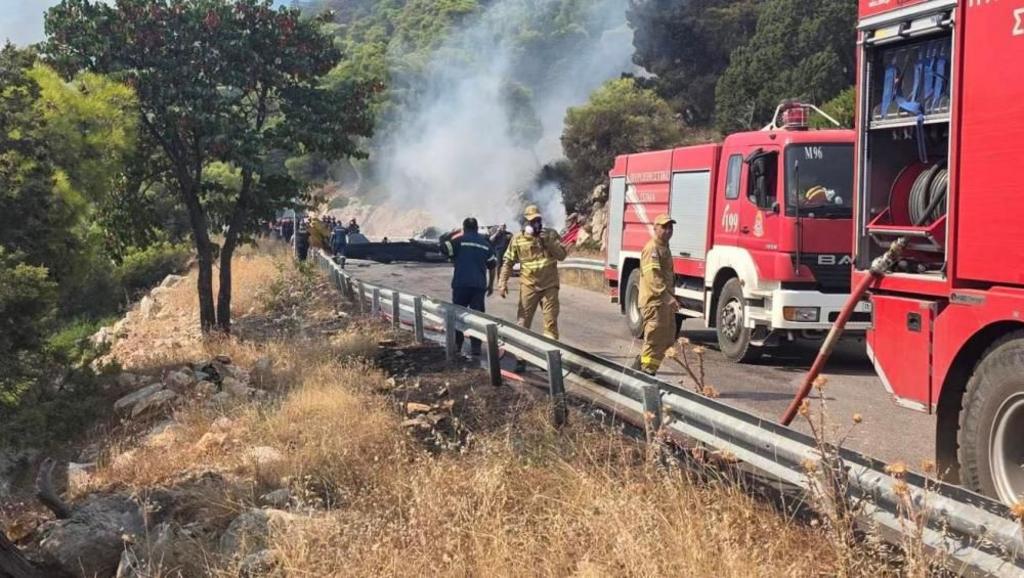
The collision occurred over the Psatha area of western Attica as both helicopters supported operations against a fast moving blaze that has destroyed more than 100 homes and forced fresh evacuations.
What We Know So Far
Both aircraft were Bell helicopters, each carrying a two person crew, according to officials. Video from the scene showed one helicopter striking the other before it went down in flames.
The helicopters belonged to the Australian firm McDermott Aviation, company founder John McDermott confirmed. He said the company has operated in Greece for seven years and had deployed 15 aircraft for this year’s fire season. Foreign crews are frequently brought in to support Greek firefighting efforts during the country’s hot, dry summer months.
Greek authorities have opened an investigation into the cause of the collision. All Bell helicopters were temporarily grounded as a precaution following the crash, though other firefighting aircraft continued operating.
Strong winds pushed the fire deeper toward communities and an industrial district west of Athens, and the same gusts prevented aircraft from drawing water from the sea to fight the flames.
What Authorities Are Saying
Greek Prime Minister Kyriakos Mitsotakis expressed sorrow over the crash and offered condolences to the victims’ families. “The loss of the Greek coordinator and the Danish pilot fills us all with grief,” Mitsotakis said in a statement.
McDermott said the company’s thoughts were with the families, friends and colleagues affected by the crash, noting that both crews had been engaged in critical work to protect nearby communities.
Why This Matters
The crash underscores the risks facing aircrews at what has become the most volatile front in a wildfire emergency spreading across southern Europe this summer. It also revives painful memories in a region scarred by the 2018 wildfire in Mati, which killed 104 people and remains the deadliest blaze in Europe this century.
The Athens area fire is unfolding alongside major blazes elsewhere on the continent. In France, firefighters have held the country’s largest wildfire within its perimeter after it forced roughly 224,000 people to flee, in what may rank as the largest civilian evacuation in the country’s history outside wartime. Hot spots continue to burn within a scorched area of about 162 square miles, and nearly 3,000 firefighters remain deployed against that fire and a second, still uncontained blaze in Provence.
In Spain, major wildfires have stopped advancing, offering a measure of relief even as recovery remains distant. Combined, the fires in France and Spain have displaced roughly a third of a million people from homes and vacation destinations at the height of the summer travel season, straining emergency services that are now managing multiple large scale disasters simultaneously.
The reliance on foreign aircrews, evident in the deaths of a Danish pilot and the involvement of an Australian aviation company, illustrates how thinly stretched national firefighting resources have become as wildfires intensify across the region. Climate scientists have linked the increasing frequency and severity of such fires to prolonged heat waves and drought conditions affecting southern Europe.
What Happens Next
Greek investigators are working to determine what caused the two helicopters to collide, with the outcome likely to influence safety protocols for coordinating multiple aircraft over active fire zones. The temporary grounding of Bell helicopters signals authorities are treating the incident as a potential systemic risk rather than an isolated failure.
Firefighting operations in Greece, France and Spain are expected to continue as long as strong winds and dry conditions persist, with authorities in all three countries balancing containment efforts against the ongoing threat of new outbreaks during what remains a volatile stretch of the European summer.
Reporting drawn from the Associated Press and Greek City Times, citing Greek government officials, McDermott Aviation and Greek fire service accounts.





