

POINT MUGU, Calif. — In a powerful show of military innovation and force, the U.S. Navy has successfully launched a cutting-edge supersonic missile built on propulsion technology dating back to the 1960s. The missile test, carried out off the California coast, marked the first time the Navy launched the experimental Solid Fuel Integral Rocket Ramjet (SFIRR) from an unmanned vehicle, signaling a potential breakthrough in long-range precision warfare.

The test launch took place over the Point Mugu Sea Range and was confirmed Thursday by the Naval Air Warfare Center Weapons Division (NAWCWD). The SFIRR missile, described as “game-changing” by Navy officials, was deployed from a BQM-34 aerial target drone, hitting supersonic speeds moments after ignition.
While the SFIRR propulsion concept stems from Cold War-era research, its modern application reflects advanced updates in avionics, fire control, and aerodynamic design. The technology utilizes a solid-fuel air-breathing ramjet system that compresses incoming air using the vehicle’s high-speed forward motion — eliminating the need for complex liquid fuel systems and reducing overall weight.
Michael Smith, a NAWCWD spokesperson, emphasized the operational benefits of the test. “Launching the missile from an unmanned vehicle can allow warfighters to safely engage targets from greater distances,” he said in a release. “This kind of rapid prototyping, going from concept to demonstration in just 12 months, is critical to preserving our warfighting edge.”
Abbey Horning, product director of NAWCWD’s Advanced Concepts, Prototyping and Experimentation Office, said the successful demonstration represents more than just a nod to retro technology. “We’re not just revisiting an old idea; we’re refining and modernizing it to fit today’s mission,” Horning said. She added that the propulsion system will ultimately deliver “greater range and speed” to U.S. forces.
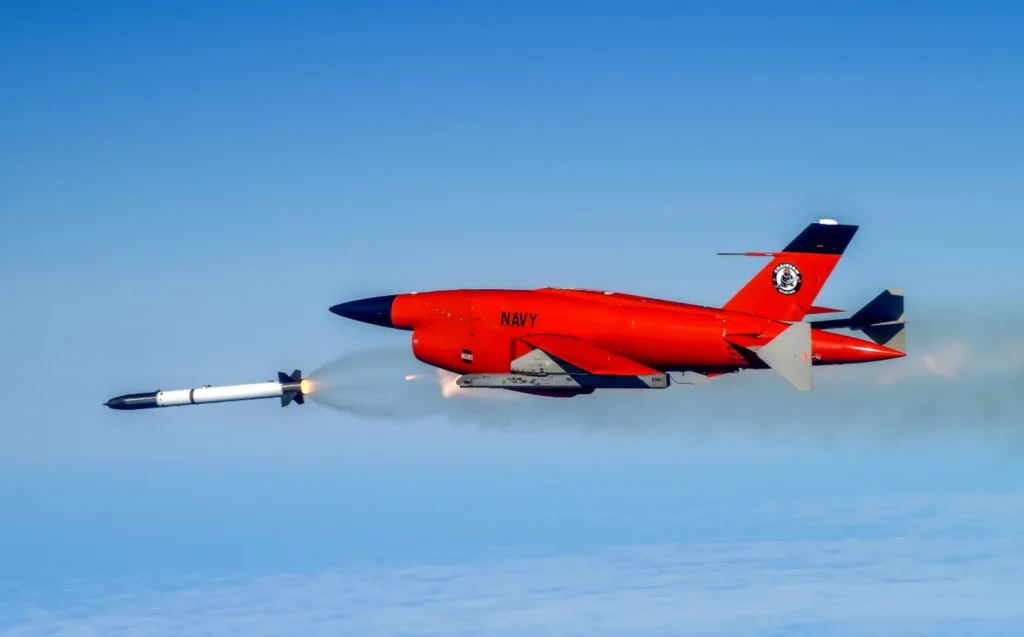
The ramjet’s reduced complexity — thanks to solid fuel — means lighter systems that can accommodate larger payloads and maneuver more effectively. Horning underscored SFIRR’s appeal as a cost-effective, reliable option tailored to meet the Navy’s evolving battlefield requirements.
Ephraim Washburn, deputy director for energetics at NAWCWD, compared the advancement in ramjet propulsion to the evolution of automobiles. “We’ve been driving cars since the early 1900s, but that doesn’t mean we stopped improving them,” he said. “Solid fuel ramjet technology had significant investment in the 1970s and 1980s, but we’re making it a modern propulsion solution for the fleet today.”
Calling the missile a “combat-credible technology,” Washburn said the Navy continues to enhance the SFIRR’s range, endurance, and targeting systems to ensure it meets operational demands.
The high-profile launch comes as the United States continues to maintain its position as the world’s most powerful military, according to Global Firepower’s 2025 rankings. The test serves as both a technological milestone and a strategic signal — reaffirming America’s commitment to maintaining its edge in global defense.
the-sun.com





