

The United Arab Emirates said Sunday it intercepted two drones it identified as Iranian aircraft in its airspace, marking the latest strain on a fragile ceasefire tied to the ongoing conflict involving Iran.
The UAE’s Defense Ministry said the interceptions were carried out without casualties. The development came amid a series of security incidents across the Gulf region that underscore the volatility of the current pause in fighting.
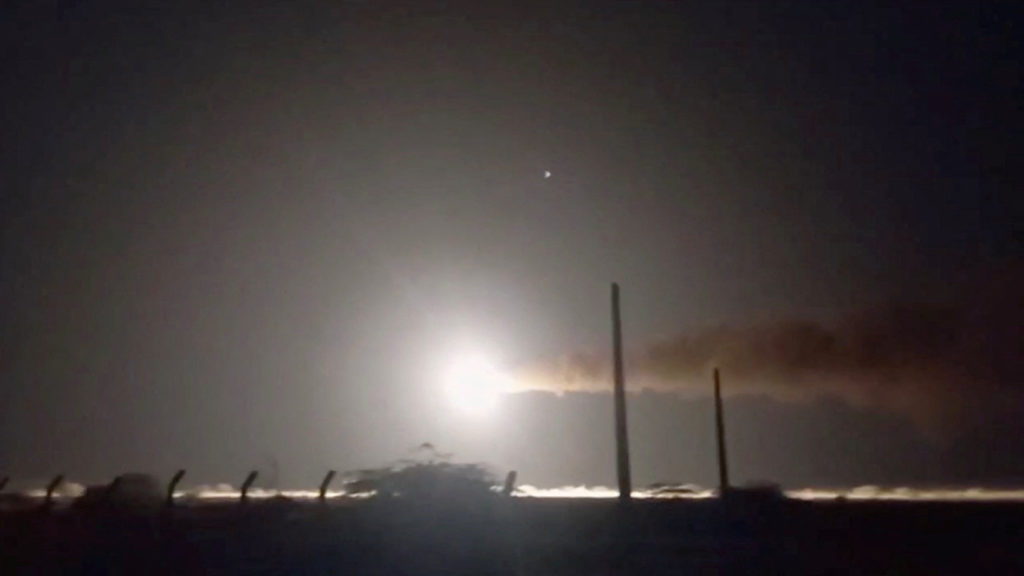
Elsewhere the same day, a drone strike ignited a small fire aboard a commercial vessel off the coast of Qatar, while Kuwait said its forces repelled a separate drone incursion into its airspace. Authorities in both countries confirmed there were no reported injuries.
The incidents represent the latest challenges to a ceasefire that has remained in place for roughly a month but continues to face repeated tests. The administration of President Donald Trump has maintained that the truce is still holding, even as tensions persist across strategic waterways and airspace.
Officials in Qatar said the vessel targeted by a drone was approaching a southern port from Abu Dhabi when the strike occurred. The resulting fire was quickly contained. The United Kingdom Maritime Trade Operations Centre indicated the incident took place about 23 nautical miles northeast of Doha, though it did not identify the vessel or attribute responsibility.
In Kuwait, defense officials said drones entered the country’s airspace before dawn. Brig. Gen. Saud Abdulaziz Al Otaibi said forces responded in line with established procedures. Authorities did not specify the origin of the drones.
The renewed security concerns come as maritime tensions continue to simmer in the Strait of Hormuz, a critical corridor for global oil shipments. Iran has largely restricted passage through the route since the conflict began earlier this year, while the United States has enforced a blockade on Iranian ports.
Washington is awaiting Tehran’s response to a proposed agreement aimed at ending the conflict, restoring shipping through the strait and limiting Iran’s nuclear program. President Donald Trump has warned that military action could escalate again if an agreement is not reached.
One of the central issues in the negotiations remains Iran’s stockpile of highly enriched uranium. The International Atomic Energy Agency has assessed that Iran holds more than 440 kilograms of uranium enriched to 60 percent purity, a level close to weapons-grade material.
In remarks carried by Iranian state media, a military spokesperson said Iran’s forces remain on high alert to protect nuclear facilities. Brig. Gen. Akrami Nia said authorities were prepared for potential infiltration or airborne operations targeting sensitive sites.
The bulk of Iran’s enriched uranium is believed to be stored at the Isfahan nuclear complex, according to Rafael Mariano Grossi, who spoke to The Associated Press last month. The site has previously been targeted during earlier phases of the conflict.
Recent days have also seen a rise in maritime confrontations. U.S. forces struck two Iranian oil tankers on Friday, asserting the vessels were attempting to bypass the blockade. Iranian naval forces responded with warnings that any further attacks on commercial or oil shipping would prompt a strong military response against U.S. assets in the region.
Diplomatic efforts to stabilize the situation continue. Shehbaz Sharif said he spoke Sunday with Sheikh Mohammed bin Abdulrahman Al Thani about ongoing mediation efforts and the broader regional outlook. Pakistan has positioned itself as a key intermediary seeking to ease tensions.
The interception of drones by the United Arab Emirates highlights how precarious the current ceasefire remains. While large-scale hostilities have paused, the persistence of drone incursions, maritime strikes and airspace violations indicates that the conflict has shifted into a lower-intensity but still highly dangerous phase.
Drones have emerged as a central feature of modern conflict in the Gulf, offering a relatively low-cost means of projecting force while avoiding direct confrontation. The incidents reported in the UAE, Qatar and Kuwait suggest a pattern of probing actions that test defensive capabilities and signal strategic intent without crossing into full-scale war.
Control of the Strait of Hormuz remains a critical factor. The waterway handles a significant share of global oil shipments, and any disruption has immediate consequences for energy markets. Iran’s restrictions, combined with U.S. enforcement measures, have created a tense standoff that continues to influence global fuel prices and economic stability.
The unresolved issue of Iran’s nuclear program adds another layer of complexity. The stockpile of enriched uranium, as assessed by the International Atomic Energy Agency, represents a major sticking point in negotiations. Any agreement will need to address not only current levels of enrichment but also long-term monitoring and compliance mechanisms.
At the same time, the involvement of multiple regional actors underscores the risk of broader escalation. Incidents affecting Qatar and Kuwait demonstrate how quickly tensions can spill across borders, drawing in neighboring states even if they are not direct participants in the conflict.
Diplomatic channels, including mediation led by Shehbaz Sharif, remain essential but face significant challenges. Trust between the parties is limited, and each new incident risks undermining fragile progress.
In practical terms, the current situation reflects a transitional phase rather than a stable peace. The absence of large-scale fighting does not equate to security, as ongoing incidents continue to test the limits of the ceasefire. Without a comprehensive agreement addressing both military and political concerns, the risk of renewed escalation remains high.
AP





