

A Ugandan court has sentenced a man to death for the killing of four children in a nursery school attack, concluding a fast-tracked and highly public trial that has drawn both public approval and legal criticism.
The ruling was delivered Thursday against 38-year-old Christopher Okello, who had pleaded not guilty and argued that he was not mentally fit at the time of the April 2 killings. The court dismissed that claim, stating that the defendant did not present sufficient evidence to support an insanity defense.
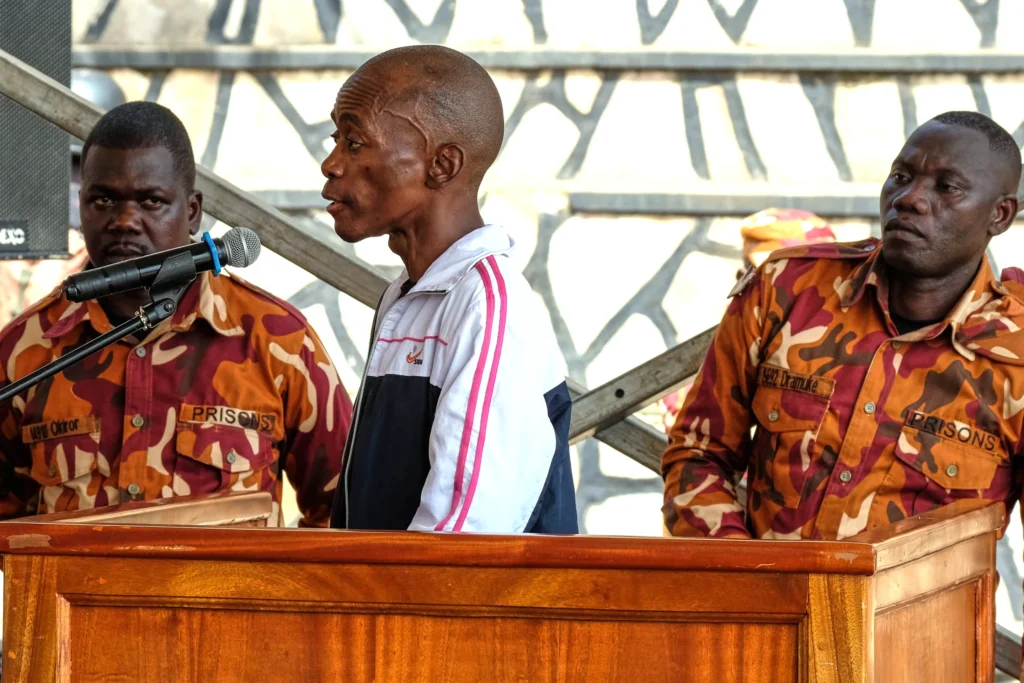
“The accused failed to provide proof that he was mentally unwell when the crimes were committed,” the presiding judge said before ordering that Okello be sentenced to death.
Spectators gathered at the open-air court responded with loud cheers following the verdict, reflecting the deep anger and grief that has gripped the community since the attack.
Authorities said Okello carried out the killings at a nursery school in a suburb of Kampala, where he allegedly entered the premises by posing as a parent. Witnesses recounted that he briefly interacted with staff before securing the gate and launching the attack using a machete. The incident left four children dead and shocked the nation.
The case was handled through a “mobile court,” a system introduced by Ugandan authorities to bring judicial proceedings closer to communities affected by serious crimes. The trial was conducted in a large tent erected near the site of the attack, allowing hundreds of residents and grieving families to observe the proceedings.
The Associated Press previously reported that the trial began earlier in the week as part of a directive from President Yoweri Museveni to expedite the case. The approach marked the first major use of mobile courts in Uganda, following the publication of formal guidelines for their operation in March.
Government officials have defended the initiative, saying it demonstrates a commitment to transparency and accessibility in the justice system. Judicial authorities described the process as an effort to ensure that communities directly impacted by crimes can witness the administration of justice.
However, the speed and public nature of the trial have sparked concern among legal experts and rights advocates. The Uganda Law Society criticized the proceedings, arguing that they risk undermining the defendant’s right to a fair trial. In a statement issued earlier, the organization characterized the process as excessive and warned against potential interference in judicial independence.
Observers also raised questions about the handling of Okello’s mental health during the trial. Reports from the proceedings described the defendant as appearing anxious and at times behaving unpredictably, including episodes of unprovoked laughter. Despite these observations, the court concluded that there was no credible evidence to support claims of mental instability.
The death penalty remains legal in Uganda, though it is rarely carried out. Individuals sentenced to death often spend years in prison as their cases move through the appeals process. It was not immediately clear whether Okello’s legal team plans to challenge the verdict.
The attack itself triggered widespread outrage, with many residents calling for swift justice. Shortly after the incident, an angry crowd reportedly attempted to assault the suspect before police intervened and took him into custody.
The motive behind the killings has not been publicly established.
The case highlights the tension between public demand for swift justice and the legal safeguards designed to ensure fair trials. Uganda’s introduction of mobile courts represents a significant shift in how high-profile cases are handled, particularly those that generate intense public interest. By bringing proceedings directly to affected communities, authorities aim to enhance transparency and public trust. However, critics argue that such visibility can also heighten emotions and potentially influence outcomes.
Legal experts note that the accelerated timeline of the trial raises broader questions about due process. In complex criminal cases, especially those involving questions of mental health, thorough evaluation and expert testimony are typically essential. The court’s rejection of the insanity defense without extensive public evidence may continue to draw scrutiny from human rights organizations.
The public reaction to the verdict underscores the depth of trauma caused by the attack. Crimes involving children often provoke strong emotional responses, which can shape perceptions of justice. In this case, the visible support for the sentence suggests a community seeking closure, though it also highlights the challenges of balancing public sentiment with legal standards.
The use of the death penalty adds another layer of complexity. While still part of Uganda’s legal framework, executions are infrequent, and international pressure has increasingly focused on limiting or abolishing capital punishment. The sentence in this case may reignite debate over its role in the justice system, particularly in cases involving severe crimes.
From a policy perspective, the trial could serve as a test case for the future of mobile courts in Uganda. If authorities view the process as successful, it may be expanded to other regions and cases. However, sustained criticism from legal groups could lead to calls for reforms to ensure that such proceedings meet international standards for fairness and due process.
As the case moves forward, attention is likely to shift to potential appeals and the broader implications for Uganda’s justice system. The balance between accessibility, efficiency and fairness will remain central to that discussion.
The Associated Press





