

FIFA President Gianni Infantino reaffirmed Thursday that Iran will compete in the 2026 World Cup, including matches scheduled in the United States, underscoring the organization’s stance that football should remain a unifying force despite escalating geopolitical tensions.
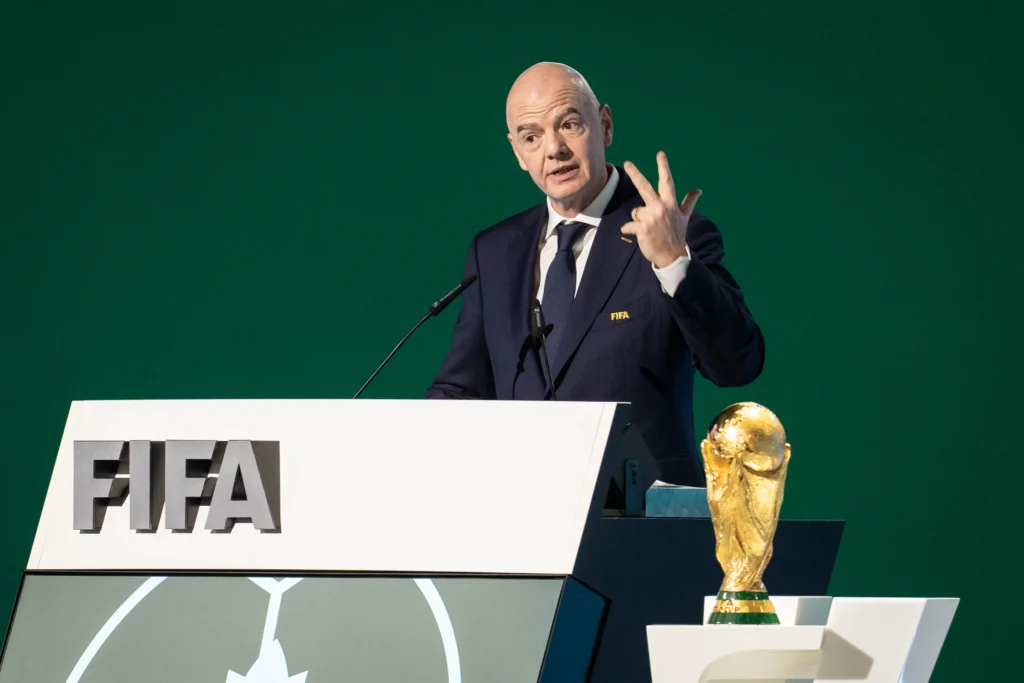
Opening the 76th FIFA Congress in Vancouver, Infantino emphasized the governing body’s commitment to inclusivity, stating that the tournament will proceed with all qualified teams regardless of political disputes.
“The reason is simple — we must bring people together,” Infantino told delegates. “Football unites the world, and FIFA has a responsibility to uphold that principle.”
The statement comes amid growing scrutiny over Iran’s participation, particularly as relations between Tehran and Washington remain strained. The issue gained further attention this week when officials from Iran Football Federation were denied entry into Canada.
Canadian Foreign Affairs Minister Anita Anand indicated that Iranian representatives, including federation president Mehdi Taj, were turned away at Toronto’s airport. The development followed reporting by Tasnim, an Iranian news agency.
Despite those complications, FIFA has maintained a consistent position. Iran had previously explored relocating its World Cup matches to Mexico, but that request was rejected, reinforcing the existing tournament framework.
The 2026 World Cup is scheduled to begin June 11, with the final set for July 19. Matches will be held across the United States, Canada and Mexico, marking the first time the tournament will be jointly hosted by three nations.
Iran’s absence was noted during the official roll call at the Congress, where all member associations were recognized. Outside the Vancouver Convention Center, a small group of demonstrators gathered, holding Iranian flags in a peaceful protest.
While geopolitical concerns linger, officials from Canadian Soccer Association used the Congress to highlight Canada’s role as a welcoming host nation. Association president Peter Augruso described the country as a hub of cultural diversity and inclusion, emphasizing its readiness to welcome teams and supporters from around the world.
Infantino also addressed concerns surrounding ticket pricing for the tournament, acknowledging criticism while defending FIFA’s revenue model. He noted that a significant portion of tickets has already been sold and that proceeds will be reinvested into global football development.
“We have both premium and affordable options,” Infantino said, adding that tournament revenues are redistributed to support the sport worldwide.
Earlier in the week, FIFA’s governing council approved an additional $100 million in funding for participating nations to offset rising costs. The decision increases the minimum financial allocation to each federation to $12.5 million.
FIFA projects total revenue for the tournament to exceed $11 billion, reflecting the growing commercial scale of the World Cup. Prize money has also risen significantly over time. The winner of the 2026 tournament is expected to receive $50 million from a total prize pool of $655 million.
For comparison, Argentina earned $42 million for winning the 2022 World Cup, while France received $38 million for its 2018 victory. The increasing financial stakes highlight the tournament’s expanding global footprint and economic significance.
Outside the Congress venue, attention also turned to local football concerns. Supporters of the Vancouver Whitecaps staged a rally to protest uncertainty surrounding the club’s future. Major League Soccer has indicated it is evaluating long-term options for the franchise, including a potential relocation.
The team’s ownership group has been seeking buyers for more than a year, with financial constraints and venue agreements contributing to ongoing uncertainty. BC Place, the club’s home stadium, is set to host several World Cup matches, further complicating planning efforts.
The FIFA Congress drew approximately 1,600 football officials from around the world and is expected to generate millions in economic activity for the host city.
FIFA’s decision to proceed with Iran’s participation reflects a broader tension between sport and geopolitics. Historically, international competitions have often served as platforms for diplomacy, even amid conflict. Infantino’s remarks align with FIFA’s longstanding position that football should remain separate from political disputes, though that principle is increasingly difficult to maintain in a polarized global environment.
The situation also raises practical challenges. Travel restrictions, visa issues and security considerations could complicate logistics for teams and officials, particularly in a multi-country tournament. Canada’s decision to deny entry to Iranian representatives highlights how national policies can intersect with global sporting events, potentially creating friction within FIFA’s framework.
From a commercial perspective, the stakes are significant. The 2026 World Cup is poised to be the most lucrative in history, and any disruption involving participating nations could have financial and reputational consequences. Sponsors, broadcasters and host cities all rely on stability to maximize returns on investment.
At the same time, the controversy underscores the evolving role of governing bodies like FIFA. As global tensions intensify, organizations are increasingly expected to navigate complex political landscapes while preserving the integrity of competition. Infantino’s firm stance suggests FIFA is prioritizing continuity and inclusivity, even at the risk of criticism.
For host nations, the tournament presents both opportunity and challenge. Canada’s emphasis on diversity contrasts with concerns about immigration policies in the United States, illustrating differing national approaches to hosting a global event. These dynamics could shape the overall experience for fans and participants.
Ultimately, Iran’s participation will remain a focal point as the tournament approaches. How FIFA and host nations manage the associated challenges may set a precedent for future international competitions in an increasingly interconnected and politically sensitive world.
AP





