

The United States military is deploying three additional warships carrying approximately 2,500 Marines to the Middle East, with another expeditionary unit of similar size already en route from the Pacific, as the Iran conflict enters its third week with no resolution in sight and the Pentagon requesting an additional $200 billion in congressional funding to sustain military operations.
The troop surge comes as Iran vowed Friday to deny its adversaries security despite nearly three weeks of devastating U.S.-Israeli strikes that have killed several of Tehran’s top leaders and severely damaged its weapons manufacturing facilities and energy infrastructure.
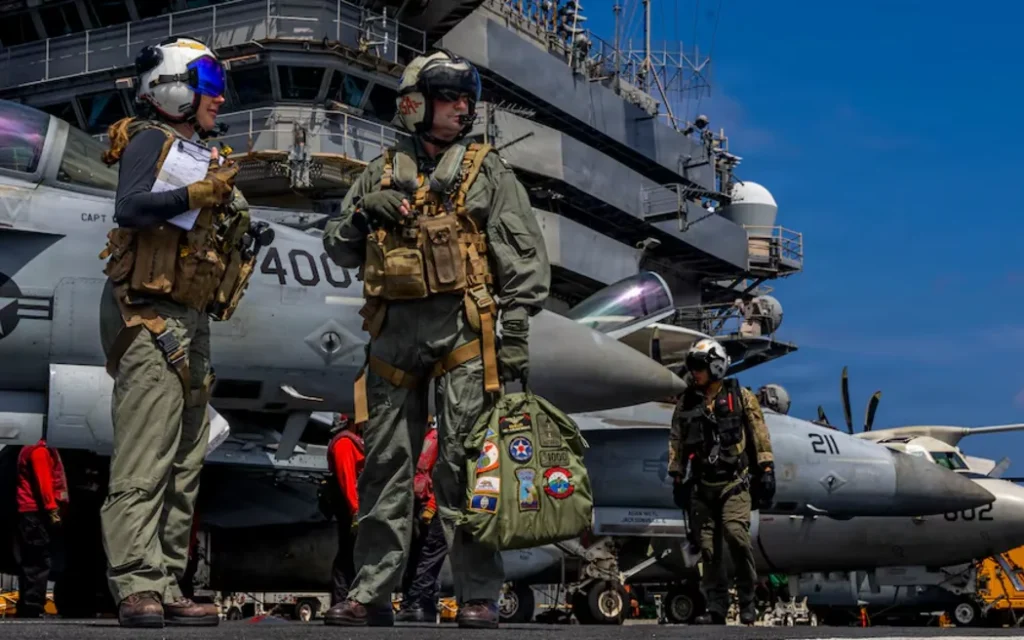
The escalating commitment of American military resources to the region signals that the conflict President Donald Trump once predicted would end swiftly shows no signs of concluding despite administration claims of overwhelming success.
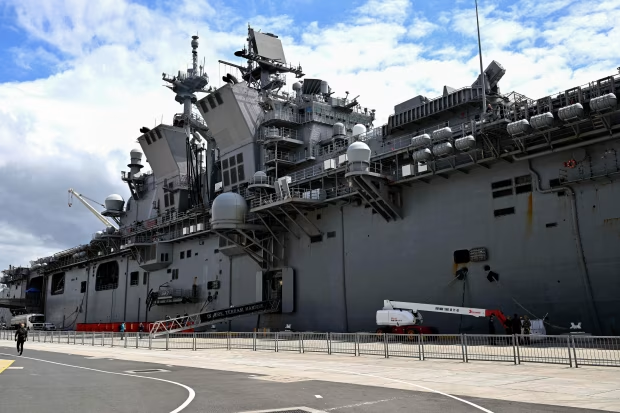
One U.S. official confirmed to the Associated Press that the USS Boxer and two other amphibious assault vessels, along with roughly 2,500 Marines of the 11th Marine Expeditionary Unit, are bound for the Middle East from their home port of San Diego. Two additional U.S. officials verified that the ships were deploying without specifying their destination, speaking on condition of anonymity to discuss sensitive military operations not yet publicly announced.
The deployment follows just days after the U.S. military redirected another Marine expeditionary group aboard amphibious assault ships from the Pacific to the Middle East. Last week, Pentagon officials confirmed that the Japan-based USS Tripoli and the 31st Marine Expeditionary Unit received orders to deploy to the Middle East—shifting them from exercises in the vicinity of Taiwan where they had been signaling American commitment to defending the democratic island against potential Chinese aggression.
Earlier this week, the USS Tripoli and another amphibious assault ship, the USS New Orleans, were identified sailing west of Malaysia on publicly available satellite imagery, confirming their westward transit toward the Persian Gulf region. The pair of Marine Expeditionary Units will add approximately 5,000 Marines and thousands of sailors to a theater where the U.S. military acknowledges maintaining roughly 50,000 troops—a figure that continues climbing as the conflict intensifies rather than resolves.
The Pentagon’s request for another $200 billion to fund continuing war operations would require congressional approval at a moment when the U.S. national debt has reached a record $39 trillion.
The massive supplemental funding request—coming atop already substantial defense appropriations—raises questions about fiscal sustainability and whether the conflict will produce the protracted financial drain that Trump repeatedly warned against during his campaigns criticizing previous Middle Eastern wars.
A spokesperson for Iran’s paramilitary Revolutionary Guard told the Associated Press Friday that Tehran continues building missiles despite weeks of bombardment targeting production facilities. The spokesperson, identified as Naeini, insisted the Iran war would persist, though Iranian state television subsequently confirmed that Naeini was killed in an airstrike shortly after making those defiant comments—illustrating both Iran’s determination to resist and the lethality of ongoing strikes against its leadership.
Israel struck the Iranian capital Tehran with airstrikes Friday, with the attack occurring as Iranians marked Nowruz—the Persian New Year celebrated across Iran and Central Asia as the most important annual holiday.
The timing of strikes during major cultural celebrations has generated international criticism about proportionality and respect for civilian populations attempting to observe traditional festivities amid warfare.
U.S. and Israeli leaders have maintained that weeks of strikes have decimated Iran’s military capabilities. Airstrikes have eliminated the supreme leader, the secretary of Iran’s Supreme National Security Council, and numerous top-ranking military and political leaders in what represents an unprecedented decapitation of an adversary nation’s entire command structure.
Israeli Prime Minister Benjamin Netanyahu declared Thursday that Iran no longer possesses the ability to enrich uranium or manufacture ballistic missiles—claims that, if accurate, would represent catastrophic strategic losses for Tehran.
Netanyahu added that Israel would refrain from additional attacks on Iranian gas fields at Trump’s request, suggesting the American president is attempting to moderate Israeli operations to prevent further disruption to global energy markets.
The price of Brent crude oil—the international benchmark—has soared since Israel and the United States initiated hostilities with Iran. The petroleum price increases reflect market anxieties about supply disruptions from the Persian Gulf region that produces approximately one-third of global oil supplies and contains the Strait of Hormuz chokepoint through which roughly one-fifth of international petroleum shipments transit.
When questioned about Trump’s plans for the additional troops and media speculation that the administration is considering occupying or blockading Kharg Island—Iran’s primary oil export terminal—a White House official emphasized that Trump has said he has “no plans” to send ground troops into Iran while retaining all military options and refusing to broadcast strategy publicly.
The official, speaking on condition of anonymity because they lacked authorization for media engagement, asserted the U.S. military could “take out Kharg Island at any time.”
The comment reflects confidence about American military capabilities while leaving ambiguous whether such operations might eventually occur despite current denials about ground force deployments.
Trump referenced the war Friday while presenting the Commander in Chief trophy to the Navy football team for defeating Army during their 2025 game. Without providing operational details, he proclaimed “We’re doing extremely well,” maintaining the optimistic characterization he has consistently employed when discussing the conflict publicly.
Trump explained that Defense Secretary Pete Hegseth and Gen. Dan Caine, chairman of the Joint Chiefs of Staff, were absent from the ceremony because they were conducting operations from the White House Situation Room—suggesting active military planning was occurring simultaneously with the public event. As the trophy presentation unfolded, an official informed the Associated Press that the U.S. was deploying three additional warships with roughly 2,500 more Marines to the Middle East as the Iran war continues.
Satellite imagery is beginning to provide visual documentation of the war’s destructive toll, with photographs showing ships ablaze in Iranian ports and destroyed buildings at American bases throughout the region.
Information has remained scarce about damage across the Middle East—particularly within closed military facilities—since hostilities commenced February 28, though commercial satellite companies are gradually releasing images that offer independent verification of combat effects.
The images originate from Planet Labs PBC, a San Francisco-based firm whose satellite imagery is utilized by media outlets including the Associated Press. Planet Labs has imposed a two-week delay on its imagery becoming publicly available, citing concerns that real-time satellite intelligence could be exploited by “adversarial actors” for targeting or operational planning purposes.
High-resolution images have also been published by competing commercial satellite firms, while other providers including the U.S. Geological Survey have been releasing lower-resolution imagery that, despite reduced detail, has proven useful for documenting major fires, explosions, and infrastructure damage across the conflict zone.
The United States and Israel have been striking diverse targets including leadership figures in Iran, military installations, missile and air defense sites, and positions of the paramilitary Revolutionary Guard and its volunteer force, the Basij. Iran has responded with drone and missile attacks targeting Israel and nearby Gulf Arab nations, creating a regional conflict that has drawn multiple countries into direct combat.
Some of the most dramatic satellite imagery from Planet Labs documents scenes in Bandar Abbas—home to a major Iranian military port adjacent to the crucial Strait of Hormuz connecting the Persian Gulf to the Gulf of Oman and the Arabian Sea.
Images captured on March 2 show multiple vessels ablaze at the port following American strikes. U.S. Central Command has been systematically targeting Iran’s naval assets and claims to have sunk or damaged more than 100 Iranian vessels since the war commenced.
Planet Labs imagery from March 6 reveals extensive damage to several buildings at the Parchin military base outside Tehran. The International Atomic Energy Agency has long suspected Iran conducted tests of high explosives that could trigger nuclear weapons at Parchin, though Iran has consistently insisted its nuclear program serves exclusively peaceful purposes. The IAEA, Western intelligence agencies, and independent analysts have concluded Tehran operated an active weapons program until at least 2003.
Israel’s military confirmed its Parchin strikes targeted “infrastructure used for the production of essential components for the development of various weapons.” The facility has been linked to Iran’s ballistic missile program, making it a priority target for operations aimed at eliminating Tehran’s ability to threaten regional targets with conventional weapons.
The island kingdom of Bahrain—home to the U.S. Navy’s Fifth Fleet headquarters—has experienced heavy Iranian fire targeting both military bases and oil installations. A March 1 Planet Labs image shows a major building at the base destroyed along with two radomes—geodesic domes covering radar antennas—likely by Iranian missile and drone strikes. Subsequent March 6 imagery revealed additional building damage, confirming that Iran has successfully struck one of America’s most important regional military facilities.
The Navy has not provided comprehensive damage assessments from the Bahrain base, though Iran has repeatedly claimed successful attacks against it. Online videos have documented incoming fire targeting the facility.
During the 12-day war last June, Iran attacked and destroyed a similar radome at Al Udeid Air Base in Qatar used for secure communications, demonstrating capabilities to damage sophisticated American military infrastructure.
Satellite images captured March 15 by an Airbus Defense and Space Pléiades Neo satellite and analyzed by the Associated Press show damage at Abu Dhabi’s Al Dhafra Air Base in the United Arab Emirates. Damage is visible at one set of hangars to the facility’s northwest.
Another hangar to the southeast appears shredded by fire with an adjacent hangar sustaining roof damage, though the contents of the damaged hangars remain unclear.
Al Dhafra typically hosts approximately 2,000 American troops and has functioned as a major operational base for everything from armed drones to F-35 stealth fighters in recent years.
The U.S. military for years only vaguely referenced Al Dhafra as a base in “southwest Asia” before the UAE became more willing to acknowledge the American military presence there.
In Abu Dhabi, damage is visible at France’s Camp de la Paix naval base. Satellite images from March 3 show destruction to two large hangar-like structures at the facility located near Zayed Port and close to Abu Dhabi’s Cultural District that includes the Louvre Abu Dhabi and other major museums. The successful strikes on French military facilities demonstrate that Iran is willing to attack European forces alongside American targets, potentially drawing NATO allies into broader conflict.
The U.S. Geological Survey’s Landsat satellites have proven particularly effective in identifying major fires across the region. Imagery captured Monday showed a fire at Dubai International Airport after an Iranian drone strike ignited a fuel tanker at the world’s busiest airport for international travel, producing a noxious black smoke plume that disrupted operations at a critical global aviation hub.
Another fire was documented Monday at Oman’s southern port in Salalah, which came under attack from suspected Iranian drones on March 11. Tehran has denied launching those strikes in its campaign targeting Gulf Arab states, though the fire has apparently burned continuously since the initial attack—suggesting substantial fuel or chemical storage was ignited.
As the conflict approaches its fourth week with 5,000 additional Marines deploying to a region already hosting 50,000 American troops, the fundamental questions about the war’s objectives, duration, and costs remain unanswered despite administration assurances of imminent victory.
The mounting troop commitments, massive funding requests, soaring oil prices, and expanding geographic scope of combat operations suggest the conflict is following trajectories of previous Middle Eastern wars that consumed far more American blood and treasure than initial optimistic projections anticipated.





