

President Donald Trump indicated Friday that the United States could begin scaling back its military operations in the Middle East, even as his administration accelerates troop deployments and seeks billions more in funding for the ongoing conflict with Iran.
The remarks, delivered through a post on the social media platform Truth Social and later reinforced in comments to reporters, came after a surge in oil prices triggered a sharp downturn in U.S. stock markets, highlighting the growing economic consequences of the war.
Trump’s suggestion of a potential drawdown appeared to contrast with recent Pentagon actions, including the movement of additional warships and approximately 2,500 Marines to the region. Defense officials have also advanced a request for $200 billion in supplemental funding, which would require congressional approval as the national debt climbs to record levels.
In his online statement, Trump outlined several objectives guiding U.S. operations but offered limited clarity on how or when those goals might be achieved. The president’s messaging also left uncertainty surrounding Washington’s role in safeguarding the Strait of Hormuz, a strategic maritime corridor critical to global oil shipments.
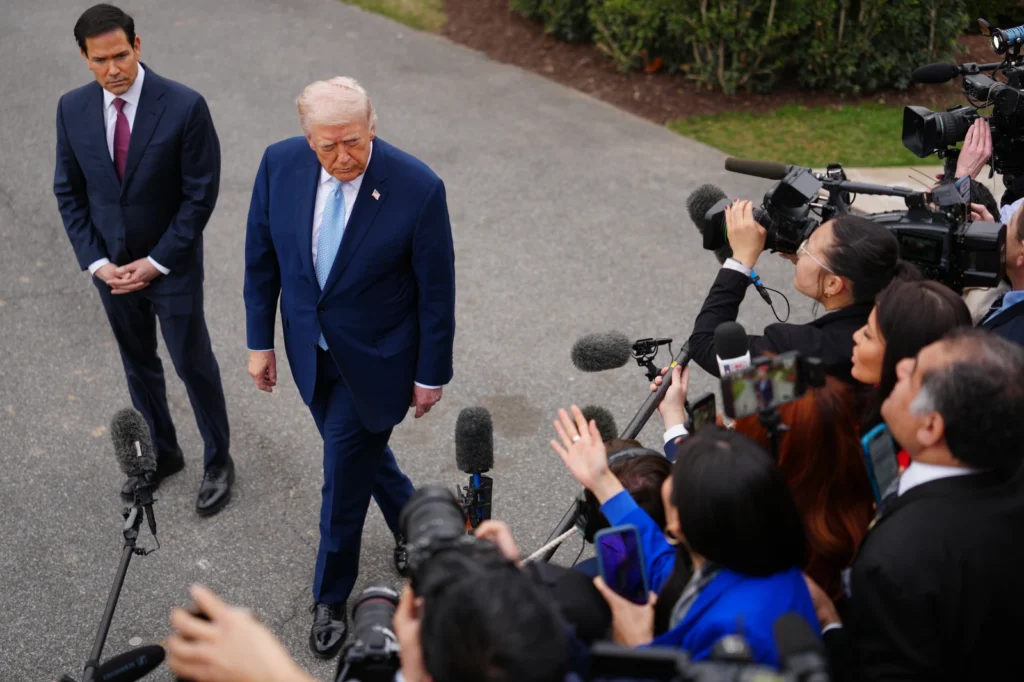
Speaking to reporters on the White House lawn before departing for Palm Beach, Florida, Trump expressed frustration with allied support, singling out the NATO alliance. He argued that member nations have not demonstrated sufficient resolve to assist in securing the waterway, despite its global importance.
“It’s a straightforward military maneuver,” Trump said, describing potential operations in the Strait. “It’s relatively safe, but it requires scale — ships, coordination, volume. NATO could contribute, but so far, they haven’t shown the willingness.”
The Strait of Hormuz remains one of the world’s most vital energy chokepoints, and recent disruptions linked to the conflict have sent shockwaves through global markets. A survey conducted by Reuters in partnership with Ipsos found that 55% of Americans say rising gas prices tied to the war have affected their personal finances, underscoring the domestic impact of the overseas conflict.
Despite hinting at a possible reduction in military engagement, Trump maintained a hardline stance on negotiations. When asked whether he would consider a ceasefire, the president dismissed the idea, signaling that U.S. operations would continue as long as military momentum remains favorable.
“You don’t pursue a ceasefire when you’re decisively overpowering the other side,” Trump said. “That’s not the position we’re in.”
The administration’s strategic ambiguity extended to questions about potential targets within Iran. When pressed on whether U.S. forces might escalate operations against Kharg Island — a key hub for Iran’s oil exports — Trump declined to provide specifics.
“I may have a plan, or I may not,” he said, adding that while the location has drawn attention in strategic discussions, he would not publicly outline any operational decisions.
According to Associated Press, internal deliberations within the administration have included scenarios involving heightened pressure on Iran’s infrastructure, though officials have emphasized that no final decisions have been announced.
The evolving U.S. posture reflects a broader tension between military escalation and political signaling. On one hand, the steady flow of additional troops and naval assets into the region suggests preparation for sustained or expanded operations. On the other, Trump’s public comments about “winding down” hint at an awareness of mounting economic and political costs at home.
Trump’s dual-track messaging reveals a complex strategic balancing act. By suggesting a potential drawdown while simultaneously reinforcing military capabilities, the administration appears to be preserving flexibility — both to escalate if necessary and to pivot toward de-escalation should conditions permit.
This approach may also serve a domestic political function. Rising fuel prices and market volatility are directly affecting American households, as reflected in polling data. By signaling a possible reduction in military engagement, Trump may be attempting to reassure voters concerned about the economic fallout, even as operational realities on the ground point in the opposite direction.
The criticism of NATO highlights another dimension of the conflict: the strain on transatlantic alliances. Trump’s remarks suggest frustration with what he perceives as unequal burden-sharing, a longstanding issue that has resurfaced in the context of securing global trade routes. However, such public criticism risks further complicating coordination at a time when multinational cooperation could prove critical.
The ambiguity surrounding the Strait of Hormuz is particularly consequential. Control of the passage is not only a military concern but a global economic imperative. Any sustained disruption could drive energy prices higher, intensify inflationary pressures, and potentially trigger broader economic instability. Trump’s mixed signals — at times asserting U.S. self-sufficiency, at others calling for allied support — reflect the difficulty of managing such a high-stakes environment.
Equally significant is the question of escalation targeting Iran’s oil infrastructure, including Kharg Island. Striking such assets could severely limit Iran’s revenue streams but also risks provoking a wider regional conflict, potentially drawing in additional actors and threatening global supply chains.
Ultimately, the contrast between rhetoric and action underscores the uncertainty surrounding U.S. strategy in the Middle East. While the administration leaves open the possibility of winding down operations, the continued influx of military resources suggests that Washington is preparing for a conflict that may persist — or even intensify — in the near term.
AP/KomoNews





