

The United States and Iran agreed to a two-week ceasefire on Tuesday evening following last-minute diplomatic intervention led by Pakistan, canceling an ultimatum from Donald Trump for Iran to surrender or face widespread destruction that legal scholars and international leaders had warned could constitute war crimes.
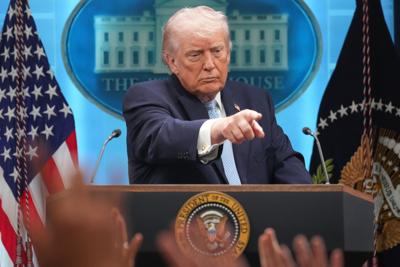
Trump’s announcement of the ceasefire agreement arrived less than two hours before the U.S. president’s self-imposed 8 p.m. Eastern time deadline to bomb Iran’s power plants and bridges in attacks that the Pope, numerous government officials, and legal experts had characterized as potential crimes against humanity. Just hours earlier, Trump had written on Truth Social: “A whole civilization will die tonight, never to be brought back again. I don’t want that to happen, but it probably will.”
B-52 bombers were documented to be en route to Iran before the ceasefire agreement was announced, suggesting military preparations for infrastructure destruction had advanced to operational stages when diplomatic breakthrough intervened. The dramatic reversal occurred through intensive mediation by Pakistan, whose prime minister Shehbaz Sharif had requested the two-week peace period to “allow diplomacy to run its course.”
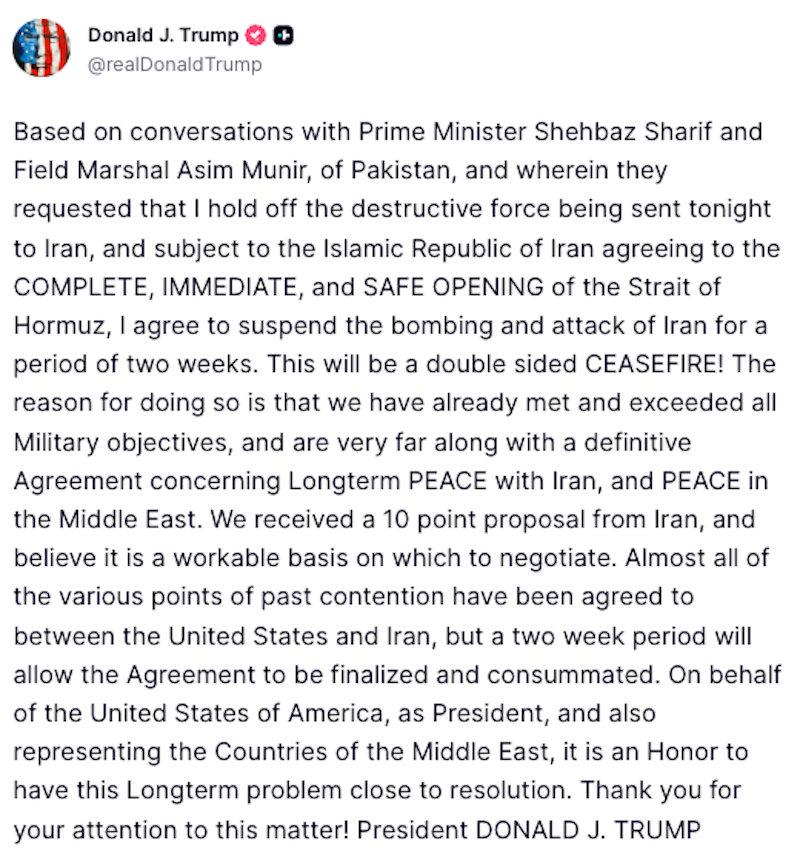
Trump wrote in a post that “subject to the Islamic Republic of Iran agreeing to the COMPLETE, IMMEDIATE, and SAFE OPENING of the Strait of Hormuz, I agree to suspend the bombing and attack of Iran for a period of two weeks.” The statement emphasized that Iran’s compliance with strait reopening represented the essential condition for American restraint from attacks on civilian infrastructure.
In the two-week period, Trump indicated, he believed the United States and Iran could negotiate over a 10-point proposal submitted by Tehran that would allow an armistice to be “finalized and consummated.” The reference to Iranian proposals represented acknowledgment that Tehran had presented substantive negotiating positions rather than merely resisting American demands.
“This will be a double sided CEASEFIRE!” he continued, employing capital letters for emphasis. “The reason for doing so is that we have already met and exceeded all Military objectives, and are very far along with a definitive Agreement concerning Longterm PEACE with Iran, and PEACE in the Middle East.”
Iran’s foreign minister, Abbas Araghchi, issued a statement shortly after Trump’s announcement confirming Iran had agreed to the ceasefire terms. “For a period of two weeks, safe passage through the Strait of Hormuz will be possible via coordinating with Iran’s Armed Forces,” he wrote, specifying the mechanism by which maritime traffic would resume through the waterway handling approximately one-fifth of global energy supplies.
The sudden reversal will allow Trump to retreat as the U.S. war in Iran has dragged on for five weeks with minimal evidence that Tehran is prepared to surrender or release its hold on the Strait of Hormuz, where traffic has slowed to a trickle since Iran effectively closed the waterway following American and Israeli attacks. The ceasefire provides Trump an exit from escalating toward infrastructure destruction that could have triggered international condemnation and domestic political backlash.
Israel will also agree to the two-week ceasefire, Axios confirmed, citing an Israeli official who added that the ceasefire would enter effect as soon as the blockade of the Strait of Hormuz ceased. The coordination between American and Israeli forces suggested both nations recognized the strategic dead end reached after five weeks of bombardment producing no Iranian capitulation.
Trump had earlier rejected Iran’s 10-point plan as “not good enough,” but the president has established deadlines previously and allowed them to pass over the five weeks of conflict. Yet he insisted Tuesday the ensuing hours would represent “one of the most important moments in the long and complex history of the World” unless “something revolutionarily wonderful” happened, with “less radicalized minds” in Iran’s leadership prevailing.
Amir-Saeid Iravani, Iran’s representative at the United Nations, declared that Trump’s threats constituted “incitement to war crimes – and potentially genocide.” During a Security Council session on the Strait of Hormuz, Iravani emphasized: “Iran will not stand idle in the face of such egregious war crimes. It will exercise, without hesitation, its inherent right of self-defence and will take immediate and proportionate reciprocal measures.”
Through his spokesperson, UN Secretary-General António Guterres issued a reminder Monday that attacking civilian infrastructure is banned under international law, but Trump proclaimed the same day he was “not at all” concerned about being called a war criminal—language suggesting willingness to violate legal prohibitions if they interfered with his objectives.
The Guardian documented that in the hours before Trump’s deadline, Israel mounted its own attacks on Iran’s infrastructure. A rail bridge in the central city of Kashan was among the first reported bombed Tuesday by Iranian state media, with two people reportedly killed as Israel’s military announced it had launched “a wide-scale wave of strikes targeting dozens of infrastructure sites.”
A bridge over a railway line near Karaj, northwest of Tehran, was struck, according to Iranian media, and power outages were documented in the same city after a substation and transmission lines were bombed. Bridges near Qom and Tabriz were also reportedly hit in coordinated attacks apparently designed to demonstrate Israel’s capability to execute the infrastructure destruction Trump threatened.
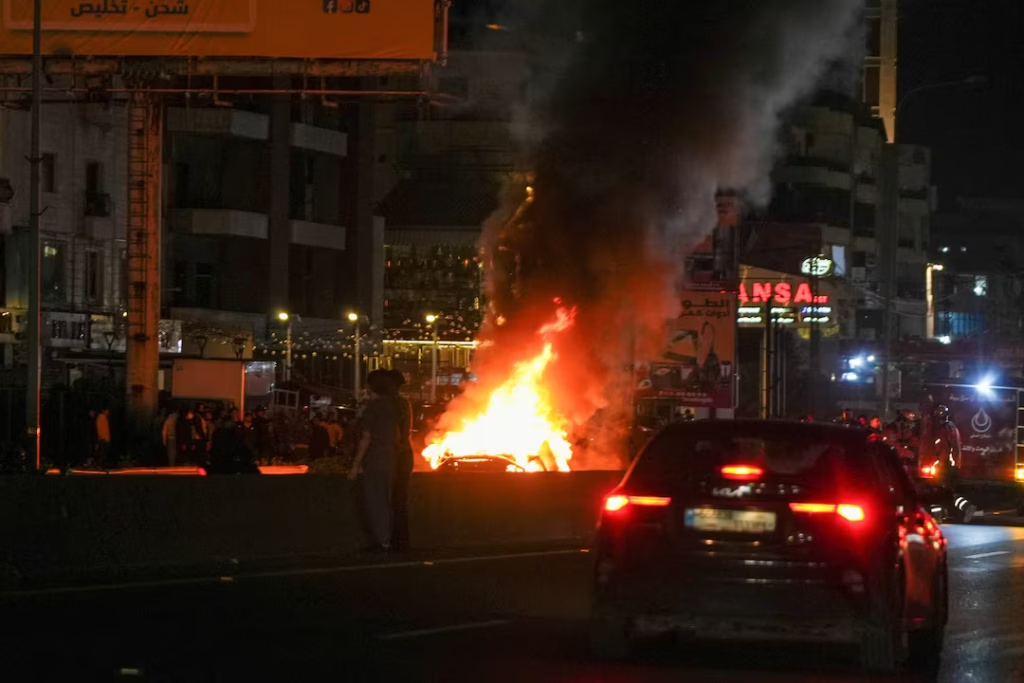
The United States also struck 50 military targets on Iran’s Kharg Island, home to its main oil export terminal, while Iran’s Revolutionary Guards disclosed they had attacked Saudi Arabia’s Jubail petrochemical complex in retaliation for strikes on an Iranian petrochemical facility the night before. The tit-for-tat attacks illustrated the escalating violence that the ceasefire would temporarily halt.
The Associated Press confirmed that the president indicated the pause includes an array of bridges, power plants, and other civilian targets—subject to Iran accepting a two-week ceasefire and reopening the Strait of Hormuz. In a post on his social media site Tuesday evening, Trump specified Iran could agree “to the COMPLETE, IMMEDIATE, and SAFE OPENING of the Strait of Hormuz” and said he would then “suspend the bombing and attack of Iran for a period of two weeks.”
Since the war began in February, Trump has established a series of deadlines threatening escalation of the conflict, only to retreat just before they expire—a phenomenon his critics have derided as “Trump Always Chickens Out,” or TACO. The pattern suggests Trump employs deadline threats as negotiating tactics rather than genuine intentions to execute threatened actions.
The president added in his social media post that Iran has presented “a workable basis on which to negotiate.” “Almost all of the various points of past contention have been agreed to between the United States and Iran, but a two week period will allow the Agreement to be finalized and consummated,” Trump declared, suggesting diplomatic progress had been more substantial than his public rhetoric acknowledged.
Trump backed off many of the sweeping “Liberation Day” tariffs he first announced in April 2025 after they caused financial markets to crash. He also largely abandoned threats to impose high levies on imported products from China, Mexico, the European Union, and Canada—among other trade partners whose resistance forced him to modify maximalist demands.
Perhaps the most spectacular example transpired during a January meeting of the World Economic Forum in Davos, where Trump insisted he wanted the United States to obtain Greenland “including right, title and ownership” only to reverse course and abandon his threat to impose widespread tariffs on Europe to press his case. The pattern of dramatic threats followed by quiet retreat has become characteristic of Trump’s negotiating style.
In his social media post, Trump disclosed he reached the decision to delay expansion of U.S. strikes “based on conversations” with Pakistan Prime Minister Shehbaz Sharif and General Asim Munir, Pakistan’s powerful army chief. Sharif, in a post on X earlier Tuesday, urged Trump to extend his deadline by two weeks to allow diplomacy to advance. Pakistan has been leading negotiations between the adversaries.
Sharif employed the same post to request Iran open the Hormuz Strait for two weeks, demonstrating Pakistan’s role as honest broker appealing to both parties to accept compromise. According to Reuters, Trump agreed to suspend “bombing and attack of Iran” for two weeks, contingent on Iran agreeing to the “complete, immediate and safe opening” of the Strait of Hormuz.
The Independent documented that Trump backed off his threat to unleash devastation across Iran. Trump wrote on Truth Social around 6:30 p.m. ET that U.S. forces would pause plans for a massive final military assault against Iran for two weeks while negotiations continued between the two countries, mediated by Pakistan.
He also claimed that complete reopening of the Strait of Hormuz would be part of arrangements around a temporary pause. “Based on conversations with Prime Minister Shehbaz Sharif and Field Marshal Asim Munir, of Pakistan, and wherein they requested that I hold off the destructive force being sent tonight to Iran, and subject to the Islamic Republic of Iran agreeing to the COMPLETE, IMMEDIATE, and SAFE OPENING of the Strait of Hormuz, I agree to suspend the bombing and attack of Iran for a period of two weeks,” the president stated.
Earlier Tuesday, the president warned that Iran’s millennia-old “civilization will die tonight, never to be brought back again” unless Tehran capitulated to his demands for a ceasefire deal by 8 p.m. ET—language evoking genocide that provoked international outrage and domestic calls for his removal from office.
Shortly afterwards, Iran’s Foreign Minister Abbas Araghchi confirmed an agreement had been reached. He disclosed in an X post that shipping traffic would be allowed through the Strait of Hormuz for two weeks, adding that Iran would cease “defensive” operations until that time, providing attacks against Iran are stopped—language framing Iranian military actions as self-defense rather than aggression.
Tuesday evening’s announcement followed a particularly dire 12 hours in Washington. The day began with the president issuing vows to unleash catastrophic military force upon Iran’s civil infrastructure, including bridges and power plants, if the Iranian government did not comply with his demand for the Strait of Hormuz to be reopened.
The closure of the strait has caused a spike in global oil prices showing no signs of alleviating as long as the waterway, through which about one-fifth of the world’s oil and gas supplies travel, remains largely blocked by Iranian mines and other forces. The economic consequences of continued closure threatened to produce recession across energy-importing nations.
That post from the president drew shocked reactions worldwide and on Capitol Hill, where despite lawmakers being out for Easter recess, many Democrats reacted with public calls for Vice President JD Vance to instigate the removal of the president via the 25th Amendment. The amendment is designed to guide power transfer when the president is incapacitated or unable to serve office duties. Others called for impeachment by the Republican-held House and Senate.
“These are not the words of a sane person, nor one who is fit to serve as president of the most powerful nation in the world,” wrote Democratic Illinois Representative Shri Thanedar in a letter addressed to Vance and top administration officials, questioning Trump’s mental fitness for office.
House Minority Leader Hakeem Jeffries added in a statement: “Congress must immediately end this reckless war of choice in Iran before Donald Trump plunges us into World War III. It’s time for every single Republican to put patriotic duty over party and stop the madness. Enough.”
Experts in military warfare and international law concur that targeting Iran’s civil infrastructure could not be accomplished without causing significant civilian casualties. The non-military designation of the targets would likely constitute war crimes unless the targets were actively being utilized for military purposes—a legal standard these infrastructure sites clearly would not meet.
U.S. forces have sought for weeks to de-mine the Strait of Hormuz and secure the waterway for global shipping traffic, without success. Trump’s efforts to convince European allies to intervene and assist in the endeavor has also largely ended in failure—a result of his frequent and toxic personal attacks aimed at European and NATO leadership that alienated potential partners.
The president’s critics immediately characterized the reversal as evidence that Trump was bluffing once again. “He’s not telling the truth. But if you accept even part of the Iranian statement, Donald Trump has agreed to give Iran control of the Strait of Hormuz. That is extraordinary and cataclysmic for the world,” Senator Chris Murphy, a Democrat from Connecticut, declared on CNN after the news broke.
The 8 p.m. deadline Trump claimed was still in effect to Fox’s Bret Baier just hours earlier represented merely the latest iteration of a deadline that the White House repeatedly extended, even as Iranian officials publicly rejected temporary ceasefire overtures. His first 48-hour “deadline” concerning the Strait of Hormuz was issued more than two weeks earlier.
It was not immediately clear from Trump’s Tuesday evening words whether the temporary ceasefire would include Israel’s military, which is also a party in the conflict, but in Tel Aviv an alert warned residents of incoming rockets just minutes after Trump’s message was posted, according to Fox News—suggesting Iranian retaliation continued despite ceasefire announcements.
For the Trump administration, the Iran war has become a murky morass as the president finds himself unable to tell Americans when it will conclude or why the White House keeps threatening to escalate the conflict if U.S. objectives have supposedly been achieved and Iran’s military is truly “devastated,” as officials claim.
At a press conference Monday, Trump could not tell a reporter whether the conflict was escalating or drawing down when asked directly. “Somebody said, ‘Oh, he doesn’t have a plan.’ I have the best plan of all, but I’m not going to tell you what my plan is,” the president also insisted Monday—language suggesting improvisation rather than strategic coherence.
As the two-week ceasefire begins, fundamental questions remain about whether substantive negotiations can bridge gaps between American and Iranian positions, whether the strait will genuinely reopen to commercial traffic, and whether Trump will follow through on infrastructure destruction threats if diplomacy fails to produce agreement he deems acceptable within the temporary peace window.
AP/Theindependent





