

Russia accused Ukraine on Sunday of striking Europe’s largest nuclear power plant with a drone, while Ukraine flatly denied involvement and called the claim propaganda, as the two sides traded attacks across a wide arc of territory and Russian drone strikes drew reports of civilian casualties and infrastructure damage across multiple regions.
Russia’s state nuclear company Rosatom said a drone hit part of reactor 6 at the Zaporizhzhia Nuclear Power Plant on Saturday, damaging a wall of the turbine hall. Rosatom said no radiation was released. The International Atomic Energy Agency confirmed it had been informed of the reported strike and was seeking direct access to inspect the site. In a statement, the agency said attacking nuclear facilities “is like playing with fire.”
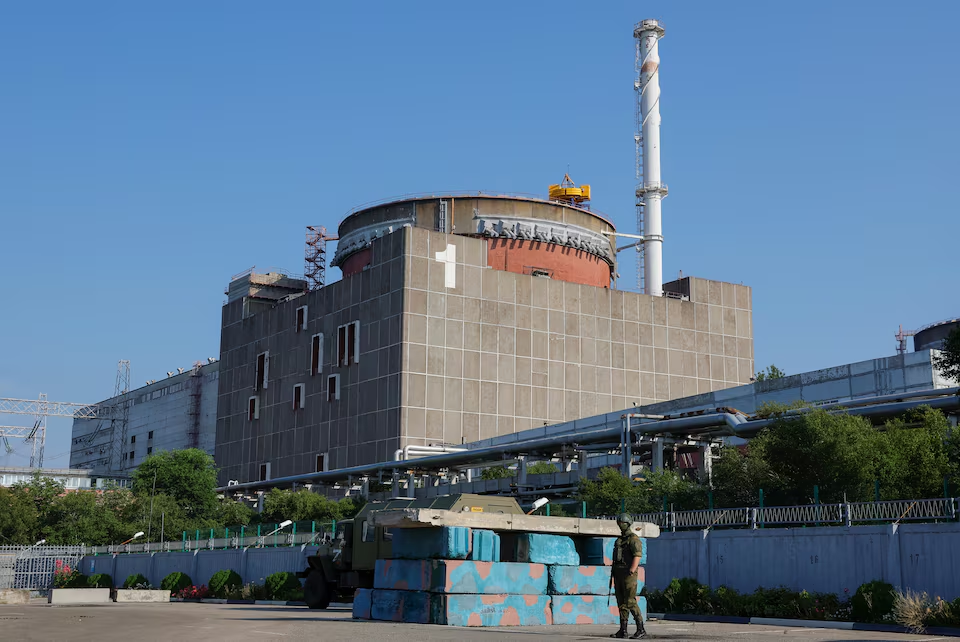
Ukraine rejected the accusation entirely, characterizing the Russian claim as propaganda and accusing Moscow of using the occupied facility as an instrument of nuclear blackmail. The Zaporizhzhia plant, which Russian forces seized in the early weeks of the full-scale invasion in 2022, has been at the center of repeated safety alarms throughout the war as fighting has periodically occurred in its vicinity and power connections to the plant have been disrupted multiple times.
Overnight Strikes Across Russia
Russian regional governors reported Ukrainian drone strikes across several regions overnight into Sunday, with damage confirmed in Saratov, Kirov, Belgorod, Rostov, and Voronezh.
Saratov governor Roman Busargin said civilian infrastructure had been damaged in the Volga region, which hosts several oil refineries and has been a recurring target of Ukrainian long-range drone campaigns in recent months. In the Kirov region, situated more than 1,300 kilometers from Ukrainian-held territory, governor Alexander Sokolov said drones struck a facility in the Urzhumsky district — a strike notable for its depth inside Russian territory.
Belgorod authorities confirmed three civilians were wounded in strikes on the border region. Governors in Rostov and Voronezh also reported overnight drone activity in their areas.
A separate wave of strikes overnight into Saturday hit oil facilities in two southern Russian regions, local officials said, part of what has become a near-daily Ukrainian campaign targeting the energy and industrial infrastructure that funds Moscow’s prosecution of the war.
In Russian-occupied Crimea, Moscow-backed governor Sergei Aksyonov announced restrictions on petrol sales following continued Ukrainian attacks on fuel infrastructure near the peninsula, a signal that the campaign was producing supply disruptions that civilian populations on the peninsula were beginning to feel directly.
The Nuclear Plant and the Dispute Over Responsibility
The conflicting accounts over the Zaporizhzhia strike illustrate the particular difficulty of establishing facts at a nuclear facility that sits inside Russian-occupied Ukrainian territory, beyond independent verification by Ukrainian officials or Western monitors, and where both sides have an established interest in controlling the narrative.
Russia’s version places blame on Ukraine and frames the strike as an attack on nuclear safety. Ukraine’s version characterizes the claim as fabricated to generate international pressure and distract from Russian military conduct. The IAEA, whose authority to inspect the plant has been constrained throughout the war by the Russian military presence there, said it was attempting to gain access to assess the reported damage firsthand.
The IAEA’s language about playing with fire was pointed. The agency has repeatedly warned since the plant’s seizure in 2022 that military activity near or at a functioning nuclear facility creates catastrophic risks, and that the seven safety pillars it considers essential for nuclear security have been intermittently violated at Zaporizhzhia throughout the conflict.
Whether the drone that allegedly struck reactor 6 was Ukrainian, Russian, or undetermined in origin, the incident adds another entry to a record of Zaporizhzhia incidents that nuclear safety experts have described as an unacceptable pattern of risk accumulation around the largest nuclear facility in Europe.
Nuclear Facilities and the Limits of War
The disputed Zaporizhzhia strike arrives at a moment when nuclear infrastructure has become a recurring feature of the broader conflict landscape. Russia has claimed attacks on its own Bushehr plant during the Iran war. Ukraine’s Zaporizhzhia facility has been a flashpoint since 2022. The IAEA has been making the same arguments about nuclear safety in conflict zones for three years, with limited effect on either side’s conduct.
The specific risk at Zaporizhzhia is not simply that a strike might cause a radiation release today. It is that a facility operating well below normal safety standards, with backup power systems that have been tested to their limits and cooling systems dependent on external power connections that have been repeatedly disrupted, represents an accumulated fragility that grows more dangerous with every additional incident. A turbine hall wall is not a reactor core. But the direction of travel matters as much as the specific location of any single strike.
Both Russia and Ukraine know that a Zaporizhzhia disaster would be a catastrophe without boundaries — radioactive contamination does not respect front lines, and the political and humanitarian consequences of a major release at Europe’s largest nuclear plant would fall on both sides of the conflict and well beyond. That mutual understanding has so far provided a floor beneath which neither side has been willing to go. How much margin remains above that floor, given everything that has already happened at and around the plant since 2022, is a question neither government has answered publicly.





