

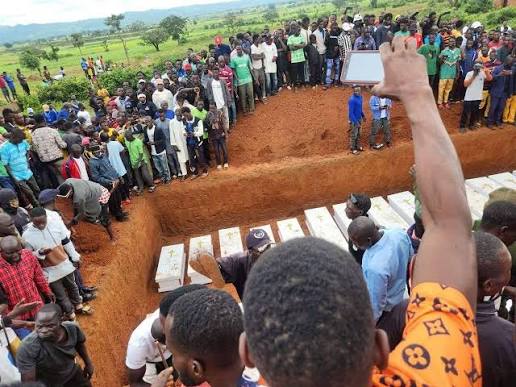
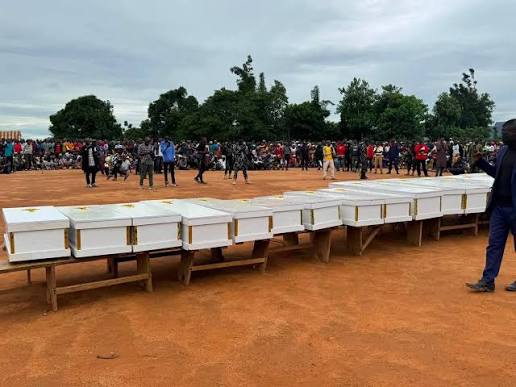
The Catholic Diocese of Kafanchan held a mass burial Saturday for 27 people killed in an attack on Naridon village in southern Kaduna state, church officials said. The remaining three victims had already been buried in the days before the ceremony.
Gunmen stormed the farming community late Sunday night, killing at least 30 people, including children, according to residents and local officials. The attackers set homes on fire and abducted an unspecified number of people while many residents slept.
News outlets gave differing accounts of the village’s exact location. Some reports placed Naridon in Kaura council area of Kaduna state, while others described it as sitting along the border between Kaduna and neighboring Plateau state. The discrepancy had not been clarified as of Saturday.
What We Know So Far
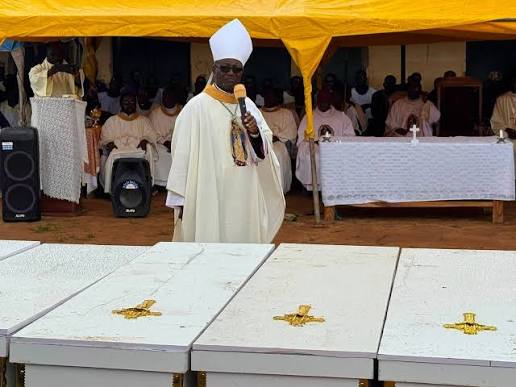
The Bishop of Kafanchan Diocese, Julius Yakubu Kundi, presided over the burial, which drew grieving families, clergy and community members. He said he asked for the coffins to be arranged side by side deliberately, to stand as evidence of a collective failure to protect the victims.
“They should not have died now,” Kundi said, addressing mourners at the ceremony.
Raphael Joshua, a resident who helped tend to the injured following the attack, said victims’ bodies were taken to a nearby hospital while burial arrangements were made. Derek Christopher, chairman of the civil society group Southern Kaduna Peace and Security Network, said the same community had been attacked around the same time last year.
Sule Shuaibu, Kaduna state’s commissioner for home affairs and internal security, said he had not been briefed on the attack. No group has claimed responsibility, and security agencies had not announced any arrests as of the latest reporting.
What Authorities Are Saying
Bishop Kundi told mourners the tragedy reflected a broader failure to safeguard vulnerable communities, singling out the grief of mothers who lost children in the attack as especially difficult to bear.
Nigerian President Bola Tinubu condemned the killings and directed security agencies to arrest those responsible. He extended condolences to the Kaduna state government and to victims’ families, describing the attack as heinous and unacceptable.
Why This Matters
The assault adds to a pattern of recurring violence in Nigeria’s northwest and north central regions, where armed groups commonly referred to as bandits carry out raids and kidnappings for ransom. Authorities have said many of these groups originated among herders who took up arms following disputes with farming communities over land and resources strained by population growth and climate pressures.
Christopher’s remark that the same village was attacked around the same time last year points to a recurring vulnerability that repeated condolences and arrest orders have so far failed to resolve. Authorities’ slow acknowledgment of the attack, reflected in the state security commissioner’s admission that he had not been briefed, echoes a broader pattern critics say has allowed violence to escalate in the region in recent years.
The attack also lands amid heightened international scrutiny of Nigeria’s security record. Over the past year, the United States has accused the Nigerian government of failing to protect Christian communities, a dispute that strained diplomatic relations and preceded a U.S. strike against suspected Islamic State fighters on Nigerian soil in December, carried out with the Nigerian government’s cooperation. Nigeria separately faces an ongoing insurgency from Boko Haram and its offshoot, the Islamic State West Africa Province, concentrated mainly in the northeast, distinct from the banditry driving attacks like the one in Naridon.
What Happens Next
Security agencies have not announced arrests, and it remains unclear whether investigators have identified those responsible for the attack. Tinubu’s directive to pursue the attackers will likely face scrutiny given the state’s acknowledged delay in responding to the incident.
Community advocates are likely to continue pressing for sustained security deployment in southern Kaduna, given the area’s history of repeated attacks in the same season in consecutive years. Whether the latest burial and presidential condemnation translate into concrete protective measures for the region remains to be seen.
Reporting drawn from Daily Post Nigeria, Vanguard Nigeria, ABC News and PBS News, citing the Associated Press, the Catholic Diocese of Kafanchan, the Southern Kaduna Peace and Security Network and Kaduna state officials.





