

At least 43 people were killed in a brutal attack by a rebel group in the eastern Democratic Republic of Congo, the army said Thursday, as violence against civilians continues to escalate in the region.
The assault took place Wednesday in the village of Bafwakoa in Ituri province, where attackers also burned dozens of homes. Army spokesperson Lt. Jules Tshikudi Ngongo said at least 44 houses were destroyed and warned that the death toll could rise as search operations continue.
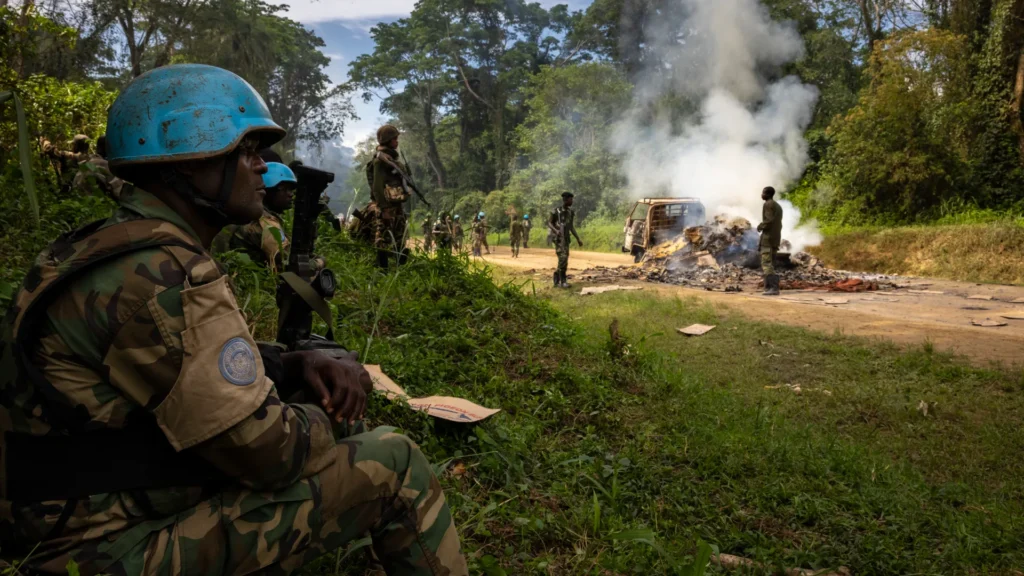
Authorities blamed the attack on the Allied Democratic Forces, a long-running armed group with ties to a global extremist network. The group has carried out repeated attacks in eastern Congo, often targeting civilians in remote communities.
Local officials described a scene of devastation. Some victims were killed with machetes, while others were trapped and burned inside their homes as buildings were set on fire. At least two people were abducted during the нападение, according to local leaders.
Baptiste Munyapandi, the territorial administrator of Mambasa, said search teams are still working in the area and that additional victims may be found. Community members reported that the attackers struck quickly and left before security forces could respond.
The Congolese army has struggled to contain the group, which operates in dense forest areas near the border with Uganda. Despite joint military operations launched in 2021 by Congolese and Ugandan forces, the rebels remain active and continue to carry out deadly raids.
Ngongo said the group typically avoids direct confrontations with the military and instead targets civilians. “They attack the population in a way that undermines peace efforts and serves as retaliation against communities,” he said.
Violence in eastern Congo has grown more complex as multiple armed groups compete for control of territory and resources. Among them is another major rebel movement that seized key cities in the region last year, further destabilizing the area.
Data from research organizations tracking violence shows the Allied Democratic Forces are responsible for a significant share of attacks on civilians in eastern Congo over recent years. The group originated in Uganda in the late 1990s and later aligned itself with an international extremist network.
Attacks by the group have intensified in recent months across Ituri and neighboring North Kivu province. Last year alone, dozens of civilians were killed in similar assaults, with many others abducted.
The ongoing violence has displaced thousands of people and deepened a humanitarian crisis in eastern Congo, where communities remain vulnerable despite continued military efforts to restore stability.
The latest attack highlights the persistent insecurity in eastern Congo, where armed groups exploit weak state control and difficult terrain to operate with relative freedom. Despite years of military campaigns, including cross-border cooperation, rebel groups have adapted their tactics to avoid direct battles and instead focus on soft targets.
Targeting civilians allows these groups to spread fear, disrupt local governance and undermine confidence in security forces. It also complicates efforts to stabilize the region, as communities are left exposed even when military operations are ongoing.
The continued presence of multiple armed factions further complicates the situation. Competition among groups not only fuels violence but also makes coordinated responses more difficult for government forces and international partners.
Unless there is sustained improvement in security coordination and governance, attacks like this are likely to continue, prolonging instability and humanitarian suffering in one of Africa’s most conflict-affected regions.
Reuters/CNN/Aljazeera





