

Israeli strikes slammed busy commercial and residential areas in central Beirut without warning Wednesday, killing at least 182 people just hours after a ceasefire was announced in the U.S.-Israeli war with Iran, making it the deadliest day in the latest Israel-Hezbollah conflict and exposing fundamental disagreements about whether the truce covers Lebanon.
U.S. President Donald Trump told PBS News Hour that Lebanon was not included in the ceasefire deal because of the Lebanese militant Hezbollah group. When questioned about Israel’s latest strikes, he characterized the violence as “a separate skirmish”—language minimizing the massive civilian death toll and suggesting American acquiescence to continued Israeli military operations despite the broader regional ceasefire.
Israel had declared the agreement does not extend to its war with the Iran-backed Hezbollah, although Iran and mediator Pakistan insisted it does—creating immediate confusion about the ceasefire’s scope and raising questions about whether the two-week pause announced just hours earlier had any meaningful effect on regional violence.
The fleeting sense of relief among Lebanese after the ceasefire announcement transformed into panic with what Israel’s military described as its largest coordinated strike in the current war, claiming it had hit more than 100 Hezbollah targets within 10 minutes in Beirut, southern Lebanon, and the eastern Bekaa Valley. The massive barrage suggested Israel was exploiting ambiguity about the ceasefire’s geographic scope to intensify operations against Hezbollah.
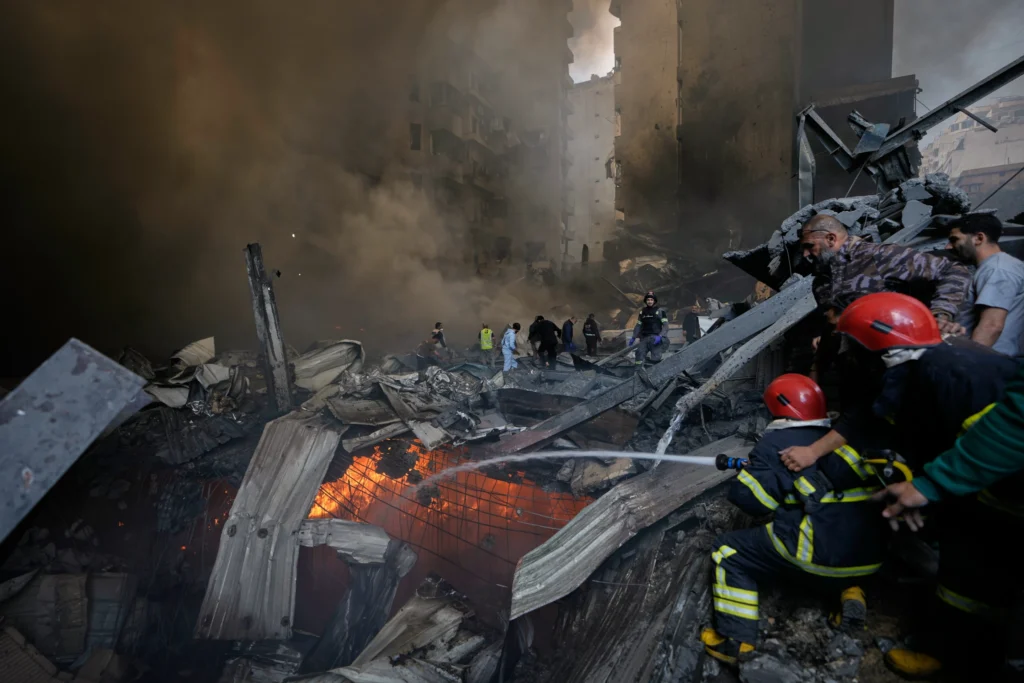
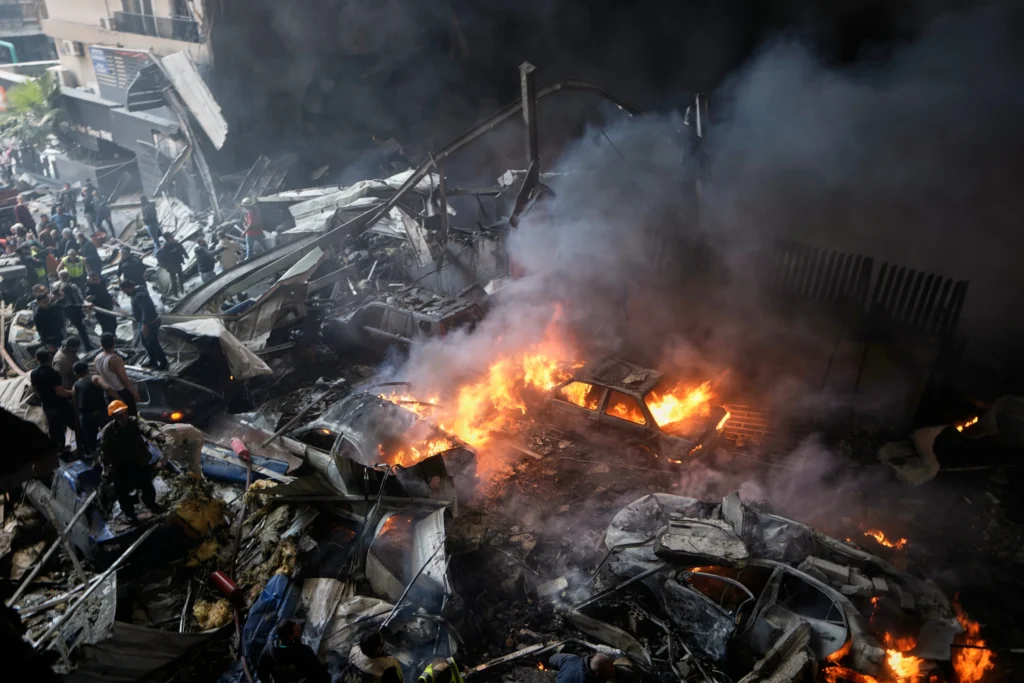
Black smoke towered over several parts of the seaside capital, where enormous numbers of people displaced by war have taken shelter after fleeing southern Lebanon and Beirut’s southern suburbs. Explosions interrupted the honking of traffic on what had been a bustling, blue-sky afternoon. Ambulances raced toward open flames. Apartment buildings were struck and collapsed, burying residents who had no warning to seek shelter.
Associated Press journalists witnessed charred bodies in vehicles and on the ground at one of Beirut’s busiest intersections in the central Corniche al Mazraa neighborhood, a mixed commercial and residential area where civilians had no reason to expect devastating bombardment during midday hours. Using forklifts, rescue workers removed smoldering debris and sifted through ruins searching for survivors trapped beneath collapsed structures.
There was no indication of Hezbollah launching strikes against Israel in the first several hours after the attacks—suggesting either the group was exercising restraint despite massive provocation or that Israeli strikes had successfully degraded its immediate retaliatory capabilities.
In response to the attacks on Lebanon, Iran later Wednesday announced it was again halting the movement of oil tankers in the Strait of Hormuz, the country’s state-run media confirmed. The closure of the vital waterway just hours after agreeing to reopen it under ceasefire terms demonstrated how fragile the truce remained and how quickly regional actors could weaponize energy supplies in response to perceived violations.
Central Beirut has been targeted previously, but not by so many strikes simultaneously and during the middle of the day when civilian casualties would be maximized. Israel had rarely struck central Beirut since the outbreak of the latest Israel-Hezbollah war on March 2 but has regularly pounded southern and eastern Lebanon and Beirut’s southern suburbs where Hezbollah maintains strongest presence.
Lebanon’s Minister of Social Affairs, Haneed Sayed, in an interview with The Associated Press condemned Israel’s wide-ranging strikes, characterizing them as a “very dangerous turning point” in a conflict already devastating Lebanese civilian infrastructure and displacing millions.
“These hits are now at the heart of Beirut … Half of the sheltered (internally displaced people) are in Beirut in this area,” she disclosed, adding that she had just driven past areas hit by Israeli missiles. The targeting of central Beirut where displaced populations concentrated represented either reckless disregard for civilian lives or deliberate strategy to inflict maximum casualties on vulnerable populations.
Sayed emphasized Lebanon’s government is ready to enter negotiations with Israel for an end to hostilities, an offer the Lebanese president previously extended. Israel has not responded to diplomatic overtures. “There are calls and efforts being made as we speak,” Sayed indicated, though the massive strikes suggested Israel was more interested in military solutions than negotiated settlements.
Prime Minister Nawaf Salam in a statement accused Israel of escalating at a moment when Lebanese officials were seeking to negotiate solutions, and of hitting civilian areas in “utter disregard for the principles of international law and international humanitarian law — principles it has, in any case, never respected.” The language reflected Lebanese officials’ frustration that Israel operates with apparent impunity regardless of civilian casualties or legal prohibitions.
Lebanese President Joseph Aoun characterized the Israeli attacks as “barbaric.” Lebanon’s health ministry disclosed that along with the 182 killed, at least 890 people sustained wounds in the strikes. Altogether, 1,739 people have perished and 5,873 have been wounded in Lebanon in just over five weeks since the war’s outbreak—casualty figures reflecting the catastrophic humanitarian toll of the conflict.
Israel’s military claimed it had targeted missile launchers, command centers, and intelligence infrastructure. It accused Hezbollah fighters of attempting to “blend into” non-Shiite Muslim areas beyond their traditional strongholds—an assertion that residents and local officials vehemently denied, insisting the buildings struck were civilian residences and commercial establishments.
“Look at these crimes,” declared Mohammed Balouza, a member of Beirut’s municipal council, at the scene of a strike in Corniche al Mazraa. An apartment building behind a popular shop selling nuts and dried fruit had been demolished. “This is a residential area. There is nothing (military) here.” The official’s on-scene assessment contradicted Israeli military claims about the targets’ military nature.
As smoke rose Wednesday, Israeli Defense Minister Israel Katz warned Hezbollah leader Naim Kassem that “his turn will come”—a direct assassination threat against the group’s top leadership. In 2024, Israel killed Hezbollah’s previous leader, Hassan Nasrallah, with an airstrike that also killed numerous civilians in the surrounding area.
Katz characterized Wednesday’s strikes as the largest blow against Hezbollah since the attack that caused pagers used by hundreds of its members to explode almost simultaneously in September 2024—an operation that killed civilians as well as Hezbollah operatives and raised questions about indiscriminate attacks violating laws of war.
Before the new strikes, a Hezbollah official told the AP that the group was providing opportunity for mediators to secure a ceasefire in Lebanon, “but we have not announced our adherence to the ceasefire since the Israelis are not adhering to it.” He spoke on condition of anonymity because he lacked authorization to comment publicly about sensitive diplomatic and military matters.
The Hezbollah official emphasized the group will not accept a return to the pre-March 2 status quo, when Israel carried out near-daily strikes in Lebanon despite a ceasefire being nominally in place since the last full-blown Israel-Hezbollah war ended in November 2024. “We will not accept for the Israelis to continue behaving as they did before this war with regards to attacks,” he stated, articulating demands that any future arrangement must prevent Israeli strikes rather than merely pausing them temporarily.
Hezbollah had fired missiles across the border days after the United States and Israel attacked Iran on February 28, sparking a regional war that has drawn multiple countries into expanding conflict. Israel responded with widespread bombardment of Lebanon and a ground invasion that has displaced over one million people.
The Israeli military chief of staff, Lieutenant General Eyal Zamir, declared the attacks are intended to protect Israel’s northern residents, who have experienced heavy fire from Hezbollah rockets and missiles. The Israeli military has claimed it has killed hundreds of Hezbollah fighters, though independent verification of militant versus civilian casualties remains impossible given Israeli control of information from strike zones.
More than one million people have been displaced throughout Lebanon—a staggering number in a nation of approximately six million total population. The displacement represents one of the largest humanitarian crises in the Middle East, with entire communities uprooted and crowded into temporary shelters lacking adequate sanitation, medical care, or security.
Early Wednesday, after the Iran ceasefire was announced and before Israel struck, many displaced people sleeping in tents on Beirut’s streets and in the coastal city of Sidon had begun packing belongings in preparation to return home. The brief optimism that the ceasefire might allow safe return to bombed-out communities proved tragically premature.
Families at sprawling displacement camps on Beirut’s waterfront later expressed confusion and despair as explosions shattered hopes for imminent return. “We can’t take this anymore, sleeping in a tent, not showering, the uncertainty,” lamented Fadi Zaydan, 35. He and his parents had prepared to head back to the southern city of Nabatieh. Instead, they decided to wait things out in Sidon, slightly closer to home but still displaced from their actual residences.
The deadliest day of strikes exposed fundamental contradictions in the ceasefire announced just hours earlier. If Iran and Pakistan—who mediated the agreement—believed it covered all parties including Hezbollah, while the United States and Israel insisted Lebanon was excluded, then the ceasefire represented diplomatic theater rather than genuine peace agreement.
Trump’s characterization of Lebanon as “a separate skirmish” minimized the massive death toll and suggested American indifference to Lebanese civilian casualties. The language implied that killing nearly 200 people in coordinated strikes on a major capital city constituted minor violence unworthy of serious diplomatic attention.
The timing of the strikes—coming immediately after ceasefire announcement—suggested either Israeli determination to exploit the ambiguity about geographic scope or deliberate effort to establish that the truce would not constrain its Lebanon operations regardless of what mediators claimed. Either interpretation indicated the ceasefire’s fragility and limited effectiveness.
For Lebanese civilians trapped between Israeli bombardment and Hezbollah’s resistance operations, the distinction about whether the ceasefire technically covers Lebanon provides no comfort as their homes are destroyed and family members killed. The diplomatic parsing of ceasefire terms becomes irrelevant when bombs are falling on residential neighborhoods during midday hours.
The international community’s muted response to the massive civilian casualties suggested that Lebanese lives commanded less diplomatic attention than the broader U.S.-Iran conflict. The ability of Israel to kill nearly 200 people just hours after a regional ceasefire without provoking strong international condemnation illustrated the selective application of humanitarian concerns based on geopolitical calculations.
As Lebanon’s health ministry continued tallying casualties and rescue workers searched rubble for survivors, the fundamental question remained whether any meaningful peace was possible in a region where ceasefires can be announced and violated within hours, where civilian casualties in the hundreds provoke minimal diplomatic consequences, and where competing interpretations of agreements allow parties to claim compliance while continuing devastation.
AP





