

A burst of gunfire inside the Mall of Louisiana Baton Rouge, Los Angeles, on Thursday left one person dead and five others wounded after a dispute between two groups turned violent in a crowded food court, authorities said.
Police in Baton Rouge described the incident as a targeted confrontation rather than a random act, though several bystanders were caught in the exchange. Officers detained five individuals in connection with the shooting, and officials said there was no ongoing threat to the public.
“This stemmed from a disagreement between two groups that escalated quickly,” Police Chief TJ Morse said during a briefing. “Unfortunately, innocent people were struck during the gunfire.”
State Attorney General Liz Murrill confirmed that some of those injured had no involvement in the dispute, underscoring the unpredictable nature of the violence.
The shooting began shortly after 1:30 p.m. in the mall’s food court area, a typically busy section filled with shoppers and workers. Authorities said an officer already stationed at the mall moved quickly toward the sound of gunfire, helping to contain the situation.
Emergency responders initially believed more individuals had been injured, but officials later revised the number to five wounded victims in addition to the person who died. Authorities have not released the identities of those involved, pending notification of their families.
Among those affected were three high school seniors from Ascension Episcopal School, local officials confirmed. Lafayette Parish President Monique Blanco Boulet expressed grief in a public statement, calling the violence “senseless” and urging the community to support the families impacted.
A spokesperson for the school declined to provide further details, citing respect for those involved.
Witnesses described scenes of confusion and fear as gunshots echoed through the mall. Alex Theriot, who was working nearby on a construction project, said he heard loud noises resembling breaking glass before realizing it was gunfire. He and two colleagues quickly secured themselves inside a workspace, bracing for what they feared could be a broader attack.
“People were running and screaming,” Theriot said in remarks shared with The Associated Press. “At first, I thought it might be something even bigger.”
Desire Batton, an employee at a clothing store, said she and others rushed into a break room and remained there until officers escorted them to safety.
“We stayed hidden until police came,” she said.
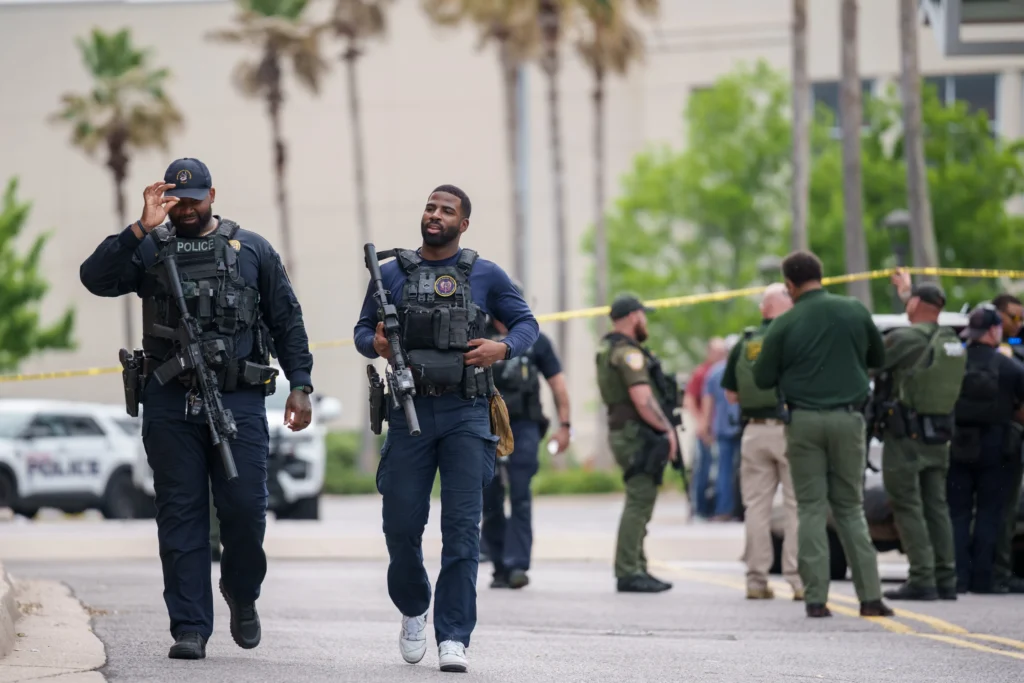
Outside, the response was swift and visible. Dozens of police vehicles filled the parking lot, helicopters circled overhead, and officers in protective gear secured the area well into the afternoon. The mall remained closed for the rest of the day, with management calling the incident deeply unsettling for everyone present.
Shoppers also recounted the chaos. Kennedy Barnum, who had arrived at the food court shortly before the shooting, said she heard someone warn of an active threat moments before law enforcement flooded the scene.
“Within minutes, everything changed,” she said, describing people running in panic and others visibly shaken.
Authorities are continuing to piece together what triggered the confrontation, urging anyone with video or information to come forward as investigators work to establish a clearer timeline.
The shooting at the Mall of Louisiana highlights ongoing concerns about public safety in high-traffic spaces, particularly as disputes escalate rapidly in crowded environments. While officials emphasized that the violence was not random, the involvement of bystanders underscores how quickly targeted conflicts can endanger the broader public.
Incidents like this reflect a wider pattern seen across the United States, where disagreements—sometimes involving young people—can escalate into deadly encounters when firearms are involved. The fact that multiple suspects were taken into custody suggests the possibility of coordinated or group-related conflict, though authorities have yet to detail the exact nature of the dispute.
The presence of law enforcement at the mall at the time of the shooting likely played a role in limiting further casualties. Rapid response in such situations is often critical, as delays can lead to higher numbers of victims. Still, the incident raises questions about prevention, including how conflicts develop and whether warning signs can be identified earlier.
Community impact is another key dimension. The involvement of high school students among the victims has already reverberated beyond Baton Rouge, affecting families, schools, and neighboring communities. Such events often leave lasting psychological effects, particularly for young people who experience or witness violence in everyday settings.
The shooting also comes amid a broader week of violence in Louisiana, intensifying concerns among residents and officials about public safety. When multiple high-profile incidents occur in close succession, they can shape public perception and increase pressure on leaders to address underlying causes.
Experts often point to a combination of factors driving such incidents, including access to firearms, unresolved conflicts, and social tensions. Addressing these issues requires not only law enforcement action but also community-based approaches focused on prevention and intervention.
As investigators continue their work, the focus will likely remain on accountability and understanding the sequence of events that led to the shooting. The findings could influence future safety measures at large public venues, including increased security presence, surveillance, and protocols for responding to conflicts.
For now, the Mall of Louisiana shooting stands as a stark reminder of how quickly violence can erupt in everyday spaces, turning routine activities into moments of crisis and leaving communities grappling with the aftermath.
AP





