

Former Botswana president Festus Mogae has died at the age of 86 following a short illness, government officials announced Thursday, marking the passing of a leader widely credited with strengthening economic stability and democratic governance in the southern African nation.
Festus Mogae served as Botswana’s third president from 1998 to 2008, a decade during which the country reinforced its reputation as one of Africa’s most stable democracies. Authorities declared three days of national mourning, while President Duma Boko paid tribute to him as a dedicated public servant and patriot.
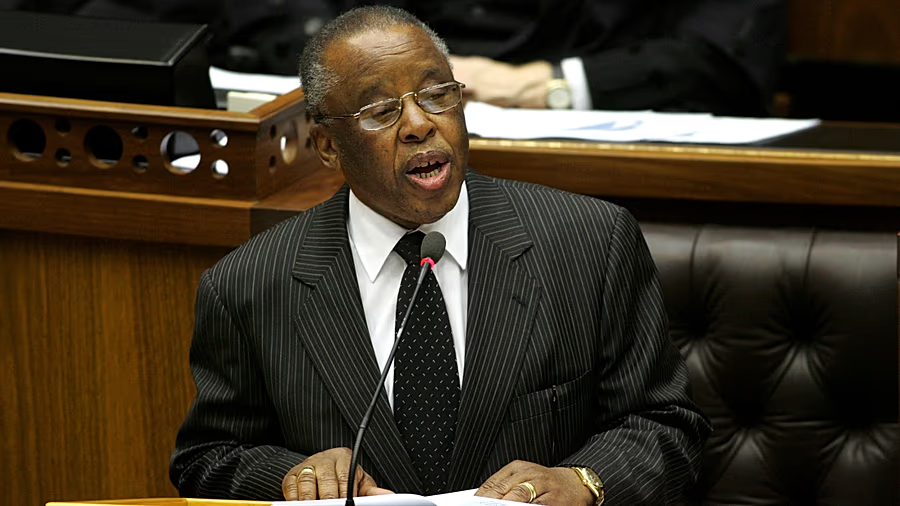
Born on Aug. 21, 1939, in Serowe, Festus Mogae pursued studies in economics in the United Kingdom before entering public service shortly after Botswana gained independence in 1966. He joined the Ministry of Finance and Development Planning in 1968 and steadily rose through senior roles, including central bank governor, finance minister and vice president.
He assumed the presidency on April 1, 1998, succeeding Quett Masire in a peaceful transfer of power that underscored Botswana’s democratic traditions. After completing the constitutionally mandated two terms, he handed leadership to his vice president, Ian Khama, in 2008.
During his tenure, Botswana continued to experience sustained economic expansion, driven largely by diamond revenues and prudent fiscal management. The country, once among the world’s poorest at independence, saw significant improvements in infrastructure, public services and financial stability under his leadership.
Beyond economic policy, Festus Mogae gained international recognition for confronting the HIV crisis at a time when Botswana faced one of the highest infection rates globally. His administration introduced one of Africa’s most comprehensive national responses, including expanded access to treatment and public awareness campaigns.
In recognition of his leadership, he was awarded the Mo Ibrahim Prize for Achievement in African Leadership in 2008, honoring his commitment to governance, transparency and economic progress during a period of significant public health challenges.
After leaving office, Festus Mogae remained active in international diplomacy. He played a key role in efforts to stabilize South Sudan, serving as chairperson of the Joint Monitoring and Evaluation Commission from 2015 to 2018. In that role, he oversaw the implementation of a peace agreement aimed at ending conflict in the young nation, though the deal later faced setbacks, as noted by Radiotamazuj.
Botswana’s government confirmed his death and highlighted his long record of public service. Duma Boko described him as a statesman whose contributions helped shape the country’s modern identity.
According to Reuters, Festus Mogae earned widespread respect for his stewardship of Botswana’s economy and his direct approach to tackling the HIV crisis, which brought global attention to the country’s public health efforts.
He is survived by his wife and three daughters.
The death of Festus Mogae marks the end of an era for Botswana, a country often cited as a model of political stability and economic management in Africa. His presidency came at a critical time when Botswana needed to transition from early post-independence growth into a more mature and diversified economy.
Mogae’s economic policies reflected a cautious but effective approach. By maintaining fiscal discipline and leveraging diamond revenues responsibly, his administration avoided many of the economic pitfalls that have affected other resource-rich nations. His tenure reinforced Botswana’s reputation for transparency and low corruption, factors that continue to attract investment.
Equally significant was his response to the HIV crisis. At a time when stigma and denial hindered action in many countries, Mogae’s government openly addressed the epidemic and prioritized treatment. This approach not only saved lives but also helped stabilize the workforce and economy, demonstrating how public health policy can directly influence national development.
His involvement in South Sudan’s peace process highlights another dimension of his legacy. Although the agreement he helped oversee did not fully succeed, his role reflected a broader trend of African leaders contributing to conflict resolution efforts across the continent. It also underscored the challenges of sustaining peace in regions with deep political divisions.
Botswana’s continued stability after his departure suggests that the institutions strengthened during his presidency have endured. Peaceful transfers of power and adherence to constitutional limits remain key features of the country’s political system, setting it apart in a region where such transitions are not always guaranteed.
Looking ahead, Mogae’s legacy may serve as a benchmark for leadership in resource management, public health response and democratic governance. His tenure illustrates how consistent policy, institutional integrity and long-term planning can produce lasting national benefits.
At a broader level, his death invites reflection on leadership transitions across Africa. As a generation of post-independence leaders and their successors pass from the scene, questions about continuity, reform and governance remain central to the continent’s future.
Reuters/Radioatamazuj





