

Vladimir Putin stood before a scaled-back parade on Red Square Saturday and declared victory inevitable in Ukraine. Then he walked inside the Kremlin and told reporters the war was almost over.
“I think that the matter is coming to an end,” Putin said.
It was the most optimistic public statement the Russian president has made about ending a conflict that has ground on for more than four years, killed hundreds of thousands of people, and consumed a war he once expected to finish in weeks. Whether it reflected genuine confidence, diplomatic positioning ahead of U.S.-brokered talks, or simply the mood of a man who had just watched North Korean soldiers march across his nation’s most sacred military ground — nobody outside the Kremlin could say for certain.
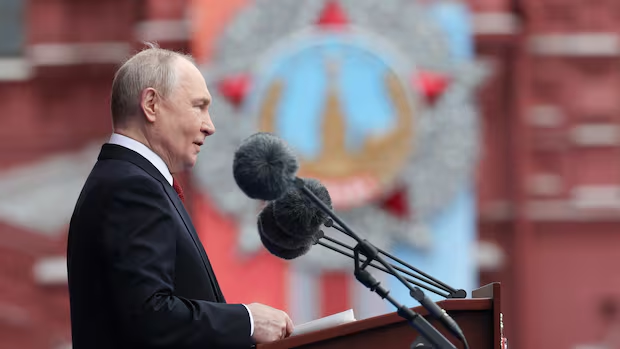
What was clear is that something has shifted. Russia and Ukraine are observing a three-day ceasefire that began Saturday, the first agreed pause in fighting that both governments have publicly confirmed. A prisoner exchange of 1,000 people from each side is underway. And the man who ordered the invasion of Ukraine in February 2022 is now saying, in public, that he thinks it is ending.
A Parade Without the Hardware
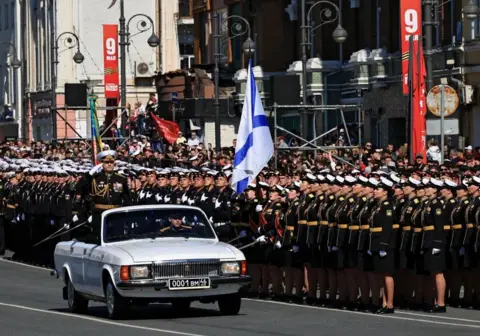
The Victory Day ceremony that preceded Putin’s remarks was itself a statement — though not the triumphant one Moscow usually projects. The annual May 9 parade commemorating the Soviet Union’s defeat of Nazi Germany in World War II, which normally fills Red Square with intercontinental ballistic missiles, tanks, armored vehicles, and a carefully choreographed display of Russian military power, was stripped to its minimum this year.
No tanks rolled across the cobblestones. No missile systems rumbled past the Kremlin walls. Instead, giant screens opposite the Kremlin showed video footage of Russian military hardware in action. A column of North Korean soldiers — troops from one of Moscow’s closest partners who have fought alongside Russian forces in Ukraine — marched across the square. The ceremony lasted 45 minutes, roughly half the length of previous years.
Foreign leaders in attendance came from Belarus, Kazakhstan, Uzbekistan, Laos, and Malaysia. The usual gathering of senior global figures was absent.
Russian authorities blamed security concerns and the “current operational situation” for the format changes. Kremlin spokesman Dmitry Peskov confirmed that additional security measures had been implemented. Internet services across Moscow were switched off during the ceremony. Security forces blanketed the capital. Officials openly acknowledged the measures were designed to protect Putin — an admission that would have been unthinkable in the early months of the war when the Kremlin was projecting total confidence.
Ukrainian President Volodymyr Zelensky had said earlier in the week that Russian authorities feared Ukrainian drones might appear over Red Square on May 9. He followed Trump’s ceasefire announcement by issuing a decree — delivered with undisguised mockery — temporarily designating Red Square off-limits for Ukrainian strikes so Russia could hold its celebration. Russian authorities had previously warned that any Ukrainian attempt to disrupt the parade would trigger a massive missile strike on central Kyiv.
Neither side reported ceasefire violations on Saturday.
The Ceasefire and the Prisoners
The three-day pause in fighting was announced Friday by President Donald Trump on social media, who declared it could be the “beginning of the end” of the war. Both Russia and Ukraine subsequently confirmed their participation — a notable moment of bilateral agreement in a conflict where the two sides have struggled to agree on anything.
The ceasefire runs from Saturday through Monday and includes a suspension of all active military operations. The prisoner exchange — 1,000 people from each country — represents one of the largest such swaps of the conflict.
Trump did not conceal his frustration with the war’s duration. “I’d like to see it stop. Russia-Ukraine — it’s the worst thing since World War Two in terms of life. Twenty-five thousand young soldiers every month. It’s crazy,” he told reporters in Washington. He added that he wanted to see a significant extension of the ceasefire beyond Monday.
The Kremlin had said the previous week that peace talks brokered by the Trump administration were on pause. Prior to Saturday, both sides had declared separate unilateral ceasefires in recent days and then accused each other of violating them. The jointly confirmed three-day pause is a different category of agreement — not larger in scope, but meaningfully different in that both governments are publicly accountable for holding it.
Who Putin Wants to Talk To
Putin’s post-parade remarks covered more than his sense that the war was winding down. He also addressed the question of European engagement, at a moment when European Union leaders were preparing for what the Financial Times described as potential talks with Moscow.
Asked whether he was open to negotiating with European governments, Putin named his preferred interlocutor: former German Chancellor Gerhard Schroeder.
“For me personally, the former Chancellor of the Federal Republic of Germany, Mr. Schroeder, is preferable,” Putin said.
Schroeder, who governed Germany from 1998 to 2005, has maintained unusually warm ties with Putin compared to virtually every other Western political figure. He sat on the board of Russian state energy company Rosneft and remained publicly resistant to cutting ties with Moscow even after the 2022 invasion. His selection as Putin’s preferred negotiating partner sends a clear signal about what kind of European interlocutor Russia is actually prepared to deal with — one whose relationship with Moscow predates the war and who has not spent the intervening years calling for Russia’s defeat.
European Council President Antonio Costa said last week he believed there was potential for the EU to negotiate with Russia on the future security architecture of Europe. European leaders as a group have taken a harder line, characterizing Putin as a war criminal whose victory would eventually threaten NATO members. Russia dismisses those assessments.
Asked about a potential meeting with Zelensky, Putin said direct talks were only possible after a lasting peace agreement had been reached — a condition that, in practice, means no meeting is imminent.
What Four Years of War Has Produced
Putin’s remark that the war is coming to an end arrives against a military reality that complicates any simple reading of the statement. Russian forces control just under one-fifth of Ukrainian territory. They have made slow and costly gains along a front line stretching nearly 1,000 kilometers but have been unable to capture the full Donbas region — the stated core objective of the invasion’s current phase. Ukrainian forces have held a line of fortified cities in the east against sustained pressure.
Ukraine has simultaneously developed long-range strike capabilities that did not exist before 2022. Its drones can now reach targets more than 1,000 kilometers inside Russia, striking energy facilities, ammunition depots, and manufacturing plants in ways that impose real costs on the Russian war economy. Russia has responded with sustained missile and drone campaigns against Ukrainian cities and infrastructure.
The war has lasted longer than the Soviet Union’s entire involvement in World War II. It has killed hundreds of thousands of soldiers on both sides. It has left large sections of Ukraine in ruins, displaced millions of civilians, and cost Russia’s $3 trillion economy a toll that economists are still measuring. Russia’s relationships with Europe are at their lowest point since the Cold War.
Putin framed all of it Saturday the way he always has — as a defensive response to Western aggression, an extension of the Soviet struggle against fascism, a fight against a NATO bloc that broke its promises about eastward expansion after the Berlin Wall fell. “Victory has always been and will always be ours,” he told the crowd on Red Square, invoking the language of the Soviet triumph to describe a war that is very much unresolved.
What Putin’s Words Mean — and Don’t Mean
When a leader who has vowed to fight until all his war aims are achieved stands up and says the matter is coming to an end, the instinct is to ask what changed. The honest answer is: it is not entirely clear.
Putin may be signaling genuine exhaustion with the conflict’s costs and a readiness to accept a negotiated outcome short of total victory. Russia’s military advances have slowed this year. The economic drain is real. The casualty numbers — Trump’s figure of 25,000 soldiers lost monthly is consistent with independent assessments — are a generational wound on Russian society that does not appear in official state media but is felt in every region of the country.
He may also be managing expectations ahead of U.S.-brokered talks, signaling enough flexibility to keep Washington engaged without committing to the specific concessions that any real peace agreement would require. Trump has made ending the Ukraine war a personal priority and has leveraged economic and diplomatic pressure on both Moscow and Kyiv. Putin has an interest in keeping that American engagement alive without giving up the territorial gains Russia has made.
Or he may simply be reading the room on Victory Day — a holiday built around the narrative of Russian perseverance and ultimate triumph — and choosing words that fit the moment without binding him to anything specific.
What the three-day ceasefire demonstrates, whatever its ultimate durability, is that both sides retain the capacity to de-escalate when external pressure and internal calculation align. That is not nothing. Whether it is the beginning of the end, as Trump suggested, or a pause before the next escalation, as the war’s history would more readily predict, depends on negotiations that have not yet begun in earnest.
Putin said the matter is coming to an end. He has been wrong about this war before.
IrishTimes/Reuters





