

A federal court in Texas has handed down lengthy prison terms to eight people convicted in a shooting tied to a demonstration outside an immigration detention facility, a case that is now drawing nationwide scrutiny over protest rights and terrorism laws.
A former U.S. Marine reservist and seven others were sentenced to decades behind bars after a July Fourth incident at the Prairieland Detention Center near Dallas left a police officer wounded. Federal prosecutors characterized the episode as a coordinated act of terrorism, while defense attorneys and family members challenged that portrayal and the severity of the punishments.
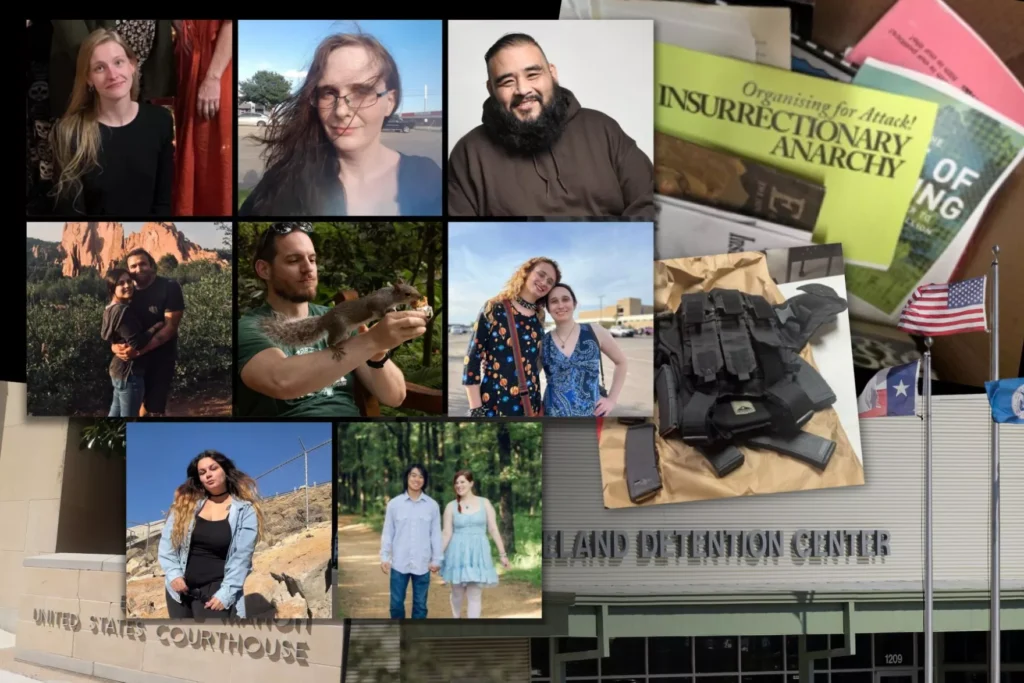
Benjamin Song received a 100 year sentence, the harshest penalty imposed, after being found guilty of opening fire during the gathering. The remaining defendants were sentenced to terms ranging from 30 to 70 years following convictions that included terrorism related charges, conspiracy, and weapons offenses. The case was reported by the Associated Press and further detailed by KERA News.
Authorities said the demonstration escalated when gunfire broke out as law enforcement arrived at the scene. Prosecutors told jurors that the group came prepared with firearms, protective gear, and supplies, arguing this reflected premeditated intent. Defense teams countered that participants had gathered for a protest and did not plan violence, maintaining that some individuals brought weapons for personal safety.
U.S. District Judge Reed O’Connor described the incident as a direct threat to democratic order, saying the court must send a strong message to deter similar actions. Acting Attorney General Todd Blanche echoed that position, stating that those who target law enforcement and federal facilities would face firm consequences.
Family members of the defendants expressed outrage after the sentencing, arguing that the punishment did not match the circumstances. Lydia Koza, whose spouse Autumn Hill was sentenced to 50 years, said the government had imposed life altering penalties despite the absence of fatalities. Defense attorneys also indicated plans to appeal, challenging both the legal framework and the interpretation of events.
Investigators said the shooting occurred during a late night demonstration that had initially been planned as a show of support for detainees. Prosecutors alleged that Song encouraged others to arm themselves before firing at an officer, while the defense argued the situation spiraled unexpectedly. Several defendants maintained they had no role in planning or executing violence, with one convicted only of concealing documents.
The case has gained broader attention because it marks one of the first major prosecutions linked to individuals described by authorities as affiliated with antifa following an executive order by President Donald Trump designating it a domestic terrorist organization. Officials acknowledged that antifa is not a centralized group but rather a loose network of activists with shared ideology.
What we know so far is that one officer was injured, eight individuals have now received lengthy sentences, and additional defendants who pleaded guilty in related charges are awaiting sentencing. Authorities said more than 20 people have been accused in connection with the incident across state and federal courts.
Officials have emphasized that the sentences reflect the seriousness of violence against law enforcement. The FBI and Justice Department stated that dismantling networks involved in such actions remains a priority. Defense teams, however, continue to argue that the case stretches terrorism statutes into areas that could affect constitutionally protected demonstrations.
The significance of this case extends beyond the courtroom. Legal experts note it could influence how protest related violence is prosecuted nationwide, particularly in politically charged environments. The use of terrorism related charges in a domestic protest context has raised questions about the balance between public safety and civil liberties.
From an economic and policy perspective, the ruling may shape federal funding priorities for law enforcement and domestic security efforts. Increased focus on internal threats could redirect resources toward surveillance, intelligence gathering, and policing strategies aimed at protest activity. This could also affect local economies, particularly in cities where demonstrations have become frequent, as businesses weigh the risks associated with unrest.
The broader competitive landscape in law enforcement policy shows a shift toward more aggressive prosecution strategies compared with earlier approaches that treated protest related incidents primarily as public order offenses. Analysts say this reflects a changing national security posture that increasingly views domestic unrest through a counterterrorism lens.
Looking ahead, appeals are expected to test the legal boundaries of the convictions and sentencing. Additional defendants tied to the case are still awaiting their day in court, and similar prosecutions in other states suggest this approach could expand. Observers say the outcome of appeals and future cases will determine whether this becomes a lasting legal precedent or a contested chapter in the evolution of protest law in the United States.
Keranews/AP





