

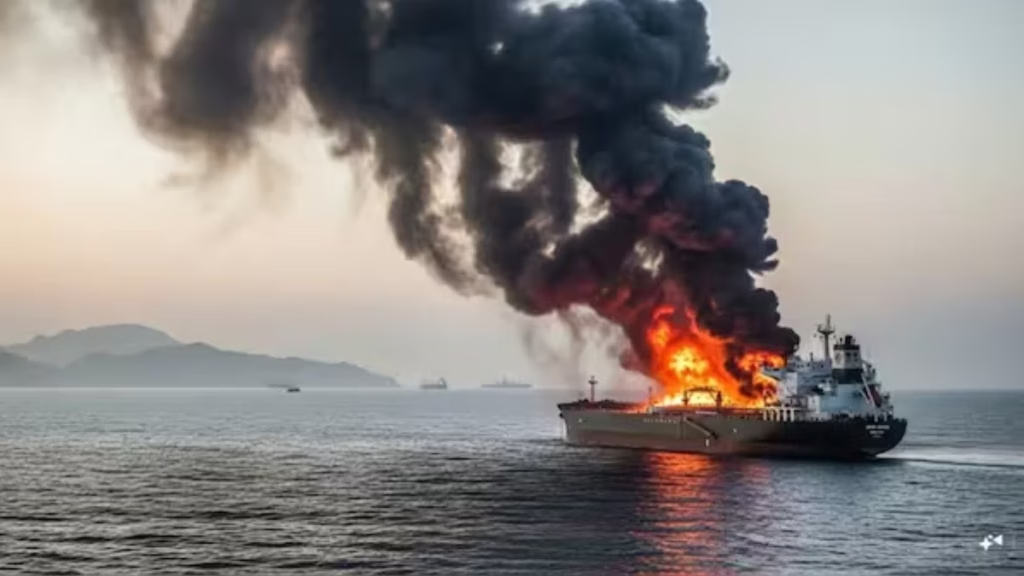
Yemen’s Iran-backed Houthi movement struck two Saudi Arabian oil tankers in the Red Sea on Thursday, setting one vessel ablaze and threatening to open a devastating new front in a war that has already shuttered the Strait of Hormuz, killed thousands, and sent fuel prices surging across the global economy, as the United States launched its 12th consecutive night of strikes against Iran with no diplomatic resolution in sight.
The tanker attacks came days after the Houthis declared a naval blockade of Saudi Arabia, a move that current and former U.S. officials warned could significantly widen the conflict and place fresh strain on an American military already stretched across multiple theaters of operation.
What We Know So Far
The Houthis confirmed in a statement carried by their SABA news agency that they had struck two tankers identified as the Encelia and the Layla in the Red Sea using ballistic and cruise missiles and drones, saying the vessels had violated their declared naval blockade on Saudi-linked shipping through the Bab el-Mandeb Strait.
Saudi state media confirmed an attack caused a fire at the bow of the Encelia while it sailed overnight in the Red Sea, with the Saudi Press Agency reporting all crew members were safe. Saudi state media did not mention the Layla separately.
The United Kingdom Maritime Trade Operations center confirmed receiving a report of a tanker struck by an unknown projectile approximately 70 nautical miles southwest of Al Shuqaiq, Saudi Arabia, with no casualties reported. British maritime risk management group Vanguard separately confirmed the Encelia had transmitted a distress call via VHF radio after being struck by a missile at the outer port limits of Saudi Arabia’s Jizan in the Red Sea, the Guardian confirmed.
The Houthis separately claimed they had forced approximately ten ships to retreat and return to port. Five tankers had changed course in the Red Sea to avoid the Bab el-Mandeb Strait on Wednesday, and three tankers loaded with Saudi oil bound for China and India made U-turns on Tuesday, ship-tracking data confirmed, the Associated Press noted.
The Bab el-Mandeb Strait, at the southern tip of the Arabian Peninsula, carries roughly 12 percent of the world’s trade including a quarter of global container traffic flowing between Europe and Asia via Egypt’s Suez Canal, the Associated Press confirmed. Its disruption, combined with the ongoing closure of the Strait of Hormuz, would represent an unprecedented simultaneous blockage of the two most critical maritime chokepoints in the global energy supply chain.
Brent crude oil jumped more than three percent on Wednesday, moving back above $95 a barrel, the Guardian confirmed.
The U.S. military’s 12th consecutive night of strikes lasted five hours and targeted Iranian military sites including maritime capabilities, missile and drone storage facilities, coastal surveillance sites, and air defense assets, U.S. Central Command confirmed. Iranian state television reported two people were killed and 11 wounded in what a Khuzestan provincial official described as a U.S. missile strike on the Shalamcheh border crossing with Iraq. Iranian media also reported two U.S. attacks on a military target in Bushehr, near Iran’s only operating commercial nuclear reactor, marking three strikes on that location in two days.
Defense Secretary Pete Hegseth told a Senate hearing Tuesday that the United States had spent $37.5 billion on the war so far. Trump traveled to Dover Air Force Base on Wednesday for the arrival of the remains of four U.S. service members killed in recent Iranian attacks on military bases. A total of 18 American service members have died and more than 450 have been wounded since the war began, the Guardian confirmed. Iran’s health ministry separately said 53 civilians had been killed and 592 wounded in U.S. strikes since late last month.
What Authorities Are Saying
Trump issued his most explicit threat yet regarding civilian infrastructure in Iran, warning Wednesday on social media that U.S. forces would destroy one bridge or power plant for every Iranian attack on a ship in the Strait of Hormuz.
“From this point forward, any time the Islamic Republic of Iran shoots at a ship in the Strait of Hormuz, whether it be by missile, rocket, drone, or any other device or weapon, the United States will bomb and destroy one bridge or power plant,” Trump wrote, the Associated Press confirmed. International law generally prohibits attacks on civilian infrastructure unless it is being used for direct military purposes.
Iran’s Foreign Minister Seyed Abbas Araghchi responded by announcing Tehran would adopt an eye-for-an-eye defense doctrine. “Any aggression against Iran, including our infrastructure, will compel a powerful and decisive response,” Araghchi posted on X.
Iran’s parliament speaker Mohammad Bagher Qalibaf, who has led Iran’s side of the negotiations, dismissed the prospect of returning the strait to its prewar status. “We have repeatedly said that the situation of the strait will not return to prewar conditions,” he wrote on social media.
U.S. Central Command said its strikes were designed to “further degrade Iran’s ability to threaten civilian mariners and commercial vessels transiting regional waters.”
U.S. Secretary of State Marco Rubio, speaking at a regional summit in the Philippines, said the United States remained open to negotiations with Iran but that Tehran did not currently appear serious about that path. “Right now they don’t seem to be serious about that, so instead the focus is on protecting shipping,” Rubio said.
An Arab diplomat, speaking on condition of anonymity given the sensitivity of the situation, told the Associated Press that Gulf states were increasingly pessimistic about finding a way off the current escalatory path and described the prospects for improvement as currently bleak.
Iran’s Interior Ministry spokesperson Ali Zeinivand said diplomacy had not been abandoned and that messages were still being exchanged, without providing details. Iranian Interior Minister Eskandar Momeni held meetings in Pakistan in recent days in an effort to revive mediation, though what new arrangement might be achievable remained unclear.
Why This Matters
The Houthi tanker attacks represent a qualitative expansion of the conflict that American military planners have been watching with considerable alarm since the Houthis declared their Saudi blockade earlier this week.
Michael Mulroy, a former deputy assistant secretary of defense for the Middle East during Trump’s first term, framed the concern directly. “The Houthis have proven many times in the past that they have the ability and willingness to obstruct maritime traffic in the Red Sea and the Bab el-Mandeb strait,” Mulroy told Reuters. That track record, established through years of attacks on commercial shipping during the Gaza war and its aftermath, gives weight to the current blockade declaration in a way that similar threats from less capable actors would not.
The strategic geometry of the situation is alarming. The Strait of Hormuz at the northern end of the Arabian Peninsula, through which a fifth of the world’s traded oil and gas passed before the war, is already largely closed. The Bab el-Mandeb Strait at the southern end, through which 12 percent of global trade flows, is now under active Houthi attack. If both chokepoints are effectively blocked simultaneously for a sustained period, the rerouting costs, insurance premiums, and supply disruptions imposed on the global economy would dwarf anything seen so far in the conflict.
Saudi Arabia’s direct involvement as a target of the Houthi blockade also raises the stakes enormously. The kingdom is the world’s largest oil exporter, and any sustained interruption to its Red Sea oil exports at a moment when the Strait of Hormuz is already closed would remove two of the primary sources of supply that global markets have been hoping would eventually restore price stability.
The Houthis have demonstrated over years of conflict that they are exceptionally difficult to suppress through airpower alone. Neither the Saudi-led coalition’s years of bombing nor more recent American campaigns have ended their capacity to threaten maritime traffic, Reuters noted. Their leader, the highly secretive Abdul Malik al-Houthi, has built a force of tens of thousands from what began as mountain fighters, and the group has repeatedly absorbed military pressure while maintaining operational capability.
Iran’s adoption of an eye-for-an-eye doctrine in response to American strikes on its infrastructure, combined with Trump’s announced intention to destroy Iranian bridges and power plants in retaliation for Hormuz attacks, creates a declared escalation ladder with no evident upper limit and no off-ramp that either side has publicly identified.
What Happens Next
With diplomatic efforts showing no meaningful progress and both sides announcing increasingly maximalist positions, the immediate trajectory of the conflict points toward further escalation rather than negotiation.
The Houthi blockade of Saudi shipping will be tested in the coming days as vessel operators weigh the risk of transiting the Bab el-Mandeb against the costs of rerouting around Africa. Each additional tanker that turns back or is struck will deepen the economic pressure on global supply chains and intensify calls for a military response that could draw additional regional actors into the conflict.
Trump’s stated intention to target an under-construction Iranian nuclear facility buried under a mountain, signaled earlier this week, remains an announced possibility that has not yet been acted upon. Any strike on Iranian nuclear infrastructure would fundamentally change the character of the war and would almost certainly produce a response from Tehran that goes beyond anything seen so far.
Pakistan and Turkey continue to pursue diplomatic channels alongside Gulf states, but the Arab diplomat’s assessment that chances for improvement currently appear bleak captures the prevailing mood among the regional actors who have been most active in seeking a negotiated exit.
The 12th consecutive night of American strikes confirms that Washington has not yet identified a military threshold at which Iranian compliance becomes more attractive than continued resistance. Whether the 13th night, or the 20th, produces a different calculation in Tehran remains the central and unanswered question of a war now approaching its fifth month.
Sources: The Guardian; Reuters; The Associated Press





