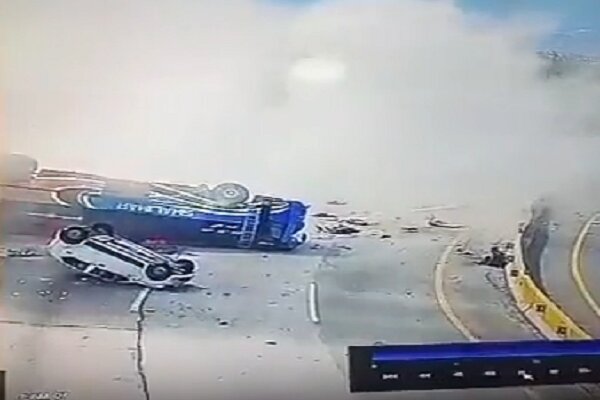
A passenger bus crashed into a truck carrying liquefied petroleum gas on a coastal highway in southwestern Pakistan on Thursday, setting off a fire that engulfed both vehicles and killed at least 10 people, including three children, police said.
The collision occurred on the Makran coastal highway in Balochistan province, senior police officer Muhammad Aslam Bangulzai told The Associated Press. Several people were injured, some critically, he said.
Arab News said 27 people were hurt, including women and children, and were taken to a Pakistan Navy hospital in the coastal town of Ormara. Their conditions were not immediately known.
Toll rose as bodies were recovered
The bus was traveling from Turbat to Karachi when it struck the LPG tanker near Taji Kor, about 60 kilometers (37 miles) from Ormara, police said, as cited by Arab News. The route, known as the N-10, links Karachi with the port city of Gwadar near the Iranian border.
Bangulzai, superintendent of the Coastal Highway Police, initially told Arab News that seven people had died, five passengers and two drivers of the gas tanker. He later said rescuers had pulled three more bodies from the bus wreckage, bringing the toll to 10.
He warned the number could climb as rescue workers continued to search the burned-out vehicle.
Overtaking blamed
Bangulzai attributed the crash to reckless driving. “The accident occurred due to a speedy overtaking attempt by the bus driver,” he said.
The impact set both vehicles ablaze, leaving the bus completely gutted, Arab News said. Footage reviewed by the newspaper showed thick columns of smoke rising from the burning bus and tanker.
An investigation was underway, the AP said.
A dangerous road record
Fatal traffic accidents are frequent in Pakistan, often blamed on poor road infrastructure and disregard for traffic laws. In August 2022, a passenger bus collided with a fuel truck in eastern Pakistan, killing 20 people, the AP said.
Balochistan, Pakistan’s largest but least developed province, has been the scene of several deadly crashes in recent years. In July, at least 40 people were killed and eight injured when an overcrowded bus plunged into a ravine in a mountainous district of the province. In October 2025, a collision involving passenger vehicles on the N-25 highway killed 12 people and injured dozens, Arab News said.
Hazardous cargo on vulnerable highways
Thursday’s crash illustrates how quickly a road collision can become a mass-casualty event when hazardous cargo is involved. LPG tankers carry pressurized, highly flammable gas, and a forceful impact can trigger fires that spread before passengers have time to escape. The fact that the bus was completely gutted suggests many on board had little chance to get out.
The police account points to driver behavior. Unsafe overtaking at high speed on two-lane highways is a recurring factor in Pakistan’s road fatalities, particularly on long-distance routes where buses compete on schedules. If confirmed, the cause would add to calls for stricter enforcement of speed and overtaking rules, as well as tighter oversight of intercity bus operators.
Infrastructure is the other part of the problem. The coastal highway spans long, sparsely populated stretches where emergency services and trauma care are limited. That the injured had to be taken to a navy hospital in Ormara reflects the scarcity of medical facilities along the route, which can delay treatment for severe burns and injuries.
The N-10 also carries growing commercial traffic tied to the port of Gwadar, increasing the mix of heavy trucks, fuel tankers and passenger buses on the same road. Separating hazardous cargo from passenger traffic, improving lane markings and adding overtaking zones are among measures that road safety advocates often recommend for such corridors.
With the July bus disaster that killed 40 still fresh, the latest crash is likely to intensify pressure on provincial and federal authorities to treat Balochistan’s highways, vital links for remote communities, as a public safety priority.
Sources: The Associated Press (AP); Arab News