

A powerful earthquake that struck southwestern Japan has killed at least 13 people and left dozens injured as emergency crews continue searching for survivors trapped beneath collapsed buildings.
The magnitude 7.1 earthquake struck Tuesday afternoon in Kumamoto Prefecture on Japan’s southern island of Kyushu. The shallow quake caused widespread structural damage, disrupted transportation and triggered a brief tsunami advisory that was later lifted.
Prime Minister Sanae Takaichi said rescue operations remain the government’s highest priority.
“People are still waiting to be rescued, and this is a race against time,” Takaichi said. “We will use every available resource to save as many lives as possible.”
Thousands of military personnel, firefighters and disaster response teams have been deployed across the affected region as authorities work to reach victims trapped beneath rubble.
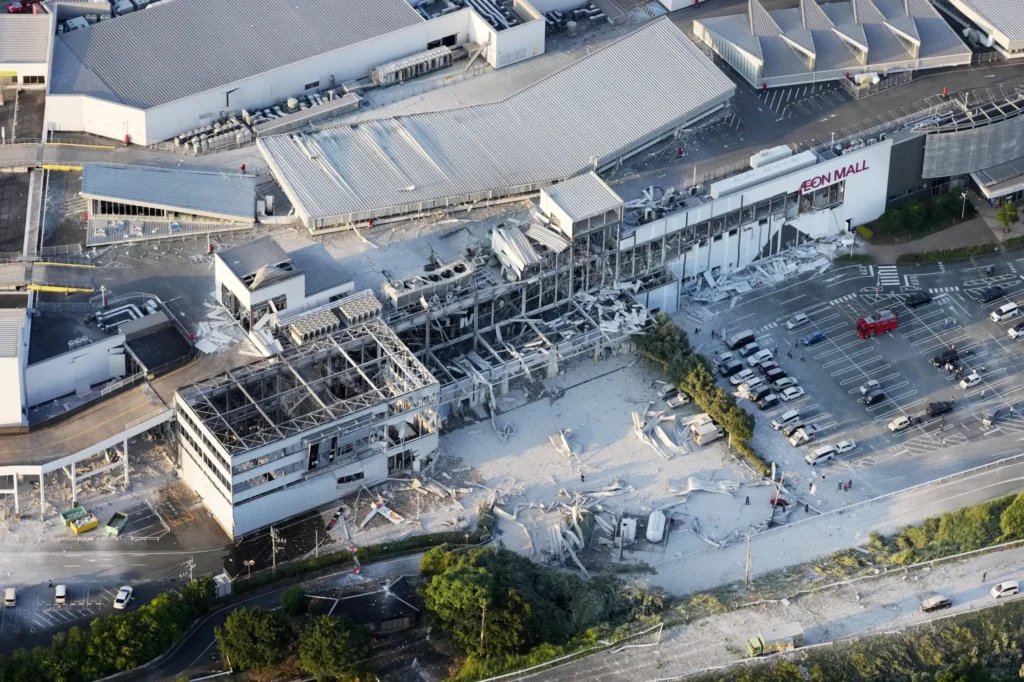
One of the deadliest incidents occurred at an Aeon shopping mall in Kashima Town, where part of the second floor collapsed following what investigators believe may have been a gas explosion triggered after the earthquake.
Two women in their twenties were among those killed inside the shopping complex. Rescue teams pulled several survivors from the debris, while search efforts continued for others believed trapped beneath the collapsed structure.
Witnesses said they detected the smell of gas before hearing a powerful explosion nearly an hour after customers had begun evacuating.
A shop employee told Japanese broadcaster TBS that staff returned briefly after helping customers leave the building when they noticed a strong gas odor before the explosion occurred.
Another major rescue operation is underway at Nippon Paper Industries’ factory in Yatsushiro, where a massive chimney collapsed during the quake.
Officials said multiple workers became trapped beneath debris. Emergency crews continued searching throughout Wednesday after recovering several victims.
The earthquake also damaged roads, bridges and residential neighborhoods across Kumamoto Prefecture.
Historic Kumamoto Castle, which continues to undergo restoration following the devastating 2016 earthquake, sustained additional structural damage as sections of stone walls collapsed.
Power outages affected approximately 35,000 households across Kyushu, while ruptured water lines and damaged infrastructure complicated emergency operations.
Authorities urged residents to remain alert for extreme heat as temperatures climbed into the upper 90s while many communities remained without electricity.
Transportation across southern Japan also suffered significant disruption.
Bullet train services throughout Kyushu were suspended while engineers inspected railway lines for structural damage.
A freight train derailed at Yatsushiro Station during the violent shaking, while flights at Aso Kumamoto Airport remained suspended as officials assessed runway conditions.
Several major manufacturers temporarily halted production.
Toyota suspended operations at three factories in Kyushu for safety inspections. Honda Motor Co., Nippon Paper Industries and other companies also paused operations while damage assessments continued.
Delivery services into affected communities were disrupted as damaged roads slowed transportation.
Hospitals across Kumamoto and neighboring cities treated dozens of injured residents, including passengers hurt aboard high speed trains during the earthquake.
More than 260,000 residents were advised to evacuate vulnerable coastal and low lying areas after tsunami advisories were issued for parts of western Kyushu.
The Japan Meteorological Agency later canceled the advisory after determining that tsunami risks had subsided.
Officials, however, warned that powerful aftershocks remain likely.
The agency cautioned residents to prepare for additional earthquakes of similar intensity over the coming week, particularly during the next two to three days.
Japan’s Nuclear Regulation Authority said inspections found no abnormalities at nearby nuclear power stations, including the Sendai nuclear plant.
The International Atomic Energy Agency said it had been informed of the inspections and would continue monitoring developments.
The safety of nuclear facilities remains a major concern in Japan following the 2011 earthquake and tsunami that triggered reactor meltdowns at the Fukushima Daiichi nuclear power plant.
Japan sits along the Pacific Ring of Fire, one of the world’s most seismically active regions where multiple tectonic plates converge.
The country experiences nearly one fifth of all earthquakes worldwide measuring magnitude 6.0 or greater, making strict building standards and rapid emergency response central to disaster preparedness.
What we know so far
- At least 13 people have died.
- Dozens of others were injured.
- Several people remain missing beneath collapsed structures.
- Part of an Aeon shopping mall and a chimney at a paper factory collapsed.
- More than 260,000 residents received evacuation advisories.
- Around 35,000 households lost electricity.
- Rail services, airport operations and manufacturing were disrupted.
- No damage has been reported at nearby nuclear power plants.
What authorities are saying
Prime Minister Sanae Takaichi said the government has mobilized all available emergency resources to locate survivors and restore essential services.
Japan’s Meteorological Agency warned residents to expect potentially strong aftershocks during the coming days and urged continued caution around weakened buildings.
The Nuclear Regulation Authority said inspections found no operational problems at nearby nuclear facilities.
Why this matters
The earthquake underscores Japan’s continued vulnerability to powerful seismic events despite decades of investment in earthquake resistant infrastructure and emergency preparedness.
Although modern engineering has significantly reduced casualties compared with past disasters, aging buildings, industrial facilities and densely populated commercial centers remain vulnerable when powerful shallow earthquakes strike near urban areas.
The disaster also serves as a reminder that recovery from previous earthquakes, including the devastating 2016 Kumamoto disaster, remains an ongoing challenge as historic landmarks and public infrastructure continue to undergo reconstruction.
What happens next
Rescue teams will continue searching collapsed buildings while engineers inspect roads, bridges and public infrastructure for additional damage.
Authorities are expected to maintain evacuation shelters until utilities are restored and structural inspections determine that affected neighborhoods are safe for residents to return.
Seismologists will closely monitor aftershock activity over the coming days, while government agencies begin assessing long term reconstruction costs and financial assistance for affected communities.
Sources: This story is based on reporting by The Associated Press and NBC News





