

A boat capsized on Lake Kivu in eastern Congo between Saturday night and early Sunday morning, killing at least 12 people and leaving dozens more missing, authorities and local media said.
Accounts differed significantly on both the number of people aboard and the vessel’s route. Local media reported the boat departed from Bukavu, capital of South Kivu province, with preliminary information suggesting more than 80 people may have been aboard. The Associated Press, citing Félix Habiragi, chief of the village of Kisheke near the accident site, reported the vessel was carrying more than 50 people and was traveling between two points on Idjwi Island itself, from Bwina to Boza, according to local administrator Muhindo Ntambuka Pascal. These are substantially different accounts of both the passenger count and the journey’s starting point, and the discrepancy had not been resolved as of the latest reporting.
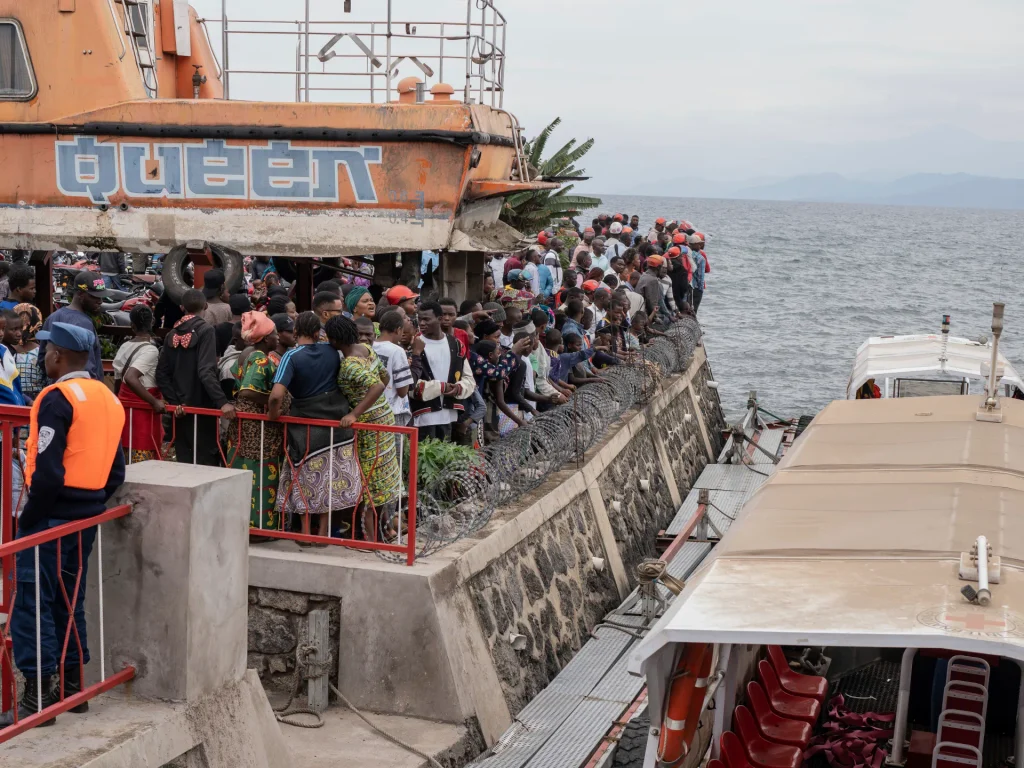
Rescue figures also varied. Local media reported five survivors had been found as of Sunday morning, while Habiragi told the AP that about 15 people had been rescued. The cause of the capsizing remained unclear under either account.
What We Know So Far
The vessel was reportedly transporting fish traders and goods at the time it capsized. Videos that appeared to show the scene depicted villagers and other passengers pulling bodies from the lake. Search and rescue operations were continuing as of Sunday, with rescuers working to locate the dozens of people still unaccounted for.
Christian Amini Ndahira, a resident of Idjwi, said he lost a friend in the accident. “We had even spoken in the evening, before he boarded that boat. It’s so sad for me and for his family,” he said.
Dorcelle Bagazane, a member of civil society on Idjwi, said authorities had previously begun requiring passengers to wear life jackets, but that many people continue to travel without them. Congo’s boats are frequently overloaded with both passengers and goods, a persistent safety issue across the country’s extensive network of lake and river transport.
Why This Matters
With numerous rivers and lakes crisscrossing the country, boats remain one of the primary means of transportation for many of Congo’s more than 100 million people, particularly in remote areas with limited road infrastructure. Boat accidents occur frequently due to a combination of aging vessels, overloading and inconsistent enforcement of safety requirements like life jacket use, a pattern Bagazane’s comments suggest persists despite past government efforts to address it.
The scale of the discrepancy between the two reported passenger counts, more than 80 versus more than 50, and the conflicting accounts of the vessel’s origin point, Bukavu versus Idjwi Island itself, illustrate how difficult it can be to establish basic facts in the immediate aftermath of these accidents, particularly in remote lake communities with limited communication infrastructure and where passenger manifests are often incomplete or nonexistent.
What Happens Next
Search and rescue operations are continuing for the dozens of passengers still missing, though authorities have not indicated when the search is expected to conclude or how many people remain unaccounted for under either reported passenger count. No investigation into the cause of the capsizing has been announced.
Given the recurring pattern of fatal boat accidents across Congo’s lakes and rivers, continued scrutiny of vessel safety practices, including passenger limits and life jacket enforcement, is likely, though similar past accidents have not historically led to substantial regulatory change.
Also in the News: South Africa Serial Killer Investigation Update
Separately, South African police said a suspect has been taken into custody in connection with a series of killings targeting women in a single Johannesburg municipality over the past two months. At least 10 women have been killed, with the most recent victim found semi-naked and stoned to death Saturday. The nine earlier victims, mostly in their 20s and 30s, were found with signs of sexual assault, and some were stripped of their clothing. Police had offered a reward of 400,000 rand, or about $25,000, for information leading to an arrest, and South Africa’s Democratic Alliance, the country’s second largest political party, contributed an additional $31,000 toward the reward. This development follows the weekend’s separate mass shootings in Wedela and Lwandle townships, which together killed at least 27 people, as South Africa continues to grapple with persistent, wide ranging violent crime.
Reporting drawn from Xinhua and the Associated Press





