

Eight gunmen armed with AK-47 rifles and pistols opened fire at a tavern in the first of two separate mass shootings in South African townships within a few hours of each other, leaving at least 27 people dead, police said Sunday.
The South African Police Service said 17 people were killed and 15 others wounded when the gunmen opened fire around 9:30 p.m. Saturday at a tavern in Wedela township, near the town of Carletonville, roughly 50 miles southwest of Johannesburg. Gauteng police spokesperson Capt. Tintswalo Sibeko said patrons were drinking inside and outside the tavern when the suspects arrived and opened fire on those outside before entering the tavern to continue shooting. The victims included 13 men and four women.
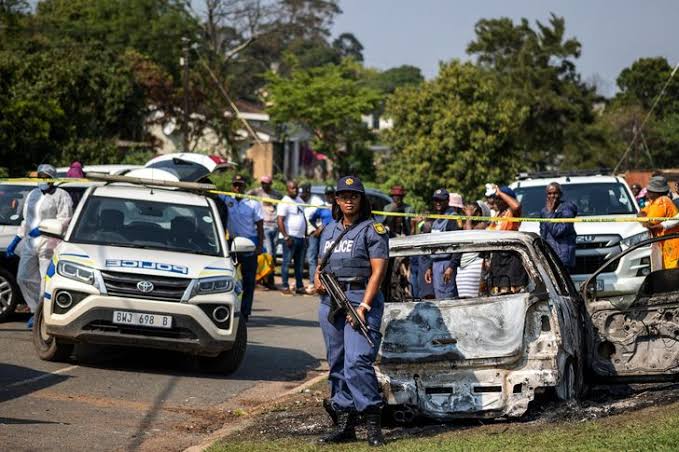
Roughly four hours later, gunmen opened fire at a venue selling grilled meat in Lwandle township on the outskirts of Cape Town, killing 10 people and wounding 11 others. Reports differed on the exact timing of the second attack, with accounts variously placing it shortly after 1 a.m., around 1:46 a.m. and shortly before 2 a.m. Sunday, a discrepancy that had not been resolved as of the latest reporting. Five victims were declared dead at the scene, and five more died after being taken to the hospital, according to The Citizen.
No arrests had been made in either shooting as of Sunday.
What We Know So Far
Sibeko said the Wedela suspects searched patrons and took their cellphones and other valuables before fleeing in two vehicles and setting fire to two other vehicles parked near the tavern. Police opened 17 counts of murder, 15 counts of attempted murder and two counts of malicious damage to property in connection with the attack. A resident who spoke to Reuters, though reluctant to discuss the incident in detail, said illegal miners known locally as zama zamas operate in the area, which sits atop a gold mining region experts describe as a hotspot for gun crime.
At the Lwandle scene, onlookers gathered behind police lines but largely declined to speak with journalists, citing safety concerns, according to Reuters. Western Cape police said Lwandle station detectives had opened cases of murder and attempted murder and were working to identify the perpetrators, adding that victims’ identities would be released once next of kin had been notified.
The motive for neither shooting was known as of the latest reports, though police in Gauteng have mobilized detectives and specialized units to pursue suspects.
Broader Context
The two attacks came just five days after a separate mass shooting at a house party in KwaMakhutha township near Durban killed at least 11 people, including a pregnant woman, on Tuesday night. Police have not reported any arrests in that earlier case either. Separately, the bodies of about 10 women have been found near roadsides and other locations in Ekurhuleni, near Johannesburg, over the past two months, prompting authorities to investigate whether the deaths are connected to a serial killer.
South Africa has struggled with high rates of violent crime for years, but experts say mass shootings involving multiple gunmen have become increasingly common in recent years, with the violence disproportionately affecting the country’s poorest communities. Police have linked some of these attacks to organized criminal gangs. Other recent mass shootings include one in June in a poor Johannesburg neighborhood that killed 12 people, and two shootings within two weeks in December that together left 21 people dead.
South African police statistics recorded 5,427 homicides nationwide during the three month period from April to June this year, an average of nearly 60 killings per day. Shootings remain the most common form of homicide in the country, and police and crime experts have long pointed to a large number of illegal firearms in circulation as a central driver of the violence.
What Authorities and Experts Are Saying
Crime expert Yusuf Abramjee said South Africa faces a serious illegal firearms problem, with weapons frequently used by organized criminal groups in gang related and other violent crimes. “Every mass shooting should therefore trigger more than an investigation into the immediate perpetrators,” Abramjee said. “Authorities need to look at the wider networks behind the violence.”
Floyd Shivambu’s Afrika Mayibuye Movement, among the first political groups to respond to the Wedela shooting, extended condolences to victims’ families and called for deeper systemic change beyond individual arrests. “Sporadic police responses are insufficient. Our communities urgently require proactive, sustained intervention strategies that prevent violent crime, ensure accountability, and restore public safety,” the party said in a statement, adding that every life matters and that the right to life must be fiercely protected.
President Cyril Ramaphosa said earlier this year that organized crime had become the biggest threat to South Africa’s democracy and deployed roughly 2,200 soldiers in March in a yearlong operation to help police combat crime in some of the country’s worst affected areas, including parts of Johannesburg and Cape Town. Critics have viewed the military deployment as an implicit admission that police were struggling to contain the violence on their own.
Why This Matters
The near simultaneous timing of Saturday night’s and Sunday morning’s attacks, following closely on the heels of Tuesday’s KwaMakhutha shooting, underscores a rapidly escalating pattern of mass casualty gun violence that is testing the effectiveness of the government’s existing crackdown measures, including the ongoing military deployment. Abramjee’s call for authorities to examine the broader criminal networks behind these attacks, rather than treating each shooting as an isolated case, reflects growing concern among experts that individual arrests alone will not address the underlying drivers of the violence.
Crime is expected to be a major issue for voters in South Africa’s municipal elections in November, when the African National Congress faces further erosion of public support, meaning the government’s handling of this surge in mass shootings carries direct political stakes beyond the immediate public safety concerns.
What Happens Next
Detectives in both Gauteng and the Western Cape are continuing to search for suspects in the two shootings, with no arrests made as of the latest reporting. Authorities have not indicated when they expect to identify those responsible for either attack.
Given the pattern of recurring mass shootings and the upcoming municipal elections, continued political and public pressure on Ramaphosa’s government to demonstrate progress against organized crime and illegal firearms is likely in the coming weeks.
Reporting drawn from the Associated Press, Reuters, SBS News and The Citizen





