

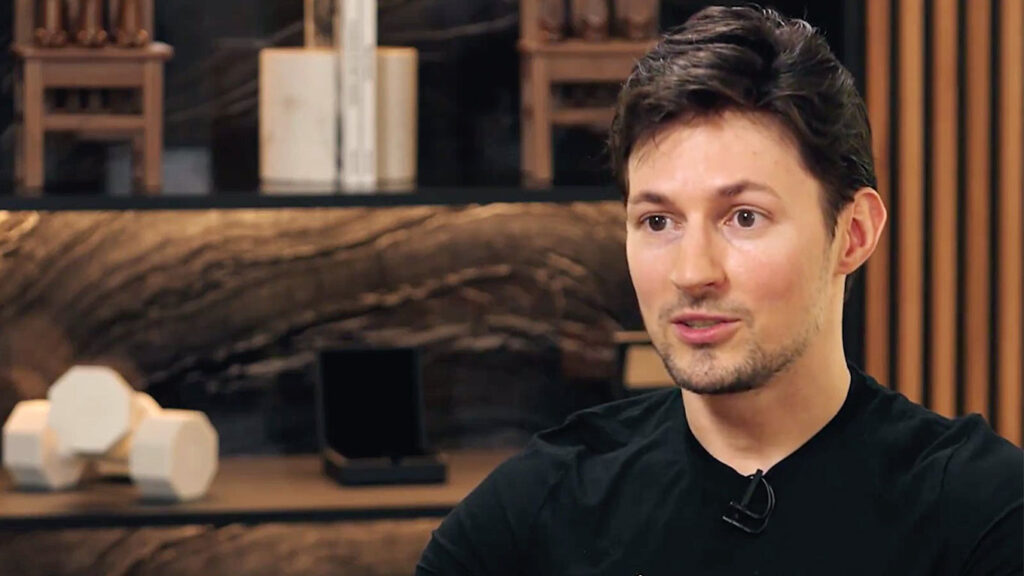
Russia’s Federal Security Service charged Pavel Durov, the billionaire founder and chief executive of the Telegram messaging app, with aiding terrorism on Wednesday and placed him on an international wanted list, in the latest escalation of the Kremlin’s campaign to bring digital communications under state control.
The charges against Durov, 41, who was born in Russia but lives in Dubai and holds citizenship in France, the United Arab Emirates, and the Caribbean nation of St. Kitts and Nevis, could carry a sentence of up to life in prison if he is convicted in a Russian court.
What We Know So Far
The FSB said in a statement that Telegram’s administration had failed to remove channels, chats, and bots allegedly used by Ukrainian intelligence agencies and extremist organizations to plan and coordinate terrorism, sabotage, mass murder, and cyberfraud inside Russia, resulting in what it described as numerous human casualties, the Associated Press confirmed.
The FSB also accused Ukrainian security services of using a popular dating chatbot on Telegram called Daivinchik, which has 13.6 million monthly active users, to lure and recruit Russians for what it called sabotage and terrorist activities. It said 46 users of the chatbot, aged between 12 and 22, had been detained across Russia over the past year for assaulting law enforcement officers and committing arson.
Durov had said earlier this year that Russian authorities had already opened a criminal investigation against him. He accused them of fabricating pretexts to restrict Telegram as part of an effort to suppress privacy and free speech.
Telegram did not respond to a request for comment. Its official account on X posted an image of Durov raising a middle finger to the camera.
Telegram boasts more than one billion monthly active users worldwide. Its company is based in Dubai, where Durov has resided since leaving Russia in 2014.
Durov’s History With Russia And France
Durov founded VKontakte, Russia’s largest social network, with his brother Nikolai in 2006. The platform came under pressure following mass anti-Kremlin protests in 2011 and 2012, eventually prompting Durov to sell his stake and leave the country.
He and Nikolai launched Telegram in 2013. Russia tried and failed to block the platform between 2018 and 2020.
In August 2024, French authorities arrested Durov in Paris on allegations that Telegram was being used for drug trafficking and the distribution of child sexual abuse material. He was released after four days of questioning on five million euros bail. French investigators have questioned him repeatedly since then, including as recently as this month, the Paris prosecutor’s office told the Associated Press. He remains under formal investigation in France.
Durov said in March 2025 that he had returned to Dubai after spending several months in France.
What Authorities Are Saying
The FSB called Telegram’s failure to moderate harmful channels a direct enabler of violence inside Russia.
Durov has consistently rejected that framing, describing Russian pressure on Telegram as politically motivated censorship rather than legitimate law enforcement.
The Kremlin’s position has shifted notably. When French authorities arrested Durov in 2024, Putin’s spokesman Dmitry Peskov criticized the action as selective. He said at the time that terrorists also use cars and asked why no one was arresting the CEO of Renault or Citroen. Peskov did not respond to questions Wednesday about what had changed in Russia’s own position.
Despite the charges and restrictions, Russian government agencies continue to use Telegram regularly. The Kremlin’s own Telegram channel had more than 284,000 followers as of Wednesday, the Associated Press confirmed.
Why This Matters
Wednesday’s charges represent a significant escalation in Russia’s long-running effort to control the internet, timed as the country prepares for parliamentary elections in September amid public fatigue with the Ukraine war and growing economic strain.
Under Putin, Russia has systematically restricted or banned platforms that declined to comply with state demands. Facebook, Instagram, and X have all been banned. YouTube has been throttled. Signal and Viber have been blocked. WhatsApp and Telegram have been restricted. In their place, Russian authorities actively promote a state-aligned messaging app called MAX, which openly states it will share user data with authorities on request and does not use end-to-end encryption.
Russia’s move against Telegram carries an additional irony. Russian military bloggers have repeatedly criticized the platform’s restriction, arguing Telegram is an indispensable tool for Russian troops in Ukraine and for activists running crowdfunding campaigns to support Russian forces. The government initially promised not to restrict Telegram on the battlefield. That promise was later walked back.
Russia itself has faced accusations from the United Kingdom, the Netherlands, and Ukraine of using Telegram to recruit individuals for sabotage operations across Europe. A British man was recruited through the platform to organize a plot to set fire to a warehouse in London containing satellite equipment for Ukraine. Dutch teenagers were contacted by Russian hackers on Telegram to map Wi-Fi networks in The Hague near the International Criminal Court and other sensitive institutions. Moscow has denied involvement in those incidents.
Telegram has long faced criticism in both Russia and the West for insufficient content moderation. Its architecture, allowing group chats of up to 200,000 users, significantly outpaces rivals and creates conditions where misinformation and criminal coordination can spread quickly. Its end-to-end encryption is available only for individual conversations and must be manually activated, unlike Signal and Facebook Messenger where it is on by default.
What Happens Next
Durov faces an international wanted notice issued by Russia. Whether that notice will have practical effect depends on which countries choose to honor it. Durov lives in Dubai and holds UAE citizenship, and the UAE has not been part of Russian extradition arrangements historically.
The Paris prosecutor’s office confirmed Durov remains under formal investigation in France, with questioning continuing as recently as this month. He faces potential charges in France covering alleged criminal activities linked to Telegram’s operations.
Both legal processes are proceeding simultaneously and independently. Durov’s response to the Russian charges, delivered via a middle finger photograph on his own platform, suggests he has no intention of engaging with Russian judicial proceedings from abroad.
Sources: AP/The Independent





