Russia unleashed one of its largest combined missile and drone assaults of the war on Ukraine overnight into Friday, damaging three bridges across the Dnipro River in Kyiv, killing at least eight people nationwide and knocking out power, heating and water in several regions, officials said.
The hours-long barrage came a day after Russian President Vladimir Putin vowed to respond to Ukrainian strikes that collapsed an entire section of the Crimean Bridge earlier this week, The Kyiv Independent said.
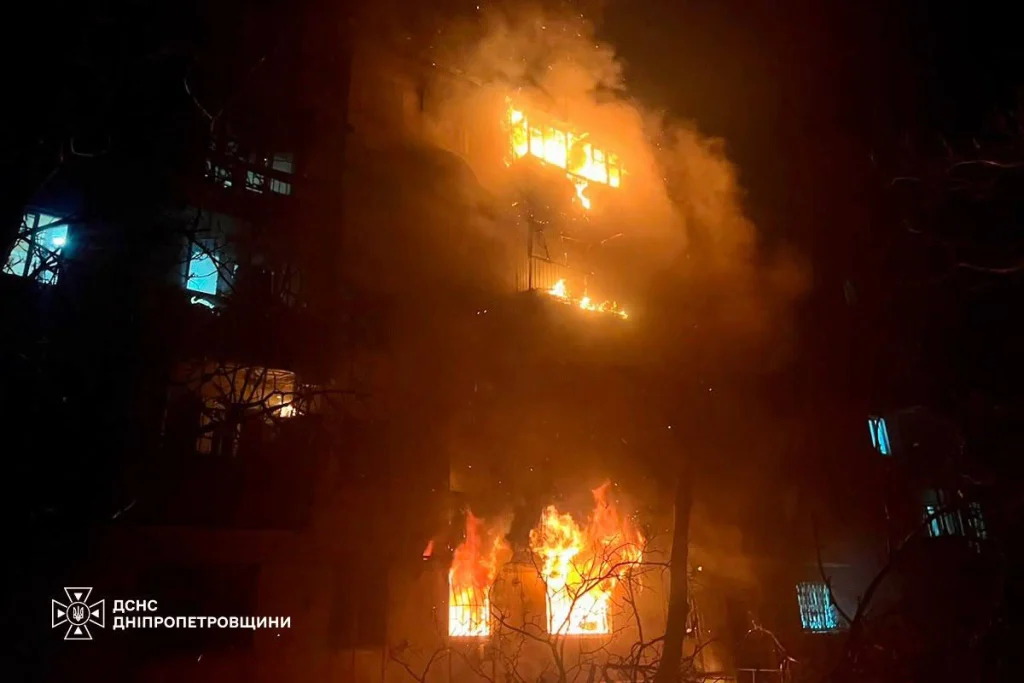
Prime Minister Serhii Koretskyi said six people were killed and 15 injured in Kyiv, and two more were killed and 13 injured in other regions he did not name.
Casualty figures varied as the attack unfolded. Politico, citing Kyiv Mayor Vitali Klitschko, reported three deaths and about 15 injuries in the capital and at least five killed nationwide.
Hundreds of drones and dozens of missiles
Ukraine’s Air Force said Russia launched 84 cruise missiles, 404 attack drones and an unspecified number of ballistic missiles, The Kyiv Independent said. Air defenses shot down three ballistic missiles, 79 cruise missiles and 380 drones, with impacts recorded at 23 locations.
Some cruise missiles were fired from Tu-160 strategic bombers, among the largest warplanes in service and capable of carrying conventional and nuclear weapons.
Bridges hit, residents told to stay off roads
Klitschko said the Podilsko-Voskresenskyi, Southern and Darnytskyi bridges were all damaged. Ballistic missiles struck the Podilsko-Voskresenskyi and Darnytskyi crossings and hit the Southern Bridge again, Politico said.
Klitschko urged residents not to drive into the city and asked employers to let staff work from home. “The enemy’s missile attack on Kyiv is ongoing,” he said.
Russia began targeting Kyiv’s bridges in early October, Politico said.
Explosions and strikes were also reported in the western regions of Lviv and Ivano-Frankivsk, in Kryvyi Rih in the south, in the northeastern Kharkiv region and in the eastern city of Dnipro.
In Lviv, near the Polish border, a strike on railway station ticket offices injured seven people, regional Gov. Maksym Kozytskyi said. Air defenses were “in continuous action for nearly 6 hours,” he said, and an attack on an energy facility forced emergency power outages across the region.
Poland reports airspace violation
Polish authorities issued air threat alerts for residents of the Lublin and Subcarpathian regions early Friday, and Rzeszów airport halted flights. An unidentified “flying object” fell near the eastern town of Lipowiec, officials said.
Prime Minister Donald Tusk said he had been briefed on “the violation of Polish airspace” near the Ukrainian border. “There is currently no threat from the air. The relevant services are on site,” he said.
Putin promised a ‘more painful’ response
The assault followed Putin’s pledge of a response “much more painful” than Ukraine’s attacks on the Crimean Bridge, Politico said. Putin said the bridge was used solely for civilian purposes, Reuters said.
Hours before the barrage, U.S. President Donald Trump called into a meeting of Ukraine’s European allies from Air Force One and said Putin was serious about peace talks, Politico said. Putin also said Europeans should come to Moscow to discuss joining negotiations.
Ukraine’s campaign against Russian supply lines
The partial destruction of the Crimean Bridge strengthens a monthslong Ukrainian effort to cut Russia’s supply routes to southern and eastern Ukraine and occupied Crimea, Reuters said, citing two analysts and two Ukrainian commanders. They said the strikes were not decisive on their own but added pressure to a strained logistics network.
The attack carried symbolic weight ahead of Putin’s three-way meeting Thursday with Trump and Chinese President Xi Jinping, Reuters said.
“The more important story here is not necessarily the destruction of the Crimean Bridge itself, but the growing pressure Ukraine is putting on Russia’s logistics system as a whole,” said John Helin, a visiting fellow at the Atlantic Council.
This week’s strikes destroyed the bridge’s road section. Ukraine struck again Thursday, its third bridge attack of the week, forcing a suspension of rail traffic. Russian officials released no further details.
Over the summer, Ukrainian forces targeted tankers carrying fuel to the peninsula, causing widespread shortages, and hit energy infrastructure across Crimea. They have also struck Russian supply convoys on the M-14 highway through occupied southern Ukraine.
With the bridge partly disabled, Russia will likely have to push more traffic along that route, said Franz-Stefan Gady of the Center for a New American Security. “More traffic means more targets,” he said, though he added that a “sudden logistical breakdown” was unlikely because Russia uses tactics such as dispersion and night driving.
The commander of a Ukrainian drone unit operating over the highway, speaking anonymously for security reasons, said Russia would likely reinforce air defenses there. “The only thing helping them (the Russians) now is the weather,” he said, referring to rain and heavy cloud.
An officer from Ukraine’s Grouping of Forces Azov said a successful strike on the bridge’s rail section could funnel all rail cargo through the same land corridor. He said the unit had hit 100 locomotives and destroyed 600 tonnes of fuel in recent months, figures Reuters could not verify.
The 19-kilometer (12-mile) road and rail bridge links mainland Russia with Crimea, which Moscow annexed in 2014. Ukraine previously damaged it with a truck bomb in 2022, sea drones in 2023 and underwater explosives in 2025.
“The real question is whether Ukraine can keep the bridge out while also sustaining pressure on the corridor,” Gady said. “Doing both at once is what would actually squeeze Russia.”
Escalation on both sides as diplomacy stirs
The overnight barrage and the Crimean Bridge strikes show both sides targeting the other’s critical infrastructure in a cycle of escalating attacks. Russia’s strikes on Kyiv’s bridges and energy systems aim to disrupt daily life and the economy in the capital as winter sets in, while Ukraine’s campaign seeks to choke the routes that sustain Russian forces in the south and Crimea.
The timing is notable. The attacks unfolded alongside a burst of diplomatic activity, including Trump’s assertion that Putin is serious about peace and Putin’s meeting with Trump and Xi. Large-scale strikes during such moments can serve to strengthen negotiating positions, though they also risk hardening attitudes and complicating talks.
The airspace incident in Poland adds a regional dimension. Each such event raises concern among NATO members about spillover from the war and tests the alliance’s response.
On the battlefield, analysts suggest Ukraine’s logistics campaign is a long-term pressure tactic rather than a decisive blow. Its effectiveness will depend on sustaining strikes on both the bridge and the land corridor, as Gady noted, while Russia adapts with air defenses and evasive measures. For civilians in Kyiv, meanwhile, damaged bridges and power cuts mean a harder winter as the war nears its fifth year.
Sources: The Kyiv Independent; Politico; Reuters