

Rescuers worked through the night and into Monday morning pulling survivors from a mountain of broken concrete and twisted steel in northern Philippines, but the effort turned to grief repeatedly as workers who had been found alive beneath the rubble died before they could be freed or revived — bringing the death toll from Sunday’s hotel construction collapse to four with 17 people still missing.
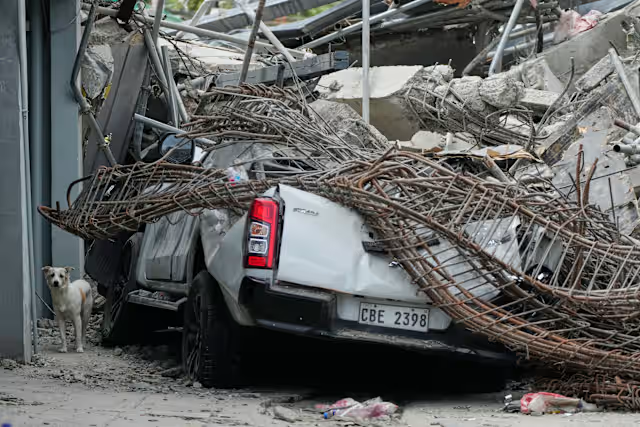
The nine-story building in Angeles City, Pampanga Province collapsed before dawn Sunday during a fierce thunderstorm, trapping construction workers who had been sleeping inside on pieces of plywood on the ground floor. The building’s fall sent a cascade of debris into a neighboring budget inn, killing a Malaysian tourist staying there. Another guest at the inn was injured but managed to escape.
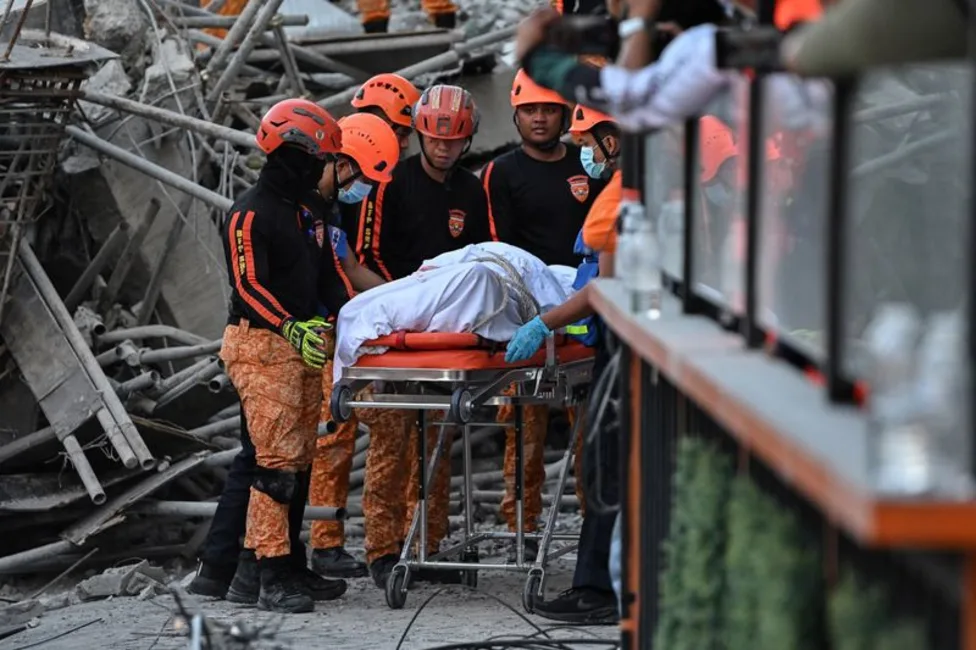
The scenes through the early morning hours carried the particular anguish of survival that slips away. One trapped man was reached by rescuers who fed him water and intravenous medicine in a desperate attempt to keep him alive in the scorching heat. He did not survive.
“He never made it despite all the efforts,” regional police chief Brig. Gen. Jess Mendez told the Associated Press.
A second worker suffered cardiac arrest around 3 a.m. while still pinned under concrete. Medical personnel could not reach him in time. A third body was pulled from the rubble on Monday — unidentified, and not on the list of the 17 missing, adding an unresolved complication to a death count that officials still could not close.
Regional fire bureau spokeswoman Maria Leah Sajili confirmed both worker deaths through AFP, saying the first was pulled out alive but his body gave out before doctors could resuscitate him. The second died from cardiac arrest while still trapped.
Twenty-six workers were either rescued or managed to run out as the building came down. Of the 17 still missing Monday, most were construction workers employed at the site.
A City Waiting at the Edge of the Rubble
Relatives of the missing workers gathered in makeshift sheds near the collapse site through the night and into Monday, watching as hundreds of rescuers, firefighters, and police officers picked through the debris. The mixture of grief and desperate hope that took hold in those sheds produced some of the day’s most affecting moments.
Lea Mendoza Casilao, 47, a sardine factory worker, had taken a bus to Angeles from her northern Manila home carrying a week’s supply of rice and canned goods for her boyfriend, a mason working the construction site. She did not know about the collapse when she boarded. She had been planning to meet him over the weekend.
“It’s very difficult, it is breaking my heart to wait for something uncertain,” she told AFP through tears, describing how she slept alone overnight in a local government building after arriving to find the site reduced to rubble.
Stephanie Batar and her mother Noby learned about the collapse through social media from their home in nearby Bulacan Province. Her 64-year-old father had taken a six-month contract at the site just weeks earlier.
“I couldn’t breathe. I couldn’t stand. It’s very painful and we did not know what to do,” she said.
Alfredo Albis, 55, had been sleeping in a workers’ barracks about five meters from the building when it collapsed. Two of his cousins were still missing Monday.
“They were working here to earn for their families,” he told AFP, “and there’s a possibility that my relatives are dead.”
Angeles City Mayor Carmelo Lazatin told the Associated Press that the search would not be reclassified as a body retrieval operation despite the mounting losses.
“My best hope is that we can rescue more people alive,” Lazatin said. “We don’t want to give the families of the trapped workers any bad news.”
He acknowledged that the work was deliberately slow. Enormous concrete slabs were being held in place only by a tangle of aluminum scaffolding underneath, and any sudden movement risked triggering a secondary collapse that could crush both the missing workers and the rescuers trying to reach them.
Sajili confirmed that thermal scanners were being used to search for survivors. If no signs of life are detected, she said, mechanical diggers and heavy equipment would be brought in to clear the site for body recovery, though she gave no timeline for that transition.
A Construction Site With a Known Safety History
The collapse has drawn scrutiny toward a project that regional labor authorities had flagged and temporarily shut down less than a year before Sunday’s disaster.
Geraldine Panlilio, regional director of the labor department, told Manila radio station DZMM that she had ordered the project halted in September 2024 after inspectors found violations of occupational safety standards. Workers at the site lacked basic protective equipment including hardhats, safety boots, safety belts, and lifelines. Lighting was poor. Safety signage was absent.
“Our labour inspectors had monitored poor working conditions, a violation that would put our workers at risk,” Panlilio said.
Construction resumed approximately one month after the shutdown, following the contractor’s confirmation that the required corrections had been made. Whether those corrections were genuine and sustained, or whether the safety violations that prompted the September closure had quietly returned in the months that followed, is now central to the investigation.
National Police Chief Gen. Jose Melencio Nartatez Jr. said his force was supporting an investigation to determine the cause of the collapse and identify possible violations of safety and building regulations.
Up to 70 workers were employed at the site, officials said, though most had gone home for the weekend. The workers who remained were the ones sleeping inside when the building came down.
Angeles City and Its Construction Boom
Angeles City sits in the shadow of the former Clark Air Base, once one of the largest U.S. Air Force installations outside American soil, approximately 80 kilometers north of Manila. The base closed in the early 1990s after the eruption of Mount Pinatubo caused catastrophic damage to the surrounding region. The former base became the Clark Freeport Zone, a bustling commercial and industrial enclave that has drawn investment and tourism for three decades.
The area around Clark has maintained the character of its base-era economy, with budget hotels, bars, and commercial accommodation forming a substantial part of the local business landscape. The collapsed building was a nine-story hotel under construction in that environment — part of a continued build-out of accommodation and commercial space in a city whose economic identity has always revolved around hospitality and mobility.
The Gap Between Inspection and Protection
The timeline of this disaster contains a detail that will dominate the official investigation and deserves direct attention. Regulators found serious safety violations at this specific site in September 2024. They shut it down. The contractor satisfied the requirements to reopen. Eight months later, the building collapsed while workers slept inside.
That sequence does not automatically mean the September violations caused Sunday’s collapse. The cause has not been established, and construction failures can stem from structural design, materials quality, foundation conditions, weather events, or a combination of factors that may or may not be related to the labor safety violations identified last year. The investigation will need to establish that connection or its absence.
What the sequence does establish is that this was not a site without a regulatory history. It was a site that had been flagged, closed, and cleared to reopen. The people sleeping in it had reason to believe it was being built to standards that someone, at some point, had verified. If the investigation finds that the conditions leading to collapse were present or developing during the period when the site was operating under its post-shutdown compliance status, the accountability question extends beyond the contractor to the inspection and certification process itself.
Pampanga Province’s broader building stock, Angeles City’s rapid commercial development, and the national pattern of construction accidents in the Philippines create context for a regulatory system under strain. The workers who went to sleep in that building on Saturday night were earning wages for their families in the one industry available to them. They had no mechanism to independently assess whether the structure above them was safe. That assessment was the responsibility of the systems that certified it.
The 17 families still waiting at the edge of that rubble deserve answers about how it failed.
AP/Euronews





