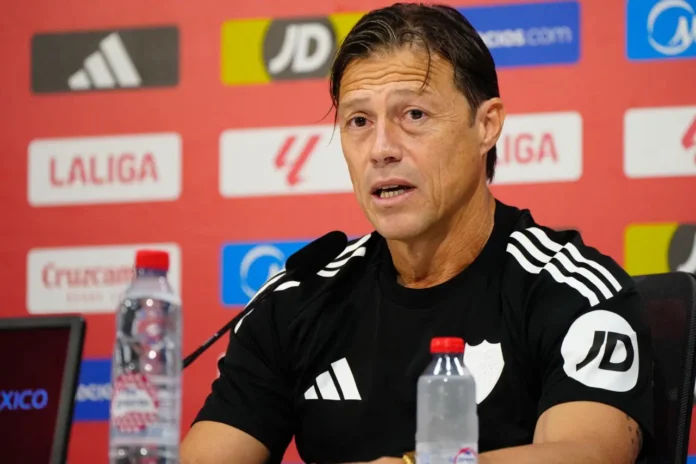
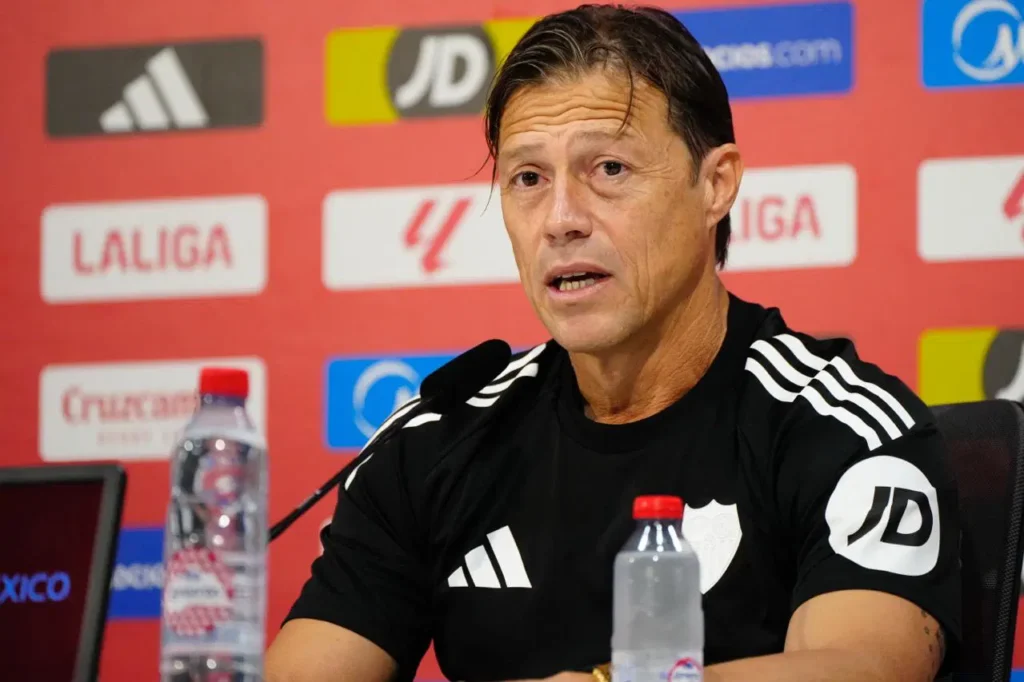
MADRID (BN24) — Sevilla coach Matías Almeyda has been suspended for seven matches after confronting a referee during his team’s recent La Liga draw against Alavés, Spain’s football authorities announced Wednesday.
The 52-year-old Argentine was dismissed during the weekend fixture at the Ramón Sánchez-Pizjuán Stadium after protesting a decision. Following the red card, Almeyda entered the field of play and engaged in a heated exchange with the match official that lasted more than a minute.
In a ruling issued Feb. 18, the disciplinary committee of the Royal Spanish Football Federation outlined the sanctions imposed on the Sevilla coach. The breakdown includes a two-match suspension for his initial protests, a one-match penalty for remaining on the pitch after being sent off, three matches for what the committee described as an “attitude of contempt” toward the referee, and an additional one-match ban for unsporting conduct.
The cumulative sanction will sideline Almeyda for half of Sevilla’s remaining league fixtures. With 14 matches left in the campaign, the club sits 13th in the standings, only two points above the relegation zone.
The absence of the head coach during a pivotal stretch of the season represents a significant setback for the Andalusian side. Sevilla has endured an inconsistent campaign and now faces mounting pressure as it seeks to secure its status in Spain’s top division.
League authorities reiterated the importance of maintaining respect for referees and match officials, particularly amid heightened scrutiny of on-field conduct across European competitions. While emotional reactions are common in high-stakes matches, Spanish football’s governing body has taken a firm stance in recent seasons against behavior deemed disrespectful or confrontational.
Almeyda, a former Argentina international midfielder, took charge of Sevilla amid expectations of stabilizing the club after a turbulent run of results. His animated presence on the touchline has been a hallmark of his managerial style, but the latest incident underscores the disciplinary boundaries coaches must navigate.
The confrontation occurred during a tense phase of the match, with both teams contesting crucial points. Although details of the specific decision that prompted Almeyda’s protest were not elaborated in the federation’s announcement, the referee deemed the conduct severe enough to warrant an immediate dismissal.
Sevilla has not publicly indicated whether it intends to appeal the suspension. Under Spanish football regulations, clubs may challenge disciplinary decisions within a specified timeframe.
The timing of the suspension compounds the challenge facing Sevilla. Hovering near the relegation zone, the club must contend with upcoming fixtures that could define its season. Without Almeyda directing operations from the technical area, assistant coaches will assume responsibility for matchday decisions.
While managers may continue to oversee training sessions during suspensions, their absence on the bench can affect tactical adjustments and in-game communication. In closely contested matches, the inability to interact directly with officials or players from the touchline can alter team dynamics.
Sevilla’s recent form has reflected broader struggles within the squad, including defensive lapses and inconsistency in attack. The pressure of a relegation battle can intensify scrutiny on leadership, making Almeyda’s suspension particularly consequential.
Spanish football has increasingly emphasized decorum toward referees amid rising tensions across competitions. In recent seasons, governing bodies have introduced stricter enforcement measures to deter confrontations involving players and coaching staff.
The federation’s decision to detail the components of Almeyda’s suspension signals an intent to reinforce accountability. By specifying the categories — protest, refusal to exit, contempt and unsporting conduct the disciplinary committee underscored that multiple infractions compounded the sanction.
Such rulings also serve as a message to other coaches navigating emotionally charged environments. The balance between passionate advocacy and regulatory compliance remains a recurring theme in professional football.
From a competitive standpoint, Almeyda’s absence may test Sevilla’s organizational resilience. Teams battling relegation often rely heavily on strong sideline leadership to maintain composure during pressure-filled encounters. A prolonged suspension could influence player morale and tactical cohesion.
At the same time, disciplinary firmness may bolster institutional credibility. Leagues across Europe have grappled with maintaining respect for referees amid heated disputes. Clear consequences for violations reinforce standards that protect match officials and preserve the integrity of competition.
For Almeyda personally, the suspension may prompt reflection on balancing intensity with restraint. His career, both as a player and manager, has been defined by fiery competitiveness. Yet in a league as tightly regulated as La Liga, emotional displays can carry steep consequences.
Sevilla’s immediate priority will be navigating a demanding fixture list without its head coach on the touchline. The outcome of this period could shape not only the club’s league position but also perceptions of its long-term stability.
As the season enters its decisive phase, the Andalusian club faces a dual challenge: securing results on the field while managing the fallout from a disciplinary episode that has drawn attention across Spanish football.
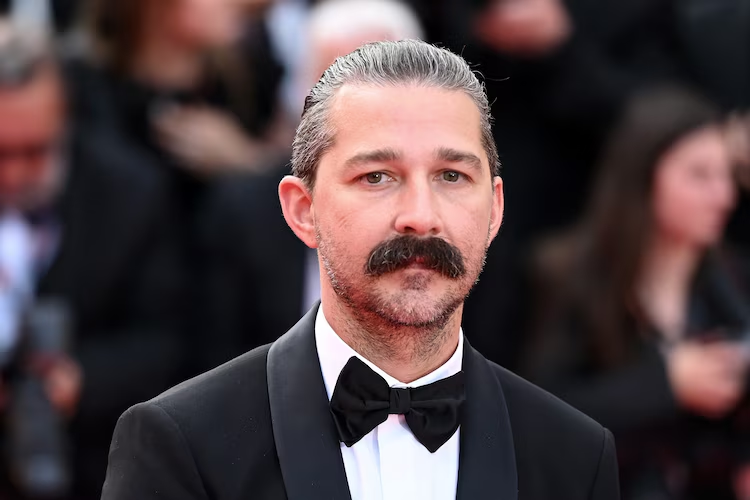
NEW ORLEANS (BN24) — Actor Shia LaBeouf was arrested early Tuesday in New Orleans on two counts of simple battery after police said he allegedly assaulted two men during Lundi Gras festivities in the city’s French Quarter.
The New Orleans Police Department confirmed the arrest in a statement provided to ABC News, outlining allegations that the 39-year-old actor became aggressive outside a business on Royal Street.
Officers were dispatched shortly after 12:45 a.m. on Feb. 17, 2026, to the 1400 block of Royal Street in response to a disturbance involving two adult male victims who reported being struck, police said.
According to authorities, LaBeouf was allegedly creating a disruption inside a Royal Street establishment and became increasingly confrontational. A staff member attempted to escort him from the premises. Once outside, investigators allege, the actor struck one of the men multiple times with closed fists.
Police said LaBeouf briefly left the scene but later returned and continued behaving aggressively. Several bystanders attempted to restrain him in hopes that he would depart without further incident. Instead, authorities allege, he again punched the same individual in the upper body before striking another man in the nose.
Officers indicated that LaBeouf was subdued and held until law enforcement arrived. He was transported to a local hospital for treatment of unspecified injuries before being booked on two counts of simple battery, the department said.
Under Louisiana law, simple battery is defined as the intentional use of force or violence upon another person without the victim’s consent. The charge is generally considered a misdemeanor but can carry penalties including fines and jail time if convicted.
The alleged altercation unfolded during Lundi Gras, a major prelude to Mardi Gras celebrations that draw thousands of visitors to New Orleans’ historic French Quarter each year. Royal Street, known for its galleries, music venues and nightlife, is often heavily trafficked during the annual festivities.
Representatives for LaBeouf did not immediately respond to a request for comment from ABC News.
LaBeouf, widely recognized for his roles in blockbuster films including the “Transformers” franchise, has faced legal and personal challenges in the past, including prior arrests related to disorderly conduct and public intoxication in other cities. However, each incident has unfolded under different circumstances, and no conclusions have been reached regarding the current allegations beyond the charges filed.
The timing of the incident, coinciding with one of the busiest celebrations in New Orleans, may add complexity to the case. Lundi Gras events often involve heightened security presence due to crowd size, alcohol consumption and the city’s dense nightlife environment.
Law enforcement agencies typically increase patrols across the French Quarter during Mardi Gras season. Officials have not indicated whether additional witnesses or surveillance footage contributed to the decision to charge the actor.
If the allegations are substantiated in court, LaBeouf could face penalties consistent with Louisiana’s simple battery statute. Legal analysts note that misdemeanor battery charges can lead to probation, fines or short-term incarceration, depending on prior record and the severity of the conduct.
The case also places renewed attention on celebrity conduct in high-profile public spaces. Incidents involving well-known figures during major public events often generate intense media scrutiny, particularly when video footage or bystander accounts circulate online.
For New Orleans authorities, maintaining public order during Mardi Gras season is a priority. Officials have repeatedly emphasized zero tolerance for violence during the celebrations, given the scale of attendance and economic significance of the festival to the city.
While the charges remain allegations pending judicial proceedings, the arrest adds another chapter to LaBeouf’s complicated public narrative. In recent years, the actor has sought professional reinvention, appearing in independent film projects and speaking publicly about personal struggles and rehabilitation efforts.
An arrest during a globally recognized cultural celebration may intensify public attention and potentially affect ongoing professional engagements. Studios and producers often weigh reputational considerations when evaluating collaborations with actors facing active legal proceedings.
From a broader lens, the incident underscores the intersection of celebrity status, public accountability and law enforcement response during high-density events. High-profile arrests can amplify scrutiny not only on the individual involved but also on how local authorities manage crowd safety and conflict resolution during large-scale gatherings.
As of Tuesday, no court date had been announced. The case is expected to proceed through the Orleans Parish criminal justice system, where prosecutors will determine how to move forward.
LaBeouf remains presumed innocent unless and until proven guilty in a court of law.
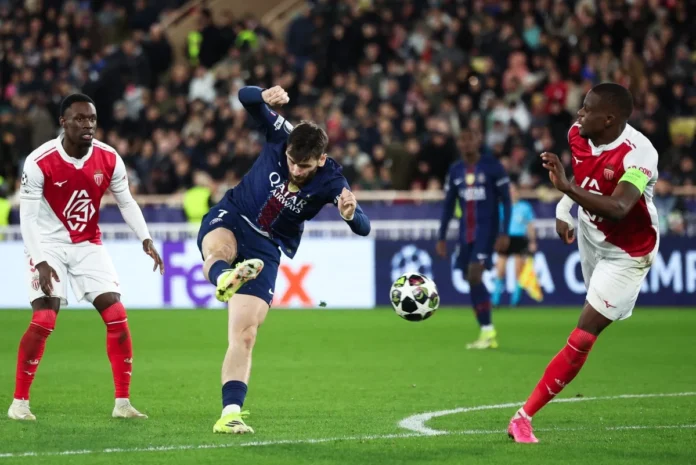
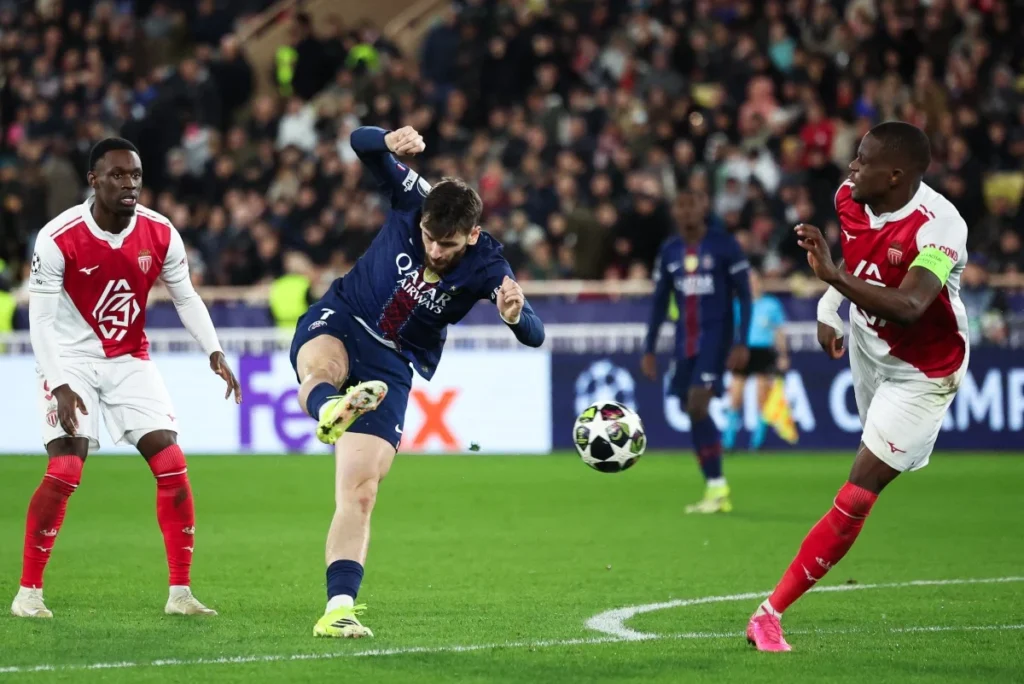
MONACO (BN24) — Paris Saint-Germain erased a two-goal deficit and capitalized on a second-half red card to secure a 3-2 victory over Monaco in the first leg of their Champions League knockout phase playoff Tuesday night, seizing momentum in a tie that now swings heavily toward the French champions.
The visitors endured a chaotic opening at the Stade Louis II, conceding twice inside the first 18 minutes as United States forward Folarin Balogun struck early and again to put Monaco firmly in command. Yet a reshuffled PSG side, sparked by substitute Desire Doue, responded with three unanswered goals to reclaim control of the contest ahead of next week’s return leg in Paris.
Balogun stunned the reigning European champions after just 55 seconds, nodding in from close range off a cross delivered by Aleksandr Golovin. The goal marked the quickest PSG have ever allowed in European competition and ignited a fevered home atmosphere.
Monaco doubled their advantage in the 18th minute when Balogun combined sharply with Maghnes Akliouche before breaking through and finishing past goalkeeper Gianluigi Donnarumma. The early onslaught placed PSG under immediate strain against a side they lead comfortably in Ligue 1 standings but one that has proven capable of troubling elite opposition on home soil.
The Paris club had an opportunity to narrow the gap midway through the half after Khvicha Kvaratskhelia was fouled inside the penalty area by Wout Faes. Vitinha stepped forward but saw his spot kick denied by Monaco goalkeeper Philipp Koehn. The miss continued a troubling pattern for PSG, who have failed to convert four of their last five penalties in Champions League play.
Further complications followed when Ousmane Dembele, last season’s Ballon d’Or recipient, exited before the half-hour mark after appearing discomforted. His departure, however, proved pivotal.
Doue entered and swiftly altered the rhythm of the match. Within minutes, he controlled a pass from Bradley Barcola in the penalty area and drilled a left-footed effort low into the far corner to reduce the deficit. The goal steadied PSG and shifted the emotional tenor of the tie.
The equalizer arrived four minutes before halftime. Doue again was central, forcing Koehn into a save with a driven attempt. Achraf Hakimi reacted quickest, gathering the rebound and slotting home to restore parity before the interval.
Monaco’s prospects dimmed moments into the second half when Golovin was dismissed following a VAR review for a challenge on Vitinha. Reduced to 10 men, the hosts struggled to regain structure as PSG pressed their numerical advantage.
The decisive moment came in the 67th minute. Warren Zaire-Emery laid off a pass to Doue, who finished clinically to complete his brace and cap a dynamic individual display. Monaco attempted to regroup but found limited avenues forward as PSG managed possession and tempo in the closing stages.
The result positions Luis Enrique’s squad as firm favorites to progress when the teams reconvene in Paris next Wednesday. The winner of the tie advances to face either Barcelona or Chelsea in the round of 16.
Despite the defeat, Monaco may draw some consolation from remaining within a single goal after playing much of the second half short-handed. The principality club had previously secured notable home results in European competition this season, holding Manchester City, Tottenham Hotspur and Juventus during the league phase and defeating PSG 1-0 in Ligue 1 in November.
PSG entered the match under scrutiny after relinquishing top spot in the domestic league following a weekend loss at Rennes, allowing Lens to climb to first. Still, the Parisians hold a commanding 20-point cushion over Monaco, who sit eighth and have struggled to string together consistent performances.
The dramatic turnaround underscores PSG’s attacking depth and resilience, qualities that have defined their European campaign. Doue’s impact off the bench also reinforces the club’s evolving identity beyond reliance on established stars. With Dembele sidelined and a penalty squandered, PSG demonstrated an ability to recalibrate under pressure rather than unravel.
Original analysis: The contest highlighted both vulnerability and maturity within this PSG side. Conceding twice inside 20 minutes exposed lingering defensive fragility, particularly in transition and aerial marking. Yet the response illustrated tactical adaptability under Luis Enrique. The manager’s willingness to trust younger options such as Doue and Zaire-Emery paid immediate dividends. Doue’s performance may accelerate his integration into high-stakes European fixtures, offering PSG greater dynamism between the lines.
Monaco’s red card altered the competitive balance, but their early efficiency revealed that PSG remain susceptible to rapid counters. Against opponents of greater clinical precision in later rounds, similar lapses could prove decisive. Additionally, the ongoing penalty conversion issue could become a significant liability in knockout scenarios where margins are slim.
Still, reclaiming composure after adversity signals psychological growth for a club often criticized for faltering in defining Champions League moments. The capacity to absorb setbacks, particularly away from home, enhances their standing as contenders rather than merely participants.
For Monaco, the challenge shifts to damage limitation and belief restoration. Competing effectively for extended stretches against Europe’s reigning champions demonstrates capability, yet disciplinary lapses and defensive fatigue ultimately proved costly. Overcoming a deficit in Paris will require not only tactical discipline but sustained mental resilience.
The second leg now looms as a test of consolidation for PSG and redemption for Monaco. While the aggregate margin remains narrow, momentum resides firmly with the capital club and with it, the expectation that their European ambitions will extend at least one round further.
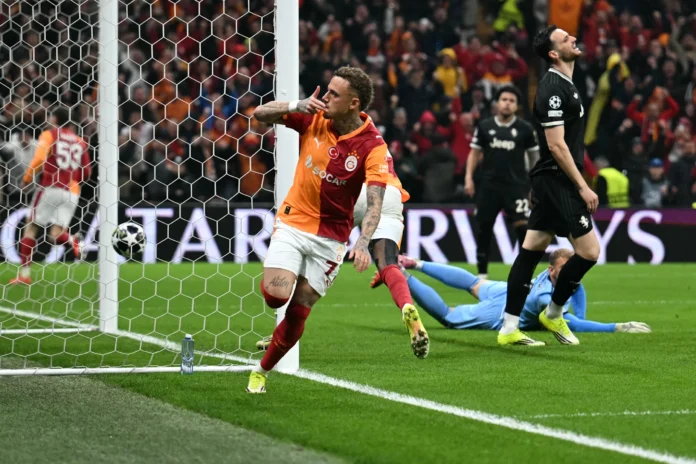
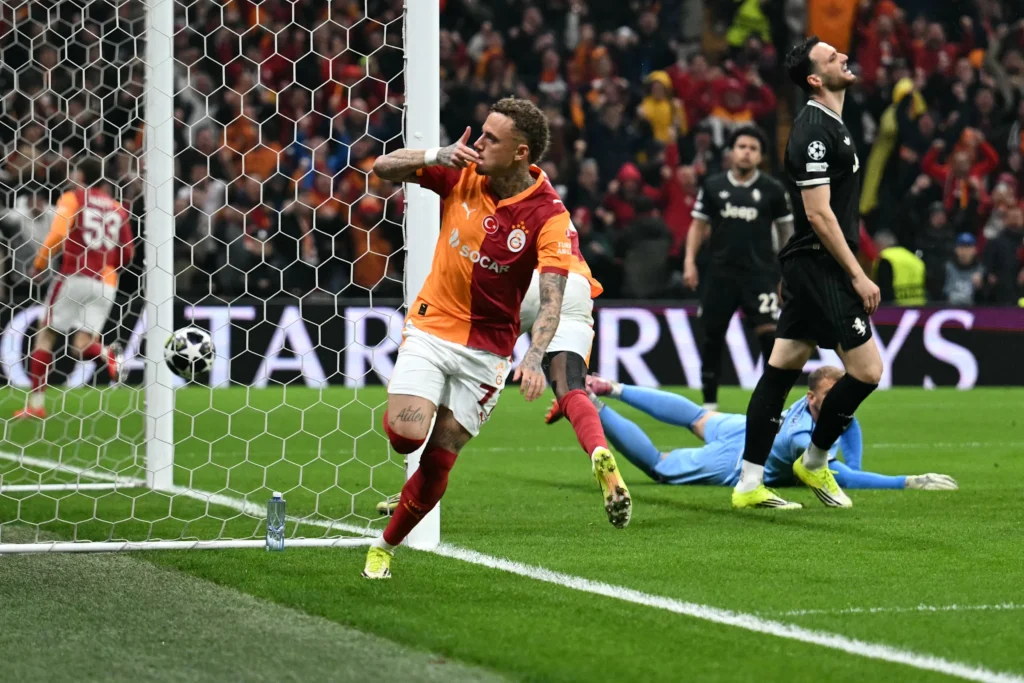
ISTANBUL (BN24) — Galatasaray delivered a commanding 5-2 victory over Juventus on Tuesday night, capitalizing on a second-half unraveling by the Italian side to seize control of their Champions League knockout phase playoff at the Ali Sami Yen Stadium.
The Turkish champions overturned a first-half deficit and exploited a red card to defender Juan Cabal, with Noa Lang scoring twice and Victor Osimhen playing a decisive role in a result that leaves Juventus facing a steep challenge in the return leg.
Juventus began brightly despite conceding early. After falling behind, the visitors responded with authority as Teun Koopmeiners struck twice to swing momentum before halftime. His brace appeared to steady the Italian club and suggested composure in a high-pressure European setting.
The tone shifted dramatically after the break.
Juventus coach Luciano Spalletti opted to withdraw Andrea Cambiaso at halftime, introducing Cabal and tasking him with containing the pace of Galatasaray forward Kenan Yilmaz. The adjustment quickly proved costly. Within 20 minutes, Cabal collected a yellow card and then conceded a free kick on the edge of the area that led to Galatasaray reclaiming the lead at 3-2.
Moments later, Cabal fouled Yilmaz again while attempting to halt a counterattack. Already booked, he was dismissed for a second caution, leaving Juventus to navigate the remainder of the contest with 10 players.
From that point, Galatasaray asserted complete control.
Lang capitalized on defensive hesitation to extend the advantage, lifting a composed finish over goalkeeper Michele Di Gregorio after Victor Osimhen pressured Juventus defender Lloyd Kelly into surrendering possession. The goal exposed mounting errors in Juventus’ back line, which struggled to cope with Galatasaray’s pressing and pace.
Osimhen’s physical presence repeatedly unsettled the Italian defense. In the 87th minute, he won a decisive duel inside the penalty area and laid the ball off for substitute Sacha Boey, who drove a powerful shot beyond Di Gregorio to seal the 5-2 result.
The final whistle triggered jubilant celebrations among the home supporters, while Juventus players exited knowing they will require a four-goal margin in the second leg to overturn the deficit and secure a place in the round of 16.
The defeat represents one of Juventus’ most difficult European nights in recent memory. For 45 minutes, the Italian side displayed tactical discipline and attacking clarity. Koopmeiners’ movement between the lines and clinical finishing suggested that Juventus could dictate the tie’s rhythm.
Yet the second-half collapse underscored vulnerabilities that have surfaced intermittently this season: defensive fragility under sustained pressure, lapses in concentration, and difficulty responding to adverse momentum swings.
Galatasaray, by contrast, showcased resilience and attacking depth. Lang’s brace highlighted his technical composure, while Osimhen’s relentless work rate and physical dominance created opportunities even when he did not score. The Turkish side’s ability to transition quickly from defense to attack proved decisive once Juventus were reduced to 10 men.
The match may serve as a defining moment in both clubs’ European campaigns. For Galatasaray, the performance reinforces their credibility as more than spirited underdogs. Their pressing structure and fluid movement in advanced areas suggest a tactical maturity capable of troubling elite opponents. Lang’s influence, in particular, signals the emergence of a player comfortable dictating high-stakes contest.
Juventus, meanwhile, face broader questions. The halftime substitution and subsequent disciplinary breakdown reflect decision-making under pressure that did not yield stability. Cabal’s dismissal was not merely an individual error but emblematic of a side struggling to recalibrate tactically once momentum shifted.
The magnitude of the deficit complicates the return leg. Overturning a three-goal gap against a confident opponent will demand both attacking boldness and defensive discipline. Juventus must balance urgency with caution to avoid conceding the away goals that could effectively end the tie.
Beyond the immediate implications, the match highlights contrasting trajectories. Galatasaray appear energized by their home atmosphere and capable of sustaining intensity across 90 minutes. Juventus, despite moments of quality, must confront structural inconsistencies that have surfaced in crucial fixtures.
The second leg now carries significant weight for Spalletti’s side. While comebacks of this scale are rare, European competition has long produced dramatic reversals. Juventus will likely emphasize controlled aggression and sharper defensive organization in pursuit of a response.
For now, however, the advantage belongs firmly to Galatasaray. A vibrant attacking display, disciplined pressing and numerical superiority combined to produce a scoreline that places the Turkish club within touching distance of the last 16 and leaves Juventus confronting one of their most daunting European assignments in recent years.
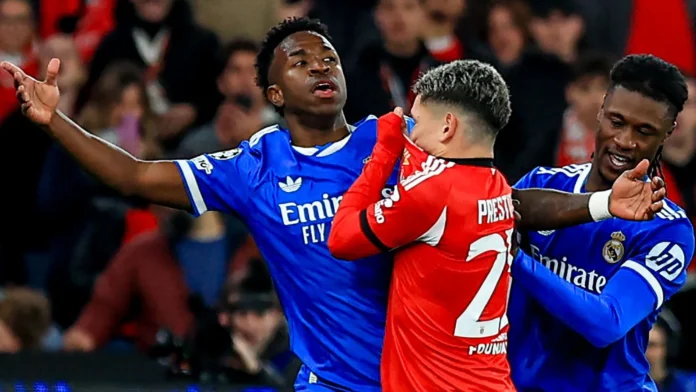
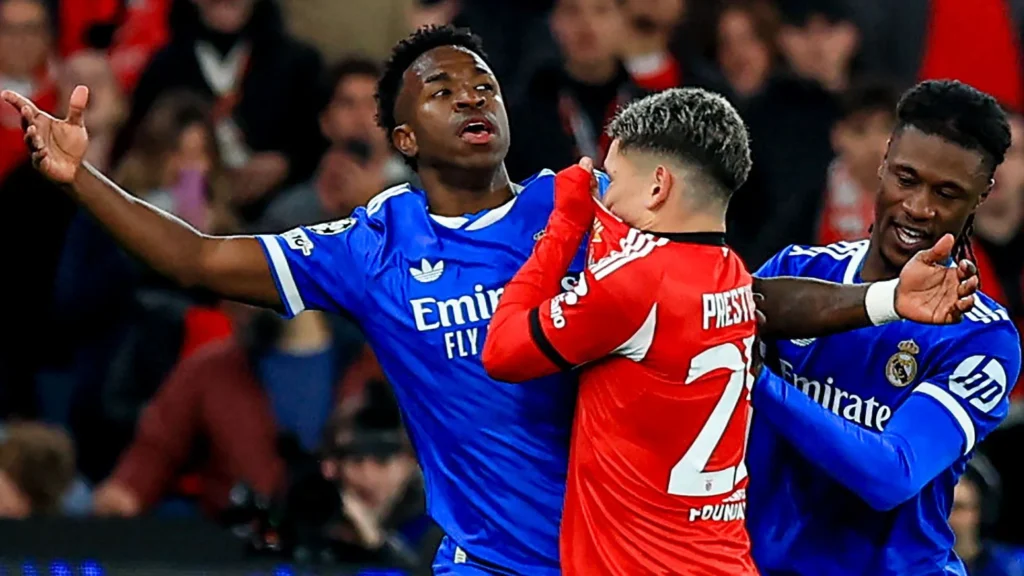
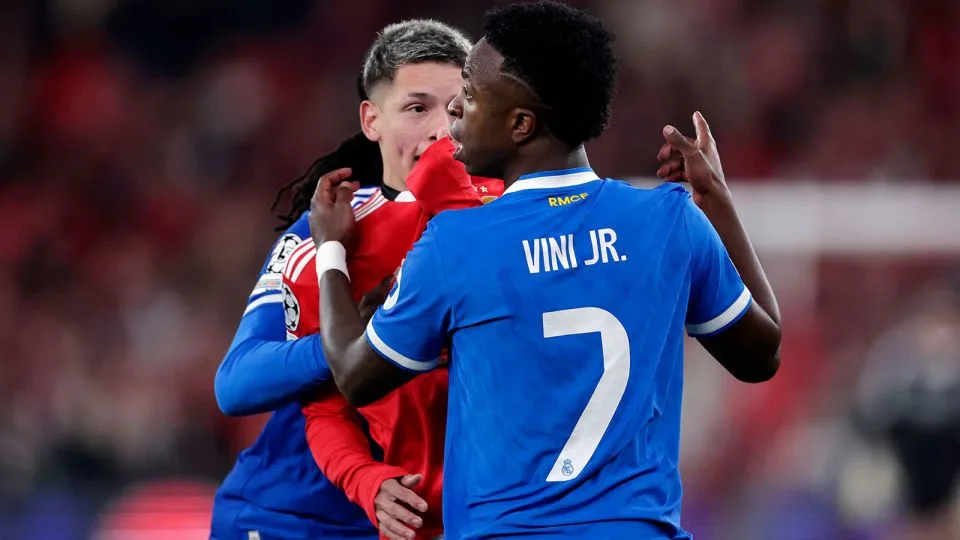
LISBON, Portugal (BN24) — A Champions League match between Real Madrid and Benfica was suspended for nearly 10 minutes Tuesday after Vinícius Júnior accused an opponent of directing a racial slur at him during Madrid’s 1-0 victory at the Estádio da Luz.
The interruption came moments after Vinícius curled a right-footed shot into the top corner in the 52nd minute, putting the Spanish club ahead. As the Brazil forward celebrated near the corner flag, sections of the home crowd responded by jeering and throwing objects toward Madrid players.
French referee François Letexier halted play, crossing his arms above his head to activate UEFA’s anti-racism protocol after Vinícius approached him with a complaint.
Television footage captured Vinícius pointing toward Benfica midfielder Gianluca Prestianni and informing the referee that the Argentine player had called him a “monkey.” Prestianni had confronted Vinícius moments earlier, speaking while covering his mouth with his jersey.
Vinícius, who has faced repeated incidents of racist abuse in Spain and elsewhere during his career, then moved toward the sideline and sat in the dugout as teammates gathered around him. Some Madrid players briefly appeared to consider leaving the field.
Forward Kylian Mbappé and midfielder Aurélien Tchouaméni later indicated that the team discussed whether to abandon the match but ultimately chose to continue. Mbappé said he consulted Vinícius before play resumed.
“What’s happened tonight is a disgrace to football,” Madrid defender Trent Alexander-Arnold said after the game. “It’s overshadowed the performance, especially after such an amazing goal. Vini has been subjected to this a few times throughout his career, and for it to happen tonight and ruin the night for us as a team is a disgrace. There’s no place for it in football or society. It’s disgusting.”
The referee allowed the match to proceed in the 60th minute. Prestianni was not cautioned and remained on the field until the 81st minute, when he was substituted to applause from home supporters. Vinícius was loudly jeered for the remainder of the match and was struck by a thrown bottle late in the contest near the sideline. Letexier requested a stadium announcement warning fans against throwing objects onto the pitch.
Madrid midfielder Federico Valverde said teammates who were nearby heard an offensive remark. “The players who were near said that he said something ugly, that shouldn’t be said,” Valverde said. “If you cover your mouth to say something it’s because you are saying something that is not nice. I’m proud of my teammates who defended Vini and of Vini.”
Benfica players disputed the allegation. Midfielder Leandro Barreiro said Prestianni described the exchange as typical on-field provocation without racial intent. “He said it was a normal provocation between players during a match,” Barreiro said. “He said it was nothing racist.”
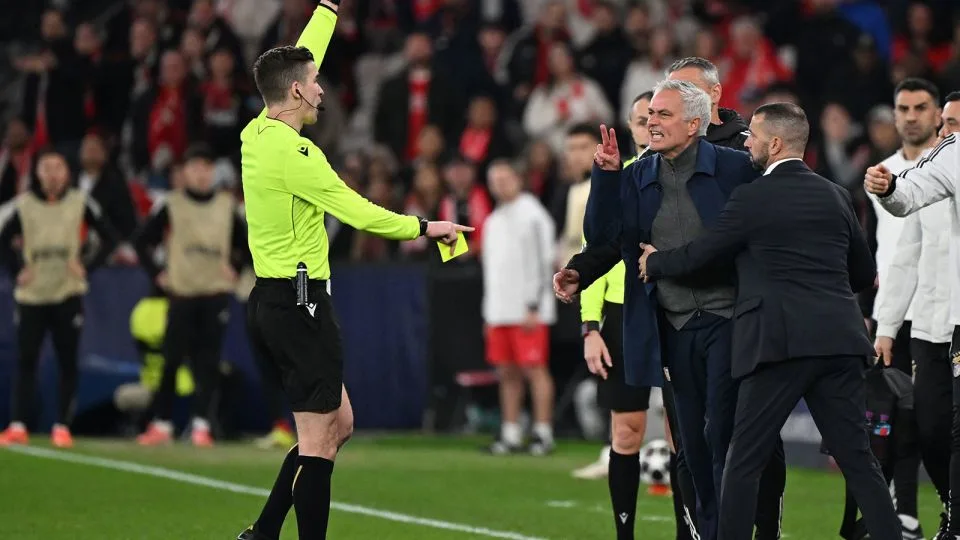
Benfica coach José Mourinho, speaking to Amazon Prime, declined to declare which account he believed after conversations with both players. He criticized Vinícius’ goal celebration near the home supporters, suggesting it inflamed tensions.
“Unfortunately he was not just happy to score that astonishing goal,” Mourinho said. “When you score a goal like that, you celebrate in a respectful way.”
Mourinho added that Benfica’s most celebrated historical figure, Eusébio, was Black and implied he found it difficult to understand why incidents involving Vinícius recur in multiple stadiums. “There is something wrong because it happens in every stadium,” Mourinho said. “The stadium where Vinicius played something happened. Always.”
Madrid coach Álvaro Arbeloa was seen speaking with Vinícius during the stoppage.
After the match, Vinícius posted a photograph on Instagram of his celebration near the corner flag and wrote: “Racists are, above all, cowards. They need to cover their mouths with their shirts to show how they are weak. … Nothing that happened today is new to me in my life and in my family’s life. I was shown a yellow card for celebrating a goal. I still don’t know why.”
The Brazilian Football Confederation expressed support on social media, declaring that Vinícius was “not alone” and emphasizing that racism is a crime with no place in soccer. The federation described his decision to report the incident as an example of courage and dignity.
Mbappé, who was seen confronting Prestianni during the heated exchanges, voiced frustration. “We can’t accept that a player who plays in Europe’s top competition behaves like that,” Mbappé said. “He shouldn’t keep playing in the competition. Let’s see what happens now.”
The referee appeared to indicate during the review that he had not personally heard the alleged remark.
The controversy overshadowed Madrid’s narrow victory, secured by Vinícius’ curling finish. Tensions escalated further in the closing minutes when Mourinho, a former Madrid coach, was sent off in the 86th minute for dissent. He later suggested that certain Madrid players were not being cautioned despite fouls that could have triggered suspensions through card accumulation.
The episode in Lisbon once again places European soccer’s anti-racism framework under scrutiny. UEFA’s protocol which includes match suspension and potential abandonment is designed to send a visible message. Yet repeated incidents involving high-profile players like Vinícius suggest that enforcement and deterrence remain inconsistent across competitions and venues.
Vinícius has become a focal point in broader debates about racism in European sport. His willingness to publicly confront alleged abuse has drawn both praise and criticism, reflecting polarized responses among supporters and commentators. The tension between expressive goal celebrations and crowd hostility illustrates how quickly competitive friction can escalate into something more troubling.
For clubs and governing bodies, the challenge lies not only in punishing confirmed offenders but in reinforcing preventive measures. The fact that players briefly contemplated leaving the field underscores how close the sport can come to more dramatic protest actions.
As investigations proceed, the incident is likely to renew calls for stronger sanctions and clearer accountability mechanisms. Whether disciplinary authorities pursue action against individuals or clubs may shape perceptions of how seriously European soccer addresses racism at its highest level.
For now, the match result stands, but the debate it reignited may carry far greater consequences than the three points secured on the field.
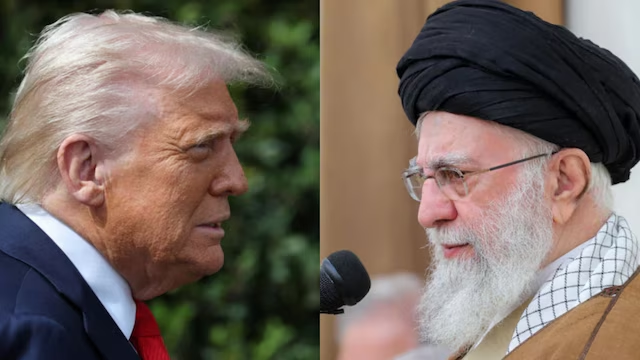
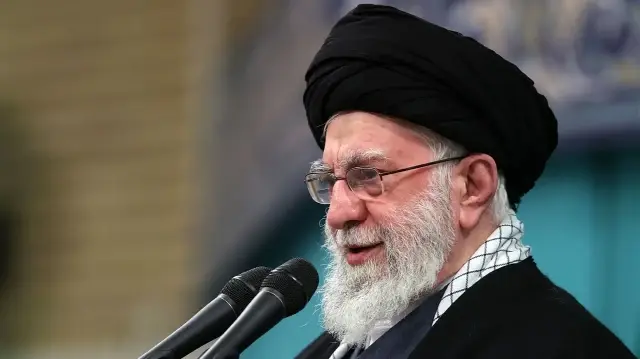
(Reuters)-Iran’s Supreme Leader, Ayatollah Ali Khamenei, warned Tuesday that U.S. naval vessels operating near Iranian waters could be sent “to the bottom of the sea,” escalating rhetoric as American and Iranian officials met for a second round of negotiations over Tehran’s nuclear program.
In posts published on the social platform X, Khamenei responded to reports of increased U.S. naval deployments in the region. “The Americans constantly say that they’ve sent a warship toward Iran,” he wrote, calling such vessels “dangerous pieces of military hardware.” He added that “more dangerous than that warship is the weapon that can send that warship to the bottom of the sea.”
The remarks came as delegations from Washington and Tehran convened in Geneva for renewed discussions aimed at curbing Iran’s uranium enrichment activities. U.S. officials are seeking a revised framework after President Donald Trump, during his first term, withdrew the United States from the 2015 Joint Comprehensive Plan of Action, the multilateral agreement that limited Iran’s nuclear activities in exchange for sanctions relief.
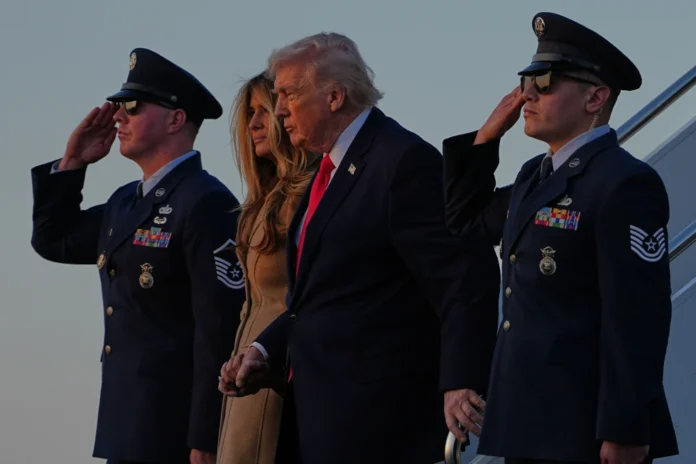
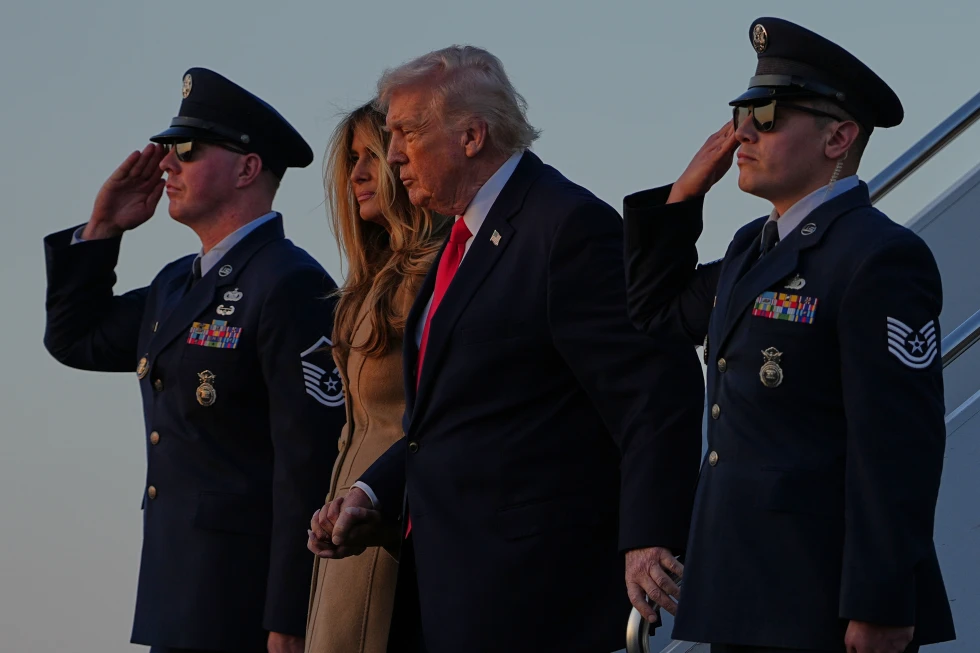
President Donald Trump has signaled optimism about reaching an accord but coupled that with pointed warnings. Speaking to reporters last week, he said failure to secure a deal would be “a bad day for Iran, very bad,” reiterating that the United States would not tolerate an expansion of Tehran’s enriched uranium program.
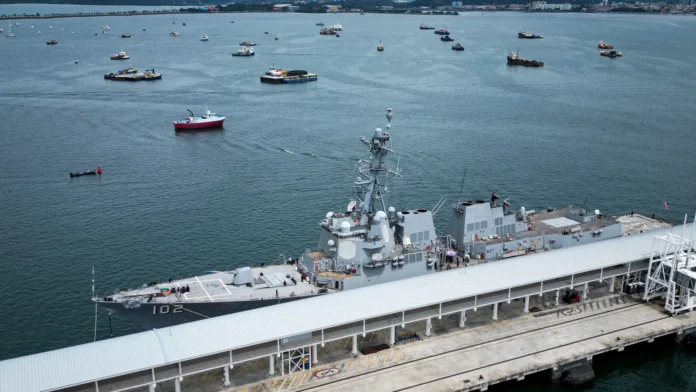
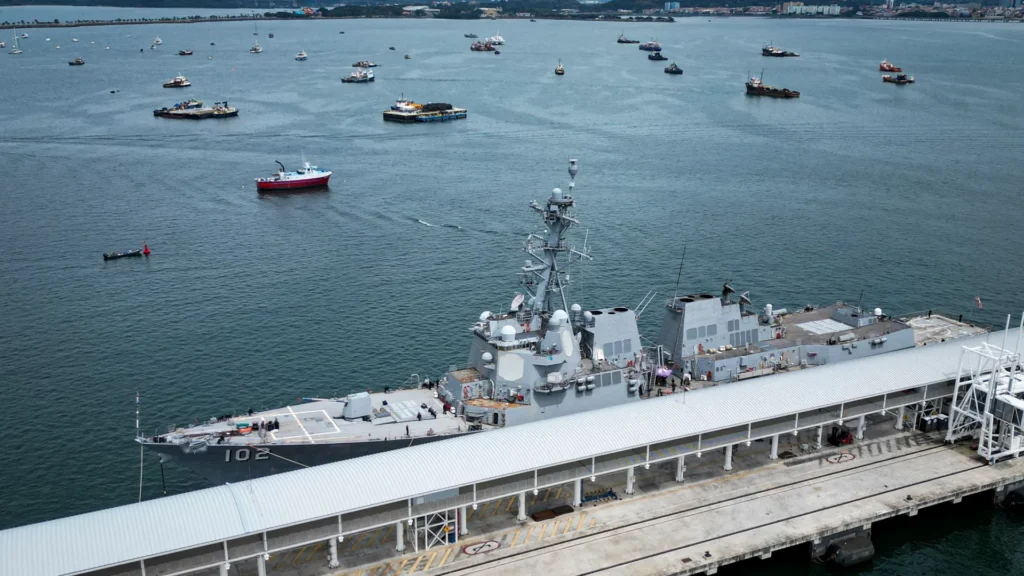
The president also confirmed that the USS Gerald R. Ford — the world’s largest aircraft carrier — is being deployed to the Middle East. The carrier strike group is set to operate alongside other U.S. warships already stationed within the area of responsibility of U.S. Central Command, the military command overseeing American operations across much of the Middle East.
The deployment underscores mounting tensions as both sides test the boundaries of diplomacy and deterrence. Trump has repeatedly stated that the United States is prepared to use military force if Iran continues advancing its nuclear capabilities or intensifies internal crackdowns. Activist groups in January estimated that more than 6,000 people had died during protests that erupted late last year amid economic turmoil and a sharply declining national currency. Iranian authorities have not released official casualty figures.
Tehran, for its part, has sought to project military readiness. Iranian forces have conducted maritime drills in recent days in the Strait of Hormuz, a strategic chokepoint through which a significant portion of the world’s oil supply passes. The exercises reportedly included live-fire missile components. U.S. Central Command had earlier cautioned Iran against what it described as unsafe maritime conduct in the region.
In a separate message Tuesday, Khamenei dismissed assertions of overwhelming U.S. military dominance. “The U.S. president keeps saying that they have the strongest military force in the world,” he wrote. “The strongest military force in the world may at times be struck so hard that it cannot get up again.”
The sharp language reflects a broader pattern of brinkmanship that has defined U.S.-Iran relations in recent years. While negotiators meet in conference rooms, both governments are addressing domestic audiences — projecting strength abroad while navigating political pressures at home.
The 2015 nuclear accord, negotiated under President Barack Obama, imposed caps on uranium enrichment levels and stockpiles, along with intrusive international inspections. In 2018, President Donald Trump withdrew from the agreement, arguing that it failed to address Iran’s ballistic missile program and regional activities. Since then, Iran has incrementally expanded its enrichment levels beyond the limits set by the original deal.
Diplomats familiar with the Geneva talks say the discussions are focused on establishing stricter verification measures and potentially broader restrictions on enrichment, while exploring phased sanctions relief. However, Tehran has maintained publicly that it will not abandon its uranium enrichment program altogether, framing it as a sovereign right under international law.
The presence of additional U.S. naval assets adds a layer of military pressure that analysts say could either strengthen Washington’s negotiating leverage or complicate delicate diplomacy. Aircraft carriers serve not only as combat platforms but also as potent symbols of U.S. resolve.
At the same time, Iran’s warnings are consistent with its longstanding strategy of asymmetric deterrence. By emphasizing its missile capabilities and its ability to threaten maritime traffic in the Strait of Hormuz, Tehran signals that any direct confrontation would carry regional and global economic consequences.
Energy markets and regional allies are watching closely. Disruption in the Strait of Hormuz could affect global oil prices and shipping routes, heightening concerns among European and Asian economies dependent on Middle Eastern energy supplies.
Despite the heated rhetoric, diplomatic channels remain open. Neither side has announced a breakdown in talks, and officials have indicated that additional rounds are expected. Whether the negotiations can yield a durable framework — or whether escalating military gestures will overshadow diplomacy — remains uncertain.
For now, the exchange between Ayatollah Ali Khamenei and President Donald Trump highlights the fragile balance between negotiation and confrontation, with warships at sea and nuclear centrifuges at the center of a high-stakes standoff.
(AP) — The Trump Organization has applied for federal trademark protection covering the use of President Donald Trump’s name on airports and a wide range of related services and merchandise, a move the company says is intended to safeguard its brand rather than generate profit.
Records filed with the U.S. Patent and Trademark Office show that a Trump family business entity, DTTM Operations, submitted applications seeking exclusive rights to three variations of the president’s name for airport-related use: “President Donald J. Trump International Airport,” “Donald J. Trump International Airport,” and “DJT.”
The filings extend beyond the naming of airport facilities themselves, encompassing transportation services such as passenger shuttle buses as well as retail items and travel accessories commonly associated with airports, including umbrellas, travel bags and flight suits.
The applications surfaced as Florida lawmakers debate a proposal to rename Palm Beach International Airport after President Donald Trump. The airport is located near Trump’s Mar-a-Lago club in Palm Beach. Separate discussions involving infrastructure projects in the Northeast and proposals connected to Dulles International Airport in Virginia have also included suggestions that Trump’s name be attached to public facilities.
In a statement, the Trump Organization indicated that the trademark applications were prompted by the Florida legislation and emphasized that no financial benefit is anticipated from the proposed renaming of the Palm Beach airport.
“To be clear, the President and his family will not receive any royalty, licensing fee, or financial consideration whatsoever from the proposed airport renaming,” the company said.
The organization described the filings as a protective measure, arguing that the Trump name is “the most infringed trademark in the world” and asserting that the move is designed to prevent unauthorized or misleading uses of the brand by third parties.
Company representatives did not immediately clarify whether royalties or licensing fees could be pursued if other airports were to adopt the president’s name or if the trademarks were applied to commercial merchandise referenced in the filings.
Josh Gerben, a trademark attorney who first identified the applications, characterized them as highly unusual. Writing on his blog, Gerben noted that while public buildings and landmarks have often been named in honor of presidents and other officials, he was unaware of any instance in which a sitting president’s private company sought trademark rights in anticipation of such naming.
“While presidents and public officials have had landmarks named in their honor, a sitting president’s private company has never in the history of the United States sought trademark rights in advance of such naming,” Gerben wrote, describing the filings as unprecedented.
The filings are the latest example of the Trump family’s broader branding efforts over the past year. The company has expanded the use of the Trump name across international real estate ventures, including towers, golf resorts and residential developments in the Middle East and Asia. It has also marketed branded consumer products such as electric guitars, Bibles and sneakers through DTTM Operations, the same entity listed in the airport-related trademark applications.
President Donald Trump has previously addressed concerns that his business interests could intersect with his public office, stating that his company is held in trust and managed by his sons. He has maintained that he does not oversee day-to-day operations.
Ethics experts say the airport trademark filings could intensify debate over the relationship between private branding and public institutions. Although trademark registration does not automatically confer naming rights to public infrastructure, it grants legal standing to prevent others from using protected terms in specified commercial categories.
Legal scholars note that federal trademark law allows individuals and companies to register names associated with living persons, provided certain consent requirements are met. Because the applications were filed by a company affiliated with President Donald Trump, issues of consent are unlikely to arise. The more complex questions, they say, involve public policy and optics rather than statutory eligibility.
If granted, the trademarks would enable the Trump Organization to challenge unauthorized commercial uses of the specified airport names in areas covered by the registrations. That protection could apply to marketing materials, branded merchandise, transportation services or other commercial activities linked to airport operations.
Whether any airport will ultimately adopt the president’s name remains uncertain. Renaming public facilities typically requires legislative approval at the state or federal level and may involve local authorities, aviation regulators and, in some cases, voter input.
Supporters of renaming efforts argue that presidents are often honored through infrastructure projects, highways and federal buildings. Critics contend that formalizing trademark protections while a president is still in office introduces new complexities, particularly when a private company is positioned to control commercial aspects tied to the name.
The U.S. Patent and Trademark Office will review the applications to determine whether they meet statutory requirements, including distinctiveness and potential conflicts with existing registrations. The process can take several months and may involve requests for clarification or opposition from third parties.
For now, the filings underscore the intersection of politics, branding and intellectual property law during President Donald Trump’s time in office. While the Trump Organization frames the move as a defensive step aimed at brand protection, legal observers say its novelty ensures that it will draw scrutiny as the review process unfolds.
The U.S. military carried out strikes on three boats it described as drug-smuggling vessels in Latin American waters, killing 11 people, in one of the deadliest single days of President Donald Trump’s expanding campaign against cartels, officials said Tuesday.
U.S. Southern Command said the coordinated action took place Monday along established maritime trafficking corridors. According to the command, two boats traveling in the eastern Pacific Ocean — each carrying four people — were destroyed, while a third vessel in the Caribbean Sea with three people aboard was also struck.
The military did not release the identities of those killed or provide independent evidence demonstrating that the boats were transporting narcotics. However, it circulated video footage showing small vessels engulfed in explosions and sinking into open waters.
Monday’s operation pushes the reported death toll to at least 145 people since early September, when the Trump administration began authorizing strikes on what it calls “narcoterrorists” operating in small craft across the region. The campaign has resulted in at least 42 known maritime strikes, according to official tallies released by the military.
President Donald Trump has repeatedly framed the operations as part of what he describes as an “armed conflict” with Latin American drug cartels. He has argued that more aggressive action is required to curb the flow of narcotics into the United States, particularly synthetic opioids and cocaine trafficked through maritime routes.
Administration officials maintain that the strikes are lawful exercises of national defense and counterterrorism authorities, asserting that criminal networks involved in large-scale drug trafficking pose a direct security threat to the United States.
Still, critics have questioned the legal basis and evidentiary standards underlying the campaign. The military’s public statements, including Tuesday’s announcement, have not included corroborating intelligence findings, seizure data, or forensic evidence linking the targeted vessels to specific drug shipments.
U.S. Southern Command described the boats as operating along “known smuggling routes” frequently used to move narcotics from production zones in South America toward Central America, Mexico and eventually the United States. Those routes, spanning the eastern Pacific and Caribbean corridors, have long been focal points for maritime interdiction efforts led by the U.S. Coast Guard and partner nations.
Unlike traditional interdiction missions, which typically involve boarding, inspection and seizure, the current campaign has relied on direct kinetic strikes that destroy suspect vessels at sea. Military officials have not detailed whether warnings were issued or whether efforts were made to detain occupants prior to engagement.
Security analysts say the shift reflects a broader recalibration in U.S. counter-narcotics policy under President Donald Trump, who has sought to elevate cartel activity to a national security priority. By labeling traffickers as “narcoterrorists,” the administration has broadened the conceptual framework for using military force beyond conventional law enforcement models.
The eastern Pacific corridor remains one of the world’s busiest drug transit zones, with traffickers often employing low-profile vessels, so-called “go-fast” boats, and semi-submersible craft designed to evade radar detection. The Caribbean Sea, meanwhile, serves as an alternative conduit for shipments destined for the southeastern United States and Europe.
The mounting casualty figures have raised concerns among human rights advocates and some lawmakers, who argue that the absence of publicly presented evidence complicates efforts to assess whether those killed were directly involved in trafficking operations. They also question whether intelligence used to designate targets has been independently verified.
Administration officials counter that operational security considerations limit what information can be released publicly. They argue that revealing detailed intelligence would compromise ongoing surveillance methods and partnerships with regional allies.
The Trump administration has consistently defended the strikes as necessary to disrupt supply chains at their source, asserting that traditional interdiction efforts have failed to stem the volume of narcotics entering U.S. markets. Supporters of the strategy say eliminating vessels before shipments reach land denies cartels both profit and operational capacity.
Regional governments have responded cautiously. While some Latin American officials have privately welcomed expanded U.S. maritime enforcement, others have expressed unease about the precedent set by unilateral or near-unilateral use of force in international waters. Diplomatic channels have remained active, but public endorsements have been limited.
Experts in maritime security note that destroying small boats does not automatically dismantle larger trafficking networks, which often rely on compartmentalized logistics structures. They argue that while strikes may disrupt individual shipments, cartels can adapt by altering routes, increasing redundancy, or shifting to land-based corridors.
At the same time, proponents contend that the psychological and financial costs imposed by repeated strikes may deter recruitment and complicate cartel planning. The administration has signaled that additional operations are likely in the coming weeks.
U.S. Southern Command did not indicate whether any drugs were recovered from the wreckage of the three boats struck Monday, nor did it disclose whether follow-up assessments are underway.
As the campaign enters its sixth month, the administration’s strategy appears firmly entrenched, with President Donald Trump continuing to portray the maritime operations as central to his broader effort to confront transnational criminal organizations.
Whether the escalation will significantly reduce narcotics flows into the United States remains uncertain. For now, the strikes mark a continuation — and intensification — of a military-led approach to a problem long dominated by law enforcement and diplomatic tools.
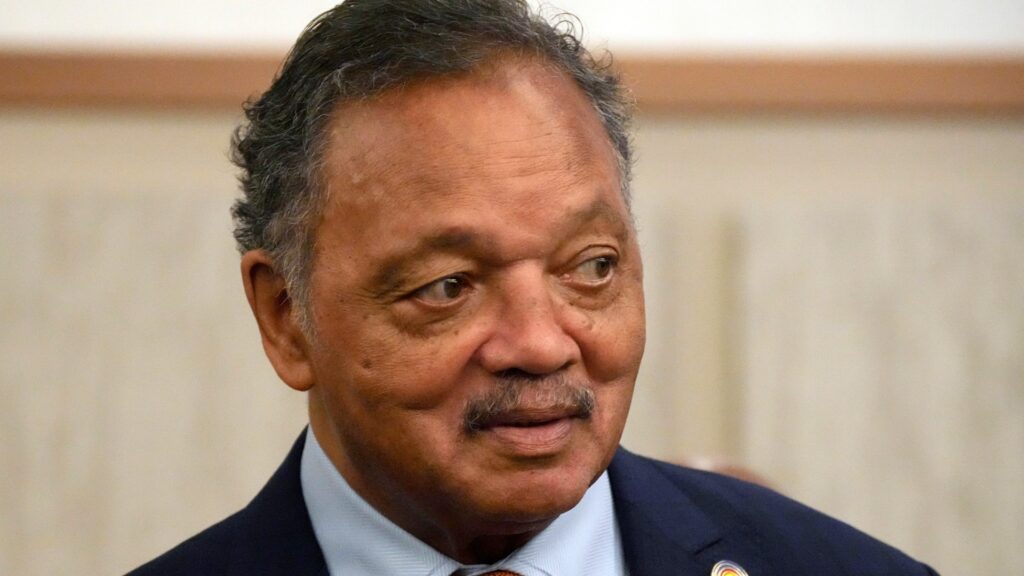
CHICAGO — The Rev. Jesse L. Jackson, who emerged from the segregated South to become America’s most prominent civil rights leader after the assassination of the Rev. Martin Luther King Jr., sustained the movement’s moral force across more than five decades of protest, politics, and international diplomacy before dying Tuesday at his Chicago home. He was 84.
The Rev. Jesse L. Jackson
His daughter Santita Jackson confirmed that her father, who suffered from a rare and debilitating neurological disorder, passed away surrounded by family members at his home, ending a life of extraordinary public consequence that transformed American politics, corporate America, and the global understanding of racial justice.
“Our father was a servant leader — not only to our family, but to the oppressed, the voiceless, and the overlooked around the world,” the Jackson family said in a statement. “We shared him with the world, and in return, the world became part of our extended family.”
The Rev. Al Sharpton, whom Jackson mentored across decades of activism, captured the magnitude of the loss with characteristic directness. “He was not simply a civil rights leader; he was a movement unto himself,” Sharpton wrote. “He taught me that protest must have purpose, that faith must have feet, and that justice is not seasonal, it is daily work.”
Jackson’s death closes a direct living connection to the civil rights era’s most transformative chapter. He was present at the Lorraine Motel in Memphis, Tennessee, on April 4, 1968, when King was assassinated, and afterward publicly positioned himself as the slain leader’s spiritual and organizational successor—a claim that defined both his towering achievements and the controversies that followed him throughout his remarkable life.
Jesse Louis Jackson was born October 8, 1941, in Greenville, South Carolina, the son of high school student Helen Burns and Noah Louis Robinson, a married neighbor. He was later adopted by Charles Henry Jackson, who married his mother. His origins in the segregated South gave visceral authenticity to his lifelong advocacy for those excluded from American opportunity.
A gifted athlete, Jackson excelled as quarterback on the football team at Sterling High School in Greenville, earning a scholarship from the University of Illinois. However, after reportedly being informed that Black athletes could not play quarterback, he transferred to North Carolina A&T in Greensboro, where he flourished as starting quarterback, honor student in sociology and economics, and student body president—demonstrating the determination to excel despite discriminatory barriers that would characterize his entire career.
His arrival at the historically Black campus in 1960 coincided with students there launching sit-ins at whites-only lunch counters, immersing him in the blossoming Civil Rights Movement at a formative moment. By 1965, he had joined the landmark voting rights march King led from Selma to Montgomery, Alabama, cementing his place within the movement’s core leadership.
King dispatched the young Jackson to Chicago to launch Operation Breadbasket, a Southern Christian Leadership Conference initiative pressuring corporations to hire Black workers—an assignment that showcased both his organizational talent and his ability to translate moral arguments into tangible economic outcomes. Jackson later described his years working directly under King as “a phenomenal four years of work.”
The circumstances of King’s assassination produced one of the most contested episodes in Jackson’s biography. He maintained that King died in his arms and wore a turtleneck he claimed was soaked with King’s blood for two days following the murder, including at a Chicago City Council memorial service. “I come here with a heavy heart because on my chest is the stain of blood from Dr. King’s head,” Jackson declared at that gathering. Several King aides questioned whether Jackson could have gotten blood on his clothing, and no photographs from immediately after the shooting show Jackson in the position he described.
In 1971, Jackson parted ways with the SCLC to establish Operation PUSH—People United to Save Humanity—on Chicago’s South Side. The organization pursued an ambitious agenda spanning workforce diversification, voter registration, and educational reform. Through lawsuits and threatened boycotts, Jackson compelled major corporations to commit millions of dollars and public pledges to hire more diverse employees, channeling the civil rights movement’s moral energy into corporate accountability in ways that fundamentally changed American business practices.
He later merged Operation PUSH with his National Rainbow Coalition to form the Rainbow/PUSH Coalition, which became the institutional home for his ongoing advocacy. Through this platform, Jackson pressured executives in corporate boardrooms, declared that Black pride and self-determination were non-negotiable demands, and channeled the aspirations of marginalized communities into tangible institutional change.
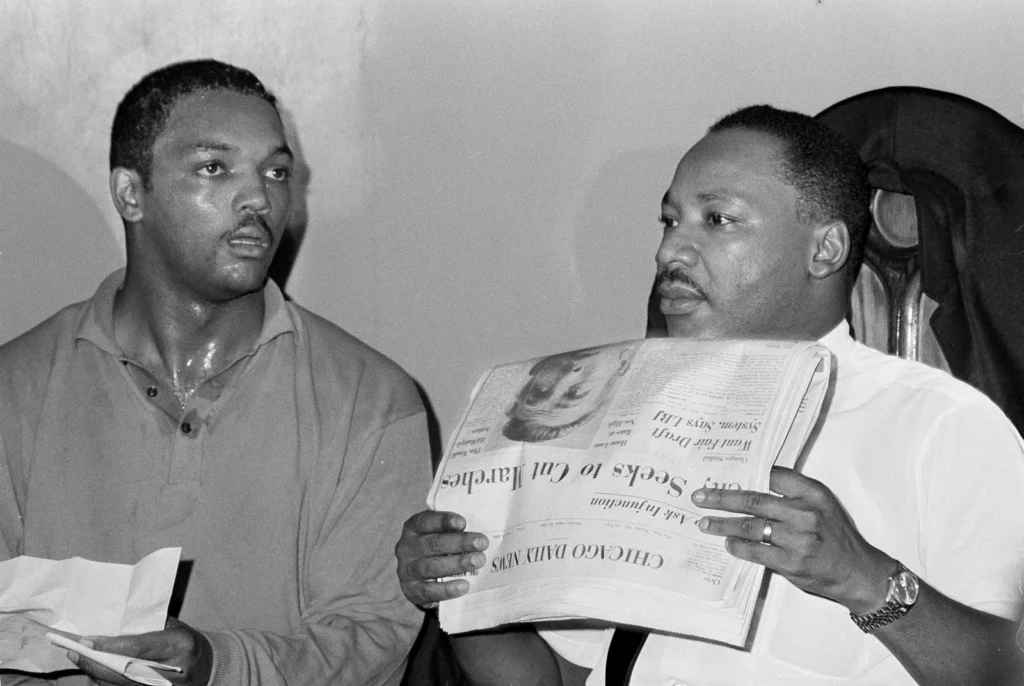
Jesse Jackson and Martin Luther King
His signature proclamation—”I am Somebody”—distilled his philosophy into a defiant declaration of human dignity. “I may be poor, but I am Somebody; I may be young; but I am Somebody; I may be on welfare, but I am Somebody,” Jackson intoned at rallies across the country, reaching audiences of all backgrounds with a message simultaneously personal and universal.
Jackson’s resonant voice, shaped by the stirring cadences of the Black church, commanded attention wherever he spoke. His deployment of rhyme and memorable slogans—”Hope not dope,” “Keep hope alive,” and “If my mind can conceive it and my heart can believe it, then I can achieve it”—gave his political philosophy a musical quality that made complex arguments accessible and memorable across diverse audiences.
His two campaigns for the Democratic presidential nomination represented watershed moments in American political history. Jackson had once told a Black audience he would not seek the presidency “because white people are incapable of appreciating me,” yet his first campaign in 1984 demonstrated substantial support that his second campaign in 1988 dramatically expanded, winning 13 primaries and caucuses—more than any Black politician had achieved before Barack Obama’s historic 2008 victory.
“I was able to run for the presidency twice and redefine what was possible; it raised the lid for women and other people of color,” Jackson told the Associated Press. “Part of my job was to sow seeds of the possibilities.”
The late Representative John Lewis, himself a civil rights icon, observed during a 1988 C-SPAN interview that Jackson’s presidential campaigns “opened some doors that some minority person will be able to walk through and become president”—a prophecy fulfilled two decades later when Obama won the White House.
When Obama was elected, Jackson stood in Chicago’s Grant Park with tears streaming down his face. “I wish for a moment that Dr. King or Medgar Evers could’ve just been there for 30 seconds to see the fruits of their labor,” he later told the Associated Press. “I became overwhelmed. It was the joy and the journey.”
Jackson also pushed for cultural transformation beyond electoral politics, joining NAACP members and other movement leaders in the late 1980s to promote identifying Black Americans as African Americans. “To be called African Americans has cultural integrity — it puts us in our proper historical context,” he explained. “Every ethnic group in this country has a reference to some base, some historical cultural base. African Americans have hit that level of cultural maturity.”
His influence extended powerfully beyond American borders. Jackson secured the 1984 release of Navy Lt. Robert Goodman from Syrian custody through direct negotiations with President Hafez al-Assad, demonstrating that private citizens with moral authority could accomplish what formal diplomacy sometimes could not. In 1990, he obtained freedom for more than 700 foreign women and children held after Iraq’s invasion of Kuwait, and in 1999 he won the release of three Americans imprisoned by Yugoslav President Slobodan Milosevic.
President Bill Clinton awarded Jackson the Presidential Medal of Freedom in 2000—the nation’s highest civilian honor—in recognition of his decades of service to human dignity and democratic values.
“Citizens have the right to do something or do nothing,” Jackson said before departing for one of his diplomatic missions. “We choose to do something.” That phrase encapsulated the activist philosophy he embodied throughout his public life.
Jackson’s career was not without significant controversy. In 1984, he apologized for private remarks to a reporter in which he called New York City “Hymietown,” a derogatory reference to its substantial Jewish population that generated lasting damage to his standing within Jewish communities and raised questions about his commitment to fighting all forms of bigotry. In 2008, an open microphone captured him complaining that Obama was “talking down to Black people” during a television taping break—comments that complicated his relationship with the man whose election he would later celebrate with tears.
He also acknowledged fathering a daughter, Ashley Jackson, with a Rainbow/PUSH employee, Karen L. Stanford. Jackson, who had been ordained as a Baptist minister in 1968 and earned a master’s of divinity degree in 2000, stated he understood what it meant to be born out of wedlock and supported his daughter emotionally and financially.
Critics throughout his career accused Jackson of grandstanding and seeking media attention at the expense of substantive work. Jackson addressed such assessments with characteristic directness, telling the Associated Press in 2011 that decades of effort had produced measurable results. “A part of our life’s work was to tear down walls and build bridges, and in a half century of work, we’ve basically torn down walls,” he said. “Sometimes when you tear down walls, you’re scarred by falling debris, but your mission is to open up holes so others behind you can run through.”
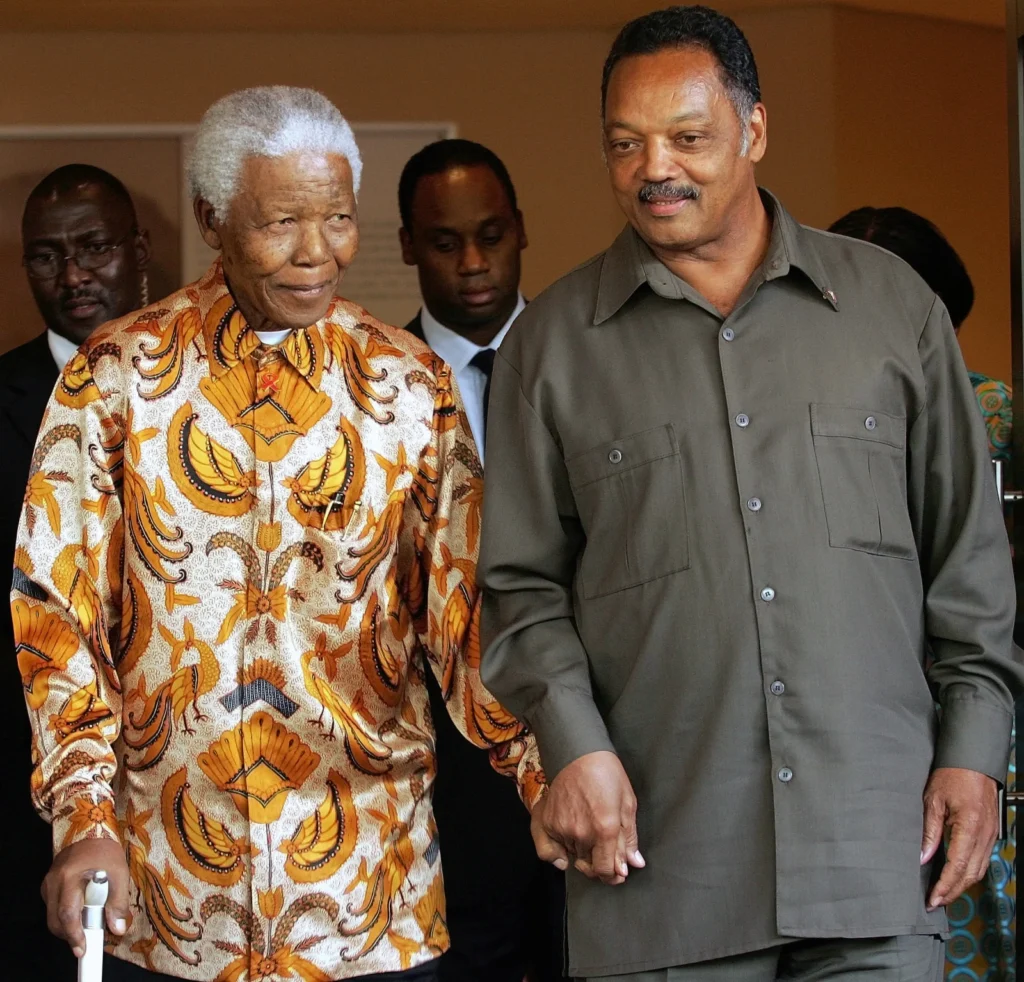
Jesse Jackson and Mandela
His constant campaigns created enormous demands that fell heavily on his wife, Jacqueline Lavinia Brown, the college sweetheart he married in 1963. She bore primary responsibility for raising their five children: Santita Jackson, Yusef DuBois Jackson, Jacqueline Lavinia Jackson Jr., and two future members of Congress, Representative Jonathan Luther Jackson and Jesse L. Jackson Jr., who resigned from Congress in 2012 and is currently seeking reelection in the 2026 midterms.
Despite escalating health challenges, Jackson refused to retreat from public engagement. He disclosed a Parkinson’s diagnosis in 2017 but continued appearing at demonstrations and public events even as the disease increasingly impaired his speech and mobility. Doctors subsequently confirmed a diagnosis of progressive supranuclear palsy, a life-threatening neurological disorder more severe than Parkinson’s that ultimately robbed him of the powerful voice that had moved millions.
In his final months, requiring around-the-clock care and unable to speak, Jackson communicated through touch—holding visitors’ hands and conveying understanding through gentle pressure. His son Jesse Jackson Jr. told the Associated Press in October that he found the silence profoundly affecting. “I get very emotional knowing that these speeches belong to the ages now,” the younger Jackson said.
Even as his physical capabilities diminished, Jackson’s moral commitments remained undiminished. In 2021, he joined the parents of Ahmaud Arbery in the Georgia courtroom where three white men were convicted of murdering the young Black jogger. In 2022, he hand-delivered a letter to the U.S. Attorney’s Office in Chicago demanding federal charges against former Chicago police officer Jason Van Dyke in the 2014 killing of Black teenager Laquan McDonald. In 2024, despite his deteriorating condition, he appeared at the Democratic National Convention in Chicago and at a City Council meeting supporting a ceasefire resolution in the Israel-Hamas war.
Jackson stepped down as Rainbow/PUSH president in July 2023, closing his formal organizational leadership role while retaining his status as a moral authority and historical witness. During the coronavirus pandemic, he and his wife survived hospitalizations with COVID-19 before he became an early vaccination advocate, specifically urging Black Americans to seek protection given their statistically higher risks for severe outcomes.
His final public reflections revealed a man who understood both what his generation had accomplished and what remained undone. “It’s America’s unfinished business — we’re free, but not equal,” Jackson told the Associated Press. “There’s a reality check that has been brought by the coronavirus, that exposes the weakness and the opportunity.”
That assessment—acknowledging progress while insisting on continued struggle—reflects the essential tension that animated Jackson’s entire public life. Born into a system designed to deny his humanity, he spent 84 years dismantling barriers, registering voters, challenging corporations, running for president, negotiating with dictators, and reminding Americans of the gap between their nation’s ideals and its realities.
Jesse Jackson’s passing leaves an irreplaceable void in American public life and closes a living chapter of the civil rights movement’s history. His legacy endures in the corporations that diversified their workforces under pressure from his campaigns, the voters whose registration he facilitated, the prisoners whose freedom he negotiated, and the political possibilities he expanded for every American of color who came after him.
“Keep hope alive”—the slogan he carried across decades of struggle—now becomes an instruction to those who continue the work he began alongside Martin Luther King Jr. more than sixty years ago on the streets of Greensboro, Selma, Memphis, and Chicago.
OMDURMAN, Sudan (AP) — As the crescent moon signaling the start of Ramadan approaches, shoppers stream through the markets of Omdurman, their arms laden with flour, sugar and cooking oil. The hum of bargaining and the shuffle of feet offer a familiar rhythm in Sudan’s second-largest city. Yet behind the bustle lies a nation battered by war and squeezed by deepening economic hardship.
The Muslim holy month, typically marked by communal meals and charitable giving, arrives this year under the shadow of a conflict that erupted on April 15, 2023, when fighting broke out in Khartoum between Sudan’s military and the paramilitary Rapid Support Forces, or RSF. The two factions had previously joined forces in a 2021 power seizure but later turned their weapons on each other, plunging the country into chaos.
In Omdurman’s markets, families prepare as best they can.
“Prices are too high during peak seasons,” said Saleh Mubarak, who fled Khartoum and now lives in Omdurman. He described tightly packed crowds and merchants raising prices ahead of Ramadan. “It is crowded here, and traders take advantage of special occasions to raise prices,” he said.
His frustration mirrors that of many Sudanese confronting record costs for staple goods. Inflation and supply disruptions have pushed basic food items beyond the reach of countless households, straining traditions central to Ramadan, including communal iftar meals at sunset.
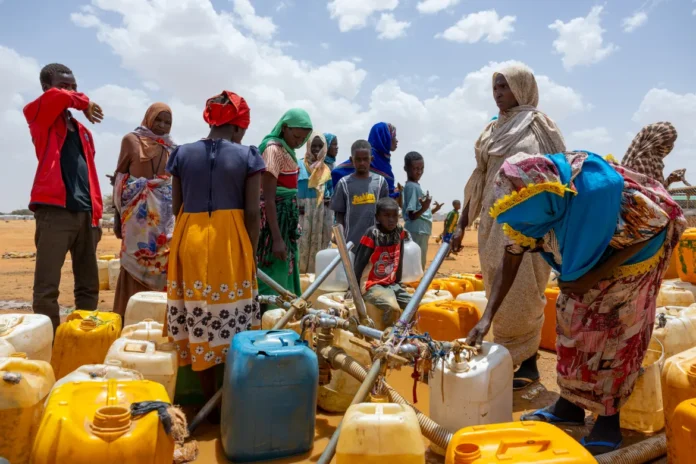
Across Sudan, the war has upended livelihoods, shuttered businesses and hollowed out entire neighborhoods. Khartoum, once the country’s commercial and political heart, saw widespread destruction as artillery fire and street battles forced residents to flee. Though some activity has resumed in parts of the capital and neighboring Omdurman, recovery remains fragile.
Othman Youssef, a merchant from Khartoum, said he reopened his shop several months after hostilities subsided in his area. He characterized demand as strong and described prices as moderate.
“I came to the market and opened my shop three or four months after the end of the war,” Youssef said. “There is high demand from customers, and prices are reasonable, neither high nor low, rather moderate.”
Other traders express guarded hope.
“We came back about a month and a half ago,” said Abd El Hameed Abd El Rahman, who returned to his business after fleeing earlier violence. He said conditions have improved compared to the height of the fighting. “Things aren’t as bad as they were before. The situation has improved; people are working again, the market is recovering, and we feel safe,” he said. Still, he noted that many merchants suffered heavy losses. “Some traders lost their goods, and I am one of them.”
While pockets of commerce signal resilience, the broader humanitarian landscape remains dire. United Nations data indicate that more than 14 million Sudanese have been displaced inside and beyond the country’s borders since the conflict began. Tens of thousands have been killed. Over half the population — roughly 21 million people — are experiencing acute hunger, according to U.N. estimates.
For millions, Ramadan will unfold not around abundant family tables but in makeshift shelters and overcrowded camps. Aid agencies warn that food insecurity has reached alarming levels, with children and the elderly particularly vulnerable.
The juxtaposition is stark: in Omdurman, shoppers haggle over dates and lentils; elsewhere, families rely on dwindling humanitarian supplies. Sudan, a nation where Ramadan has long been defined by neighborhood generosity and open-air iftar gatherings, now confronts a fractured social fabric.
The conflict has also disrupted supply chains critical to food distribution. Agricultural production in several regions has been curtailed by insecurity, while transportation routes remain unreliable. Economists say the combination of currency depreciation, damaged infrastructure and reduced exports has intensified price volatility.
Despite these hardships, Ramadan carries symbolic weight in Sudan, where the vast majority of citizens are Muslim. The month traditionally fosters community solidarity and spiritual renewal. In neighborhoods scarred by violence, some residents say they are determined to preserve that spirit.
Mosques in relatively stable districts have begun organizing modest iftar meals, funded through small donations. Community leaders describe these efforts as a way to counter despair and maintain social cohesion amid prolonged uncertainty.
Sudan’s experience this Ramadan underscores a broader reality: the conflict has evolved from a political power struggle into a multidimensional national crisis. What began as a confrontation between rival armed factions has rippled outward, destabilizing food systems, eroding purchasing power, and reshaping demographic patterns through mass displacement.
The reopening of markets in Omdurman suggests that localized stability can spur economic revival. However, such recovery remains uneven and vulnerable to renewed violence. Without a comprehensive ceasefire and political settlement, any gains are likely to be fragile.
Moreover, inflation during Ramadan, when demand typically surges, exposes structural weaknesses in Sudan’s economy. In times of stability, seasonal price increases might be manageable. In a war-ravaged environment, they deepen inequality, disproportionately affecting displaced families and wage earners whose incomes have evaporated.
The humanitarian statistics point to a longer-term challenge. With over half the population facing acute hunger, the risk of entrenched poverty looms large. Prolonged food insecurity can undermine health outcomes, educational attainment, and workforce participation, compounding the country’s recovery hurdles.
International engagement will likely play a decisive role. Humanitarian corridors, sustained funding for relief operations, and diplomatic pressure aimed at de-escalation could mitigate the crisis. Yet aid alone cannot substitute for political resolution.
As Sudanese families mark Ramadan, some in revived markets, others in tents far from home, the contrast highlights both resilience and vulnerability. The month’s emphasis on charity and reflection may offer moments of solace. But without durable peace and economic stabilization, the underlying hardships are unlikely to fade.
For now, in Omdurman’s crowded stalls, the rhythms of commerce coexist with uncertainty. Beneath the lanterns and sacks of grain, a nation observes its holiest month while navigating one of the darkest chapters in its modern history.