Home Blog Page 307

Protesters Swarm Streets Nationwide in ‘No Kings’ Anti-Trump Demonstrations Amid Tight Security

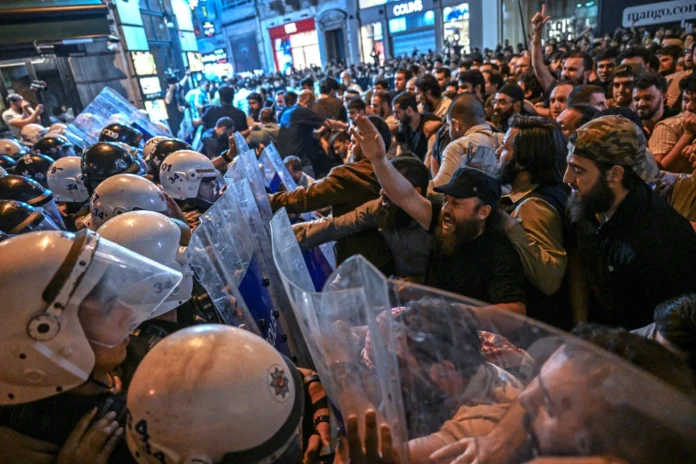
WASHINGTON (BN24) — Tens of thousands of demonstrators marched in cities and towns across the United States on Saturday in coordinated “No Kings” protests denouncing President Donald Trump, calling for the protection of democracy, and opposing authoritarianism. The widespread protests, which unfolded under heightened security, were largely peaceful, although some confrontations with law enforcement occurred in several cities.

From New York and Los Angeles to Charlotte and Philadelphia, demonstrators rallied under banners reading “No Kings,” waving American flags—some upside down in a symbol of distress—and voicing support for immigrants and civil liberties. Organizers said more than 2,000 events were planned nationwide under the 50501 Movement, which stands for 50 states, 50 protests, one movement.

The demonstrations came amid a climate of political tension and a growing pattern of violent incidents, including the earlier assassination of Minnesota State Rep. Melissa Hortman and the shooting of State Sen. John Hoffman. In response, Minnesota organizers canceled all planned rallies, and Gov. Tim Walz urged residents to avoid public gatherings until the suspect is apprehended.

“Given what happened overnight, we need to prioritize public safety,” Walz wrote on social media. “Until this threat is neutralized, please do not attend political rallies in Minnesota today.”

In other states, governors deployed National Guard troops and reinforced police presences. Republican governors in Virginia, Texas, Nebraska and Missouri ordered Guard units to assist local law enforcement amid fears of unrest.

Flagship Rallies Draw Thousands

In Philadelphia, intermittent rain did little to slow a massive turnout at Love Park, where marchers waved signs reading “Fight Oligarchy” and “Deport the Mini-Mussolinis.” Protesters marched to the Philadelphia Museum of Art while chanting, “Whose streets? Our streets!” U.S. Rep. Jamie Raskin of Maryland addressed the crowd, asking, “Are you ready to fight back? Do you want a gangster state or do you want free speech in America?”

In Atlanta, the official “No Kings” rally reached its 5,000-person capacity within an hour, while thousands more gathered outside the barriers in front of the Georgia State Capitol. In Charlotte, North Carolina, crowds marched behind a “No Kings” banner, chanting, “No kings, no crowns, we will not bow down,” as they wound through downtown streets under the watchful eye of police.

In Los Angeles, thousands surrounded City Hall, waving signs such as “Protesting is not a crime” and “ICE out of LA.” Demonstrators carried a Trump piñata adorned with a crown and a giant helium balloon caricature of the president. A Native American drum circle and dance performance led the rally before the march spread through city streets.

Protests Met with Police Response

While most protests were peaceful, isolated confrontations occurred. In Charlotte, officers on bicycles briefly blocked a downtown march, prompting chants of “Let us walk.” In northern Atlanta, police used tear gas to disperse several hundred demonstrators attempting to reach Interstate 285. A journalist was reportedly detained during the confrontation, and police helicopters monitored the crowd overhead.

In Florida, about 1,000 protesters rallied at the old Capitol in Tallahassee, waving signs with slogans such as “One Nation Under Distress” and “Dissent Is Patriotic.” Marchers near Trump’s Mar-a-Lago resort in Palm Beach were turned back by sheriff’s deputies before reaching the gates.

Voices of Protest

Karen Van Trieste, 61, a nurse from Maryland who traveled to Philadelphia for the protest, said she joined the march to stand against what she views as authoritarian actions by the Trump administration. “I just feel like we need to defend our democracy,” she said, citing concerns over executive orders and attacks on immigrant communities.

In Charlotte, Jocelyn Abarca, 21, said, “If we don’t stop it now, it’s just going to keep getting worse,” referencing deportations and the recent deployment of National Guard troops in Los Angeles.

Symbolism and Unity

Many protesters wore symbolic attire, including a woman in Philadelphia dressed as the Statue of Liberty who led an anti-Trump sing-along using the tune of “Y.M.C.A.” Some held signs quoting founding fathers, while Revolutionary War-era costumes appeared in several rallies. Mexican flags—frequently used in immigration rights protests—were also seen throughout Saturday’s events.

Organizers emphasized nonviolence and urged participants to avoid confrontations. The 50501 Movement’s mission is to oppose authoritarianism and promote democratic values, organizers said, with the “No Kings” name meant to reflect the movement’s call for equality under the law.

President Trump, meanwhile, spent the day in Washington, attending a military parade celebrating the Army’s 250th anniversary, which also marked his 79th birthday. A parallel protest in the capital featured a massive “Trump must go now” banner leading thousands through the streets.

AP

Democratic Lawmaker and Husband Killed, Another Lawmaker Injured in ‘Politically Motivated Assassination’ in Minnesota

BROOKLYN PARK, Minn. (BN24) — A Minnesota state lawmaker and her husband were shot dead and another legislator and his wife were critically wounded in a politically motivated attack early Saturday that state officials are calling an “assassination.” Authorities have launched an intensive manhunt for the suspected gunman, identified as 57-year-old Vance Boelter.

The fatal shooting occurred at the home of State Rep. Melissa Hortman, 55, a prominent Democratic-Farmer-Labor (DFL) legislator from Brooklyn Park. She and her husband, Mark, were both pronounced dead at the scene. At nearly the same time, State Sen. John Hoffman of Champlin and his wife, Yvette, were attacked in their home and remain hospitalized in serious condition.

“This was a targeted, politically motivated act of violence,” Minnesota Gov. Tim Walz said at a press conference Saturday. “Melissa and Mark were murdered for her public service. This was an assassination.”

Boelter allegedly gained access to the homes by impersonating law enforcement, wearing a tactical vest, blue shirt, and a replica badge. Police recovered an SUV fitted with flashing lights, a ramming bumper, and other law enforcement features, believed to have been used by the suspect. Investigators also found a “manifesto” and a list of other Minnesota lawmakers and public officials in the vehicle.

Authorities say Boelter fled after exchanging gunfire with police around 3:35 a.m. at Hortman’s residence. The area near Edinburgh Golf Course remains under a shelter-in-place order as law enforcement agencies from across the state, including the Minnesota Bureau of Criminal Apprehension and federal authorities, continue the search.

Gov. Walz confirmed that the shootings appear to be connected to national anti-government protests planned under the banner “No Kings,” including one that had been scheduled in northeast Minnesota. That event was canceled following the shootings. Police said fliers with the same slogan were found inside the suspect’s vehicle, though the extent of the connection remains under investigation.

“This kind of politically driven violence cannot stand,” Walz said. “Disagreement does not justify terror. We must all speak out against this extremism.”

The deadly shootings come amid a troubling pattern of political violence across the country. Just last year, President Donald Trump survived two assassination attempts, including one by a man later found dead at the scene in Pennsylvania. In separate incidents this year, extremist-linked attacks have targeted politicians, diplomats, and public events — including a car bombing in California and a firebombing at Pennsylvania Gov. Josh Shapiro’s home.

President Trump condemned Saturday’s violence in Minnesota and said he was briefed by Attorney General Pam Bondi and FBI Director Christopher Wray. “Such horrific violence will not be tolerated in the United States of America,” Trump said in a statement. “We will bring those responsible to justice.”

Rep. Hortman, a former Speaker of the Minnesota House, was a leading progressive voice who had recently co-authored legislation supporting equal rights and condemning Trump’s controversial pardons of January 6 offenders. Sen. Hoffman authored major legislation on aging and elder care services.

Democratic Sen. Amy Klobuchar, who served with both lawmakers, expressed heartbreak on social media. “This is a stunning act of violence. My prayers are with the Hortman and Hoffman families,” she wrote.

Former Rep. Gabby Giffords, who survived an assassination attempt in 2011, also responded. “An attack on lawmakers is an attack on American democracy itself,” she said in a statement. “We must reject violent extremism in all its forms.”

The Brooklyn Park Police Department urged residents to avoid the area around the Edinburgh Golf Course as the search for Boelter continues. Authorities say additional names found on the suspect’s hit list are being contacted and given protection.

Missile Strike Kills Man and Woman in Israel, Dozens Injured as Iran Launches Retaliatory Barrage

TEL AVIV (BN24) — A missile launched during a wave of Iranian retaliation struck an apartment complex in the Israeli city of Rishon Lezion on Saturday, killing a man and a woman and injuring dozens more, according to Israel’s national ambulance service.

The strike came amid a night of escalating conflict between Israel and Iran, with both nations trading direct missile attacks in one of the most severe military escalations in recent Middle East history.

Rescue crews combed through the wreckage of residential buildings in Rishon Lezion, a city just south of Tel Aviv, as shocked neighbors watched emergency teams pull injured civilians from the rubble. Authorities said the missile appeared to have struck near homes in the early hours, causing widespread destruction in the densely populated area.

Israeli officials attributed the strike to one of the many missiles launched from Iran in response to Israeli airstrikes the day before that targeted Iranian nuclear and military sites, including the Natanz enrichment facility. Israel’s Defense Minister Israel Katz condemned the attack and blamed Tehran directly. “Iran has crossed a red line by deliberately targeting civilians,” Katz said, vowing that Iran “will pay a heavy price.”

The strike in Rishon Lezion wasn’t the only civilian casualty reported Saturday. In the Israeli-occupied West Bank, a separate missile launched by the Iran-aligned Houthi militia in Yemen killed five Palestinians, including three children, according to the Palestinian Red Crescent. The incident underscores the widening regional reach of the conflict.

Air raid sirens sounded throughout Israeli cities — including Tel Aviv and Jerusalem — as successive waves of Iranian ballistic missiles filled the skies. The Israeli military reported that fewer than 100 missiles were fired and most were intercepted or fell short. However, those that landed, like the one in Rishon Lezion, caused deadly consequences.

The escalation was sparked by Israel’s largest-ever air offensive against Iran on Friday. Israeli fighter jets targeted top commanders, nuclear scientists, and key infrastructure at Iran’s nuclear facilities. Iran’s U.N. envoy reported that 78 people were killed and more than 320 injured in the Israeli strikes, most of them civilians.

Iran’s response was swift and forceful. Tehran claimed it launched hundreds of ballistic missiles in retaliation, including those that hit Israeli civilian zones. Fires were reported in Tehran following Israeli strikes on Friday, with Iranian media confirming that projectiles hit the Mehrabad airport, a military-civilian facility near key government institutions.

U.S. President Donald Trump confirmed that American forces had assisted Israel by intercepting some of the incoming Iranian missiles. Still, the damage on both sides raised alarms over the potential for a wider regional war.

As search operations continued in Israel on Saturday, local officials urged civilians to remain in shelters. “What we are witnessing is no longer proxy warfare,” said one Israeli military spokesman. “This is direct state-to-state conflict, and Israeli civilians are paying the price.”

At Least 11 Dead, Others Missing as San Antonio Reels from Devastating Flash Floods

SAN ANTONIO (BN24) — At least 11 people are confirmed dead and several others remain missing after torrential rain triggered catastrophic flash flooding across San Antonio, Texas, USA, early Thursday morning, prompting a widespread search-and-rescue operation that continued into Friday, city officials said.

The storm struck before dawn, when nearly 8 inches of rain fell within just a few hours, overwhelming creeks, roads, and drainage systems, the National Weather Service reported. Fueled by a potent upper-level trough, the system swept across central Texas, spawning two confirmed tornadoes in Hays County while dumping relentless rain on the San Antonio metro area.

San Antonio’s fire and police departments, joined by Texas A&M Task Force 1 — a FEMA-affiliated national search and rescue team — are combing flood-ravaged zones for the missing, particularly along Salado Creek near Perrin Beitel Road and Leon Creek.

“These teams are conducting detailed ground searches across creek beds, low-water crossings, and debris fields,” the fire department said in a statement.

The worst flooding struck just after midnight Thursday, when at least 15 vehicles were swept into rapidly rising waters around Perrin Beitel Road. According to the weather service, ten people were rescued — some pulled from treetops — and two others managed to escape the floodwaters on foot. One of the recovered victims was found nearly a mile downstream from the road.

More than 70 water rescues have been carried out since the flooding began, officials confirmed Friday. San Antonio Police Chief William McManus described scenes of sudden inundation, where floodwaters surged with little warning, overwhelming roadways and catching drivers off guard.

“These are low-water crossings where the depth and speed of the water are incredibly deceptive and dangerous,” McManus said.

Among the missing is Stevie Richards, 42, who was on his way to work when he called his wife, Angela Richards, saying his vehicle had stalled and begun to float. Then the line went dead.

“I could hear whatever the car hit and then the water taking over the car,” she said. “And that’s the last I heard.”

As emergency crews worked through floodwaters and debris, the National Weather Service confirmed that two tornadoes touched down near Wimberley, roughly 60 miles northeast of San Antonio. Both twisters were rated EF0 with peak winds between 65 and 85 mph, leaving tree damage and minor structural impacts.

City officials reported that the deluge damaged 15 of San Antonio’s 141 low-water crossings, while 18 roadways remained closed Friday due to flood damage or lingering debris. The full extent of infrastructure damage is still being assessed.

San Antonio Mayor Ron Nirenberg expressed heartbreak over the unfolding tragedy and offered prayers for the families impacted.

“Our hearts are with the families of those we’ve lost to this week’s flash floods and the families who continue searching for their loved ones,” Nirenberg said in a statement. “Erika and I will be praying that those who are missing are found without harm.”

As the city braces for sweltering conditions — Friday’s high was forecasted at 107°F — officials also warned that rivers and creeks remained swollen and hazardous. The National Weather Service issued flood warnings for portions of the San Antonio River and Cibolo Creek, both of which are expected to overflow their banks through at least Saturday morning.

“Floodwaters from heavy rains earlier this week continue to move downstream,” the agency cautioned in a hazards alert.

The full scope of the storm’s toll is still emerging as rescue crews press forward, navigating a dangerous and emotional aftermath.

Nationwide ‘No Kings’ Protests Set to Challenge Trump’s Military Parade and Leadership Style

WASHINGTON (BN24) — As President Donald Trump prepares to preside over the largest U.S. military parade in decades to commemorate the 250th anniversary of the Army — an event that coincides with his 79th birthday — a grassroots protest movement is mobilizing nationwide under the banner “No Kings.”

The demonstrations, scheduled for Saturday across all 50 states including Alaska and Hawaii, aim to counter what organizers describe as Trump’s authoritarian drift and militarization of governance. The protests are being coordinated by a decentralized activist coalition called 50501 — representing 50 states, 50 protests, one movement. Organizers expect around 2,000 participants, marking what could become the most significant wave of dissent since Trump began his second term in 2025.

While the protests will include criticism of Trump’s sweeping immigration enforcement policies — which have sparked unrest in places like Los Angeles — their central message is broader: a firm rejection of what demonstrators see as Trump’s growing executive overreach. Under the slogan “No Thrones. No Crowns. No Kings,” protesters seek to reassert the importance of democratic institutions, civil liberties, and constitutional checks and balances.

Saturday’s military spectacle in Washington, D.C., has been promoted by Trump as a show of strength and national pride. The event will feature soldiers in historic uniforms from major American conflicts — from the Revolutionary War to Vietnam — marching beside their modern-day counterparts. Tanks, fighter jets, and helicopters will roll through the capital in a massive display of U.S. military power.

“We will celebrate a spectacular military parade in Washington, D.C., like no other,” Trump declared. “It will be better and bigger than any parade we’ve ever had in this country.”

The last such parade took place in 1991 under President George H. W. Bush, marking the end of the Gulf War. Trump had previously attempted to launch a similar event during his first term, but plans were shelved over budget concerns and potential infrastructure damage. This year’s parade, greenlit amid rising patriotic fervor, is estimated to cost $45 million, including $16 million earmarked for road repairs caused by heavy military equipment.

The president has explicitly warned against counterdemonstrations in the capital, stating that “those who want to protest will be met with very big force.” In response, organizers of the “No Kings” movement have deliberately planned their events away from the immediate vicinity of the parade, stressing that the day should belong to the people, not a single man.

In Los Angeles, where tensions have surged over Trump’s intensified deportation raids and the deployment of nearly 700 U.S. Marines and National Guard troops, large-scale protests have already been underway for several days. While mostly peaceful, the protests have led to clashes with federal agents and several arrests.

The “No Kings” protests aim to draw attention beyond immigration crackdowns. Their mission, according to their website, is to confront what they see as Trump’s erosion of civil rights, his defiance of judicial authority, and his use of executive power to sidestep congressional oversight.

“They’ve defied our courts, deported Americans, disappeared people off the streets, attacked our civil rights, and slashed our services,” reads a statement on the movement’s website.

Trump’s critics accuse him of behaving more like a monarch than a president — cutting through constitutional norms, centralizing power, and cultivating a personality cult that celebrates military might and executive authority over democratic deliberation.

While Trump’s supporters praise his leadership for restoring order, streamlining government, and cracking down on what they see as illegal immigration and bureaucratic waste, his opponents view his presidency as a sustained threat to democratic norms. For them, Saturday’s military parade is not a celebration of America’s armed forces but a symbolic display of presidential power that demands civilian rebuke.

“Real power isn’t staged in Washington. It rises up everywhere else,” the “No Kings” group stated.

Though relatively modest in projected turnout, the “No Kings” protests symbolize a growing resistance movement within the United States — one that views Trump’s leadership as a departure from democratic governance. Organizers say their aim isn’t just to protest one day, but to galvanize a broader civic awakening that can restore what they believe Trump has eroded: accountability, balance, and rule of law.

As the capital prepares for its biggest parade in a generation, much of the rest of the country is preparing to march for a very different vision of America.

Israel and Iran Exchange Heavy Strikes Amid Escalating Conflict Over Tehran’s Nuclear Ambitions

TEL AVIV, Israel (BN24) — Israel and Iran unleashed a new round of mutual strikes early Saturday, intensifying the most dangerous escalation between the two regional powers in decades. The flare-up follows Israel’s unprecedented aerial assault on Iranian nuclear infrastructure and senior military leadership, which Tehran answered with a barrage of ballistic missiles aimed at Israeli cities.

As air raid sirens wailed across Tel Aviv and Jerusalem before dawn, Israeli civilians scrambled into bomb shelters while air defense systems roared to life. The Israel Defense Forces (IDF) confirmed that dozens of Iranian missiles had been launched, with many intercepted mid-air. Still, several projectiles struck populated areas, including a Tel Aviv high-rise and residential buildings in nearby Ramat Gan, causing widespread damage and civilian casualties. Israel’s national ambulance service reported 34 injuries, and police confirmed at least one fatality in the Tel Aviv area.

Simultaneously, explosions were reported in Tehran. Iran’s semi-official Tasnim and Fars news agencies stated that multiple Israeli projectiles struck Tehran’s Mehrabad airport — a sensitive site hosting both an Iranian air force base and key command infrastructure. Flames and secondary explosions were seen across the capital, intensifying concerns that Israel’s operation had directly targeted Iran’s military logistics.

The Fars agency later reported that Iran launched a third wave of retaliatory airstrikes on Saturday, continuing a counteroffensive that began Friday night following Israeli airstrikes on Iranian nuclear scientists, Revolutionary Guard Corps commanders, and sensitive nuclear installations, including the massive underground Natanz facility.

Iran’s state media declared the barrage a justified response to what it termed a “war of aggression” by Israel. IRNA said Tehran launched hundreds of ballistic missiles at Israeli territory in retaliation for the Israeli strikes, which reportedly killed 78 individuals — including top military officials — and injured more than 320, many of them civilians.

The U.S. military, according to American officials, played a supporting role by intercepting Iranian missiles headed toward Israel. The Pentagon confirmed that air defense assets in the region were engaged but reiterated that the U.S. was not directly involved in Israel’s offensive operation. Still, Iran’s ambassador to the United Nations, Amir Saeid Iravani, blamed the United States for aiding what he called a “blatant act of aggression,” and warned that Washington “shared full responsibility for the consequences.”

Israel’s ambassador to the U.N., Danny Danon, defended the airstrikes, stating that intelligence showed Iran was just days away from producing sufficient fissile material for multiple nuclear weapons. “This was an act of national preservation,” Danon said.

The International Atomic Energy Agency (IAEA) confirmed that Israel’s strikes had destroyed the above-ground pilot enrichment plant at Natanz. IAEA Director General Rafael Grossi informed the U.N. Security Council that inspectors were still assessing damage to the Fordow Fuel Enrichment Plant and another facility in Isfahan.

Iran’s Supreme Leader Ayatollah Ali Khamenei accused Israel of initiating a full-scale war, promising that “nowhere in Israel will be safe” from retaliation. President Masoud Pezeshkian declared Iran’s response would be “painful, strategic, and unwavering,” asserting that Tehran would not stop until “justice was achieved.”

Despite the rapidly deteriorating situation, President Donald Trump urged Tehran to pursue diplomacy before more devastation unfolds. “It’s not too late,” Trump said in a Truth Social post. He noted that Iran had been given a 60-day ultimatum to strike a new nuclear deal but failed to respond. “Today is Day 61,” he said. “I told them what to do — they just couldn’t get there. Now they may have a second chance, but time is running out.”

Israel has stated its campaign — described by Prime Minister Benjamin Netanyahu as “the most critical operation in Israel’s modern history” — will continue until Iran’s nuclear weapons capability is neutralized. The operation has already spanned dozens of strategic strikes on Iranian military and nuclear infrastructure, including in Natanz, Fordow, and Isfahan.

Military analysts warn the conflict could trigger a broader regional war, though Iran’s regional proxies — Hamas in Gaza and Hezbollah in Lebanon — have largely been neutralized by prior Israeli operations. However, the scale and pace of current Israeli and Iranian strikes have raised the specter of prolonged conflict with regional and global implications.

7 Men Convicted of Using Teenage Girls as ‘Sex Slaves’ in Rochdale Child Exploitation Case

Seven men have been convicted of using two teenage girls as “sex slaves” in a major child exploitation case that has concluded at Minshull Street Crown Court in Manchester. The defendants were found guilty on 53 sexual offences believed to have occurred between 2001 and 2006, following a 72-day trial that lasted approximately four months.

The court heard testimony from two victims, now adults in their thirties, who described systematic abuse that began when they were just 13 years old. One victim testified that social services in Rochdale had labeled her a “prostitute” when allegations against the men first emerged, highlighting failures in the system designed to protect vulnerable children.

Evidence presented during the trial revealed that both victims were groomed and forced to engage in sexual acts with the defendants “whenever and wherever” they demanded. The abuse occurred in degrading conditions including on soiled mattresses, in car parks, and in alleyways throughout Rochdale and surrounding areas.

The victims were provided with drugs, alcohol, and cigarettes by their abusers as part of the grooming process. The court also heard that the girls were introduced to taxi drivers for further sexual exploitation, demonstrating the organized nature of the abuse network.

Mohammed Zahid, 64, of Station Road, Crumpsall, Manchester, emerged as a central figure in the exploitation ring. Known to victims as “Boss Man,” Zahid operated a market stall and used offers of free lingerie to lure the teenage girls. He was convicted of 20 offences including rape, indecency with a child, and attempting to procure a girl for unlawful sexual intercourse.

Kasir Bashir, 50, of Napier Street East, Oldham, was convicted in his absence and is now wanted by authorities. He was found guilty of four offences including rape and indecency with a child. His current whereabouts remain unknown to law enforcement.

Mushtaq Ahmed, 67, of Corona Avenue, Oldham, was convicted of nine offences including rape and indecency with a child. The court heard evidence of his repeated abuse of both victims over the five-year period covered by the charges.

Four additional defendants received convictions for their roles in the exploitation network. Roheez Khan, 39, of Athole Street, Rochdale, was found guilty of rape. Mohammed Shahzad, 44, of Beswicke Royds Street, Rochdale, was convicted of six offences including rape and assault by penetration. Nisar Hussain, 41, of Newfield Close, Rochdale, was found guilty of three offences including rape and assault by penetration. Naheem Akram, 48, of Manley Road, Rochdale, was convicted of seven offences including rape and assault by penetration.

All seven defendants had denied any wrongdoing throughout the investigation and trial proceedings. The jury delivered unanimous guilty verdicts on Friday following three weeks of deliberations, bringing the lengthy legal process to a conclusion.

Detective Chief Inspector Guy Laycock, the senior investigating officer, described the case as “complex” and revealed that investigators devoted “thousands of hours” to building the prosecution case. He emphasized the crucial role played by the two survivors in securing the convictions.

“They have been pivotal in bringing these abusers to long-awaited justice by bravely giving painful and difficult testimony during a four-month trial,” Laycock stated. “Without them this would not be possible, and today is about them.”

The detective characterized the defendants’ behavior as predatory, stating they “preyed on vulnerability for their own depraved sexual gain.” He described how the men “abused, degraded and then discarded the victims when they were just children,” noting that the abuse “knew no limits” despite consistent denials from the defendants.

Laycock criticized the convicted men’s lack of remorse, saying they showed “callous disregard for these women when they were girls, and continue to show no remorse for their unforgivable actions all these years later.”

This case represents part of broader efforts to address historical child exploitation in Rochdale and Greater Manchester. According to Greater Manchester Police, a total of 32 offenders have been sentenced to a combined 300 years in prison as part of two major investigations conducted over the past decade.

The legal proceedings are far from over, with an additional 20 men scheduled to face trial in connection with related charges. Their court date has been set for September 2025, indicating that the full scope of the exploitation network may extend beyond the seven men convicted in this case.

The convictions come years after the abuse occurred, highlighting the challenges faced by survivors in coming forward and the complex nature of investigating historical child exploitation cases. The successful prosecution demonstrates the commitment of law enforcement to pursue justice regardless of the time elapsed since the offences were committed.

The case has drawn attention to the ongoing need for improved safeguarding measures and support systems for vulnerable children, particularly in light of the victim’s testimony about being mislabeled by social services rather than being recognized as a victim of exploitation.

Sentencing for the seven convicted men has not yet been scheduled, but they face substantial prison terms given the serious nature and number of offences for which they have been found guilty.

Kenyan Senior Police Officer Arrested Over Death of Blogger in Custody, Igniting Public Outrage

NAIROBI, Kenya (BN24) — A senior Kenyan police officer has been arrested in connection with the death of blogger Albert Ojwang, whose body was found in a Nairobi police cell last week under suspicious circumstances, sparking nationwide protests and renewed scrutiny of police abuse in the East African nation.

Arrested Kenyan police officer

Kenya’s Independent Policing Oversight Authority (IPOA) confirmed Friday that the officer in charge of Nairobi’s Central Police Station was taken into custody, alongside a CCTV technician accused of tampering with surveillance footage from the night Ojwang died.

Ojwang, 31, was found dead on Sunday, two days after being arrested. Police initially reported his death as a suicide, but an independent autopsy revealed signs of physical assault, contradicting the official version and prompting public outcry.

According to IPOA Commissioner Samati Kemboi, the station’s CCTV system had been intentionally interfered with, with footage altered and formatted in the early hours of Sunday, shortly before Ojwang’s death was discovered. The CCTV technician is accused of playing a direct role in the cover-up.

The case has reignited deep frustrations over Kenya’s long history of police brutality, extrajudicial killings, and enforced disappearances. Hundreds of demonstrators took to the streets in Nairobi on Thursday, setting vehicles on fire and clashing with police, who responded with tear gas to disperse the crowds.

Protesters specifically called for the resignation of Deputy Police Chief Eliud Lagat, who filed a formal complaint against Ojwang just days before his death. Lagat alleged that an X (formerly Twitter) account linked to Ojwang had published “continuous false and malicious publications” targeting him personally, according to IPOA’s investigative report.

blogger Albert Ojwang

The backlash over Ojwang’s death has exposed deeper fissures in Kenya’s security system, with watchdog groups and civil society organizations accusing authorities of using intimidation and violence to silence dissent and muzzle critical voices online.

Kenya’s national police service issued an apology for its initial suicide claims, a rare move in a country where state security forces are often accused of operating with impunity.

IPOA has pledged a thorough and transparent investigation, but critics remain skeptical given Kenya’s checkered history of accountability in police-related deaths.

Ojwang’s death marks the latest flashpoint in a series of alleged abuses that have drawn international concern and emboldened local demands for systemic reform.

Mali Military Government Passes Bill Extending Junta Leader Assimi Goita’s Rule by Five More Years

BAMAKO, Mali (BN24) — Mali’s military-led government has approved a bill that would extend the rule of junta leader Gen. Assimi Goita for an additional five years, a move that further entrenches the power of the man who seized control of the West African country through back-to-back coups in 2020 and 2021.

The decision, announced Wednesday by Mali’s Council of Ministers, paves the way for a major revision of the Transition Charter, allowing Goita to begin a five-year renewable mandate starting in 2025. The bill reflects recommendations made during April’s national dialogue consultations, a government-organized event boycotted by political parties and opposition leaders.

The legislation now heads to the National Transitional Council, Mali’s de facto legislature under the current military government, for ratification.

The controversial extension follows a string of authoritarian moves by the junta, including Goita’s May decree dissolving all political parties, which came amid increasing resistance to military rule. The crackdown coincided with a wave of kidnappings targeting democracy activists in Bamako, the capital, and shortly after hundreds demonstrated against the regime.

Human rights advocates say the dissolution of political parties has stripped the country of any institutional political opposition, compounding fears of a slide into long-term military autocracy.

Goita had initially vowed to return Mali to civilian rule by March 2024, but that promise remains unfulfilled. Elections were postponed indefinitely, and the junta has not announced a new date for the presidential vote.

The government’s new bill marks a clear departure from its previous commitments to democratic governance, further alienating international partners and West African neighbors who have pressed for a return to constitutional order.

Mali, a landlocked Sahel nation, continues to face a dire security crisis. Jihadi insurgencies linked to al-Qaida and the Islamic State group have deepened instability, particularly in rural areas. Since Goita’s initial takeover, the military government has severed ties with traditional Western allies and increased cooperation with Russia, including hiring the controversial Wagner Group mercenaries.

Political analysts warn that extending Goita’s mandate without broad-based political support or electoral legitimacy risks exacerbating the country’s internal tensions and deepening its international isolation.

Iran Tells UN That 78 Dead, Over 320 Wounded in Israeli Strikes, Blames U.S. for Complicity

UNITED NATIONS (BN24) — Iran’s ambassador to the United Nations told an emergency session of the U.N. Security Council on Friday that Israeli airstrikes killed 78 people and wounded more than 320, most of them civilians, in a sweeping military campaign that struck multiple sites across Iran. The ambassador, Amir Saeid Iravani, also accused the United States of complicity in the attacks, alleging Washington provided both intelligence and political cover for Israel’s assault.

“The overwhelming majority of the victims were civilians, including women and children,” Iravani said. “By aiding and enabling these crimes, the United States shares full responsibility for the consequences.”

The devastating death toll comes as tensions between Israel and Iran have exploded into direct conflict, with Israeli warplanes targeting Iranian nuclear facilities, military command centers, and senior officials, including top scientists. Iravani described the Israeli operation as a “barbaric and criminal attack,” branding it a flagrant violation of international law and a clear act of state terrorism.

The Iranian government reported that many of the 320 injured were non-combatants caught in densely populated areas hit by Israeli strikes. The attacks, which marked one of the most expansive Israeli military operations against Iran to date, prompted an immediate response from Tehran.

Just hours later, Iran launched dozens of long-range missiles targeting Tel Aviv and surrounding cities. Israel’s emergency medical services said at least 34 people were wounded, including a critically injured woman trapped under rubble. In Ramat Gan, east of Tel Aviv, rescuers worked to free 15 residents trapped inside a home that was hit during the barrage. The missile strike damaged multiple buildings and destroyed several vehicles.

Yossi Griver, a spokesperson for Israel’s Home Front Command, said the home had been full of families gathered for Friday night dinner, including many elderly residents. Scenes from the affected neighborhood showed homes with walls torn away and charred vehicles lining the streets.

At the U.N., Iravani emphasized that Israel’s strikes were not only aimed at military figures but also specifically targeted Iranian nuclear scientists, an act Tehran sees as a direct threat to its sovereignty and scientific advancement.

“These atrocities are part of a larger pattern of aggression by Israel, targeting both civilian infrastructure and key elements of our national defense,” Iravani told the Council.

The Israeli airstrikes came amid growing alarm over Iran’s expanding nuclear program, which has recently advanced its uranium enrichment efforts despite international pressure. Israel has long warned it would act unilaterally if it believed Iran was nearing the capability to build a nuclear weapon.

While past U.S. administrations had sought to deter Israel from launching a preemptive strike — fearing it would ignite a wider regional war — Iran now contends that the U.S. enabled the current assault.

Iran’s Supreme Leader Ayatollah Ali Khamenei declared that Israel would not “escape safely from this great crime,” vowing further retaliation for the deaths and destruction wrought by Israeli airpower.

As smoke and flame from missile interceptions lit the skies over both countries, global leaders called for restraint. However, both sides appeared poised for further escalation, with mutual threats and military deployments accelerating across the region.