Home Blog Page 308

Fox News Reporter Trey Yingst Caught in Missile Attack During Live Broadcast in Tel Aviv

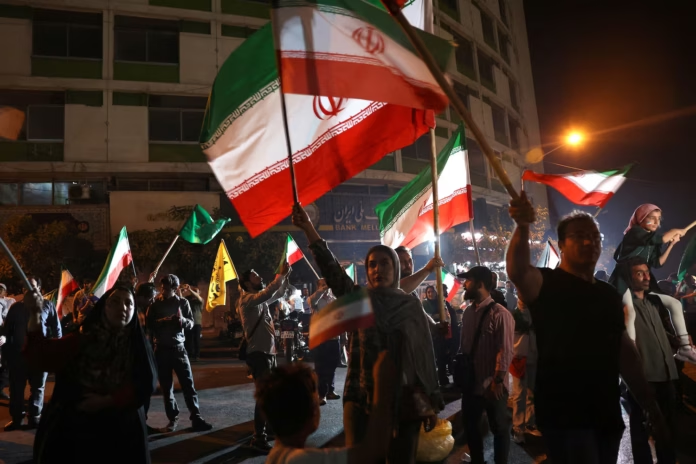
TEL AVIV, Israel (BN24) — Fox News foreign correspondent Trey Yingst was forced to run for cover during a live broadcast Friday night as Iranian missiles rained down on Tel Aviv, marking one of the most dramatic moments of real-time reporting since tensions between Israel and Iran erupted into open confrontation.

Video footage from Fox News showed Yingst yelling for his team to take cover as missiles streaked through the night sky, intercepted mid-air by Israeli air defense systems. “Everyone move!” Yingst shouted urgently, as fireballs exploded overhead and plumes of smoke rose across the city. The missile strike, part of a broader Iranian retaliation, occurred around 9 p.m. local time and sent air raid sirens blaring across central Israel, including in Tel Aviv and the nearby city of Ramla.

“There’s a massive amount of fire coming to Tel Aviv right now,” Yingst said at the start of the broadcast, his voice steady despite the looming threat. Moments later, as explosions rocked the city and Israel’s Iron Dome interceptors lit up the sky, he was seen abandoning his broadcast position, sprinting for safety with his camera crew.

Yingst later posted on social media, assuring viewers that he and his team were safe and continuing to report from the region.

The Associated Press confirmed that U.S. military forces are aiding Israel in intercepting the barrage of Iranian ballistic missiles. Though specifics were not disclosed, past instances have seen the U.S. employ both Air Force fighter jets and Navy destroyers equipped with missile defense systems in similar scenarios. The cooperation comes as part of Washington’s ongoing efforts to protect both U.S. regional assets and Israeli territory from the widening fallout of the escalating conflict.

The missile barrage from Iran followed a series of preemptive Israeli airstrikes on key Iranian nuclear and military targets, including sites near Natanz, Isfahan, and Fordo, where Iran conducts uranium enrichment. Among those killed in the strikes were three senior Iranian military officials, dealing a significant blow to Tehran’s defense command structure.

In response, Iranian President Masoud Pezeshkian vowed a “powerful response,” while Israel’s Prime Minister Benjamin Netanyahu warned citizens to “brace for impact” and declared the nation ready for prolonged engagement.

Friday’s missile exchange represents the most serious escalation yet in the yearslong shadow war between the two regional powers and has raised fears of a broader conflict engulfing the Middle East. Regional and global leaders have urged restraint, but military activity on both sides continues to intensify.

Nigerian-Australian Woman Arrested for Trafficking Papua New Guinean Students into Forced Farm Labor in Australia

BRISBANE, Australia (BN24) — A Nigerian-Australian woman has been arrested in connection with the trafficking of 15 students from Papua New Guinea, who were lured to Australia with false promises of educational scholarships but were instead forced into grueling, unpaid labor on Queensland farms, according to the Australian Federal Police (AFP).

Binta Abubakar, 56, was taken into custody at Brisbane Airport on Wednesday upon arrival from Papua New Guinea, where she had primarily operated her business. The arrest follows a two-year investigation by the AFP’s Northern Command Human Trafficking Team, which began its probe in July 2022 after receiving intelligence from Queensland Police.

Abubakar is accused of orchestrating a complex trafficking scheme through her company, BIN Educational Services and Consulting, by offering fraudulent full scholarships to at least 15 Papua New Guinean nationals, aged between 19 and 35, between March 2021 and July 2023.

According to the AFP, once the students arrived in Australia, they were allegedly coerced into signing a series of legal agreements obligating them to repay substantial debts that included “tuition, airfare, visa application, insurance, and legal costs.” These debts, which were never clearly disclosed upfront, were used as a means of coercion, effectively trapping the victims in debt bondage.

Forced Labor in Queensland

Instead of receiving education or training, the victims were reportedly dispatched to work on fruit farms in Queensland, including in Lockyer Valley and Stanthorpe, often in breach of their visa conditions. Police say the students worked 10-hour days, seven days a week, with wages allegedly collected and withheld by Abubakar as repayment for their so-called debts.

“The farmers did not know of Abubakar’s alleged scheme,” the AFP clarified in a statement, indicating that the exploitation was orchestrated solely by the accused.

Police also alleged that when students resisted or questioned their circumstances, Abubakar used threats and intimidation, including threats of deportation or harm to their families back in Papua New Guinea, to maintain control over them.

Criminal Charges and Court Proceedings

Abubakar now faces 31 criminal charges, including:

  • Four counts of trafficking in persons
  • 14 counts of deceptive recruiting for labor or services
  • 13 counts of engaging in conduct that caused a person to enter into debt bondage

She was granted conditional bail and is scheduled to appear in court on September 19.

AFP Condemns Human Trafficking Exploitation

AFP Detective Superintendent Adrian Telfer condemned the exploitation, describing the case as a stark reminder of how traffickers prey on vulnerable people through false promises of opportunity.

“Victims of debt bondage and other human trafficking offences can be lured to Australia with promises of a dream career or free education—things they may not have access to in their country of origin,” Telfer said. “When those conditions change, the victims find themselves in extremely vulnerable positions, isolated in a foreign country, often with no financial or emotional support and struggling with language barriers.”

Telfer emphasized that the AFP remains committed to protecting foreign workers from exploitation and encouraged the public to report any suspicions. “The AFP can help people who are exploited. We are focused on ensuring the welfare of victims,” he said.

This arrest comes less than two months after German authorities arrested 13 suspected members of a Nigerian criminal syndicate accused of international trafficking and fraud, highlighting growing concerns over transnational human trafficking networks operating under the guise of education or employment.

The case also underscores the challenges facing international students and workers in Australia, particularly those from less-developed nations, who are often targeted by unscrupulous actors exploiting legal loopholes and administrative gray areas for profit.

U.S. Military Assists in Intercepting Iranian Missiles as Israel-Iran Conflict Escalates into Regional Crisis

JERUSALEM/TEHRAN/WASHINGTON (BN24) — The U.S. military has joined efforts to intercept missiles fired by Iran at Israel in retaliation for a sweeping Israeli air campaign that struck the heart of Iran’s nuclear and military infrastructure, a U.S. official confirmed Friday.

The official, speaking on condition of anonymity due to the sensitivity of ongoing operations, said American military assets had been repositioned closer to Israel in recent days. Though details remain classified, past operations have seen U.S. destroyers and fighter jets play a key role in intercepting inbound threats. The assistance comes amid mounting fears of a broader war in the Middle East following Israel’s largest-ever strike inside Iranian territory.

In a high-risk and long-planned operation, Israel unleashed waves of airstrikes and drone attacks early Friday across Iran, targeting uranium enrichment facilities in Natanz and Fordo, and a nuclear research center in Isfahan. Israeli military sources said the strikes were carried out by nearly 200 aircraft and supported by Mossad-commanded drone units that had pre-positioned explosives near Iranian air defense batteries.

Among the most significant casualties were three of Iran’s highest-ranking military leaders: Armed Forces Chief Gen. Mohammad Bagheri, Revolutionary Guard Commander Gen. Hossein Salami, and Gen. Amir Ali Hajizadeh, head of the elite force’s missile program. Iranian Supreme Leader Ayatollah Ali Khamenei confirmed their deaths, describing them as martyrs and accusing Israel of committing a “great crime.”

“The Zionist enemy has opened its wicked and blood-stained hand to a crime in our beloved country,” Khamenei said in a televised address, vowing revenge and pledging that Israel “will not escape unharmed.”

Late Friday, Iran retaliated with a barrage of more than 100 ballistic missiles and drones launched toward Israel. Loud explosions echoed over Tel Aviv and Jerusalem, where smoke was seen rising and emergency crews responded to reports of injuries. Israeli military officials confirmed that many of the incoming threats were being intercepted outside national airspace with the assistance of allied forces, including the U.S.

Brig. Gen. Effie Defrin, an Israeli military spokesperson, said the strike on Natanz had “significantly degraded” Iran’s nuclear capacity and that the broader operation could continue for up to two weeks. “This mission is not over,” he said. “It is the beginning of a necessary campaign to prevent a nuclear-armed Iran.”

The Biden administration, while publicly distancing itself from Israel’s unilateral action, confirmed that military resources were being shifted across the region to protect American assets and personnel. Two U.S. officials said American warships had been moved closer to the eastern Mediterranean and that embassy personnel in Baghdad had been partially evacuated as a precaution.

U.S. Secretary of State Marco Rubio emphasized that Washington had not participated in the Israeli strikes but reaffirmed support for Israel’s right to self-defense. He also issued a stern warning to Iran: “Let me be clear: the United States will defend its people and interests in the region without hesitation.”

President Donald Trump, reelected in November, broke his silence on the crisis Friday via Truth Social, urging Iran to abandon its nuclear ambitions. “Iran must make a deal before there is nothing left,” he posted, warning that “Israel’s attacks will only get worse” if Tehran continues its current path.

Friday’s events triggered widespread condemnation and alarm. The United Nations Security Council convened an emergency meeting at Iran’s request, while world leaders called for restraint. Iran’s Foreign Minister Abbas Araghchi labeled the Israeli attacks “state terrorism” in a formal letter to the Council and declared that Iran had the right to self-defense under international law.

In Tel Aviv and Jerusalem, residents scrambled for supplies amid reports of further Iranian reprisals. Military reservists were activated, and troops deployed across Israel. Though streets were largely deserted, officials urged calm and insisted defense systems were intercepting the majority of inbound threats.

Hezbollah, Iran’s proxy in Lebanon, offered condolences but stopped short of declaring direct involvement. The group’s last major war with Israel ended with a U.S.-brokered ceasefire in late 2024, after most of its senior leadership was eliminated in Israeli strikes.

Israeli Prime Minister Benjamin Netanyahu said in a recorded statement that the attack had been in preparation since November, shortly after Hezbollah leader Hassan Nasrallah was killed. The final order to launch was given after Iran was censured on Thursday by the International Atomic Energy Agency (IAEA) for failing to comply with nuclear safeguards.

“This was a preemptive strike—one that became necessary to prevent Iran from crossing the nuclear threshold,” Netanyahu said. “The danger to Israel’s survival was real and imminent.”

Israel maintains that its intelligence showed Iran was weeks—possibly days—away from being able to assemble a nuclear weapon, despite international assessments suggesting Tehran had not yet resumed weaponization.

While Israeli officials insisted their strikes were aimed solely at military and nuclear targets, Iran accused Israel of hitting residential neighborhoods. State media shared images of damaged homes and wounded civilians in Tehran and Isfahan. Khamenei vowed the country would pursue justice for “our fallen scientists, our generals, and our civilians.”

Despite high casualties among Iran’s top leadership, the country has not yet signaled whether it will escalate beyond missile retaliation. Analysts warn that the death of senior military figures could limit Iran’s ability to coordinate a longer-term response.

The International Atomic Energy Agency said Friday that it was closely monitoring radiation levels and damage to Iran’s enrichment infrastructure. Meanwhile, U.S. intelligence continues to assess whether Iran intends to rebuild its nuclear program or shift further underground.

Regardless, Israeli leaders have made clear they view this moment as existential. “This is not about politics,” said Defense Minister Israel Katz. “This is about survival.”

UPDATED: Israeli Strikes Kill Top Iranian Military Commanders, Nuclear Scientists as Iran Launches Drone Retaliation

JERUSALEM/TEHRAN (BN24) — Israeli airstrikes on Friday killed several of Iran’s top military leaders and at least six nuclear scientists, prompting a rapid retaliation by Tehran in the form of a massive drone barrage targeting Israeli territory, according to officials and state media reports from both countries.

Firefighters work at the scene of a damaged building in the aftermath of Israeli strikes, in Tehran, Iran, June 13, 2025. Majid Asgaripour/WANA (West Asia News Agency) via REUTERS

The unprecedented escalation followed a series of covert operations inside Iran led by Israel’s Mossad intelligence agency, which helped lay the groundwork for what Israeli officials are calling Operation Rising Lion. An Israeli security source confirmed that Mossad operatives carried out sabotage missions targeting Iranian air defenses, deployed precision-guided explosives near surface-to-air missile systems, and even established a covert drone-launching base near Tehran ahead of the main assault.

Drones Fill Skies Over Iraq as Iran Responds

Two senior Iraqi security officials, speaking on condition of anonymity due to the sensitivity of the matter, confirmed that more than 100 drones originating from Iran had crossed Iraqi airspace en route to Israel. The officials said that radar systems tracked the drones across the country, while residents of Iraq’s Diyala province near the Iranian border reported hearing explosions and the roar of aircraft before dawn.

Shortly after, civilians in Diyala said they witnessed waves of drones launched from Iranian territory streaking across the sky toward Israel. The Iranian attack marks Tehran’s first large-scale retaliation since Israeli airstrikes reportedly killed senior commanders of the Islamic Revolutionary Guard Corps and crippled nuclear research sites across multiple Iranian cities.

Iran Confirms Deaths of Nuclear Scientists

Iranian state media reported that at least six nuclear scientists were killed in Friday’s Israeli strikes, which targeted critical infrastructure involved in the country’s uranium enrichment and ballistic missile development programs. It remains unclear how many additional casualties occurred, though Iranian officials have acknowledged the loss of senior military figures.

This follows an earlier report that the Revolutionary Guard’s headquarters in Tehran had been engulfed in flames following a direct hit, with speculation continuing over the fate of Gen. Hossein Salami, the Guard’s top commander.

IDF: Over 100 Iranian Drones Launched

The Israel Defense Forces (IDF) confirmed that Iran had launched more than 100 drones in retaliation, marking one of the largest direct attacks on Israeli territory by the Islamic Republic to date.

IDF Brig. Gen. Effie Defrin said Israel’s air defense systems were fully activated and were intercepting the drones “far from Israeli airspace.” While not disclosing specific interception sites, another Israeli official, speaking on condition of anonymity, said much of the interception effort was taking place outside Israeli territory.

“The State of Israel is intercepting Iranian drones in real-time,” the official said. “Our defense infrastructure has been preparing for this moment, and we will respond with force if necessary.”

A Coordinated Strike and an Emerging Regional Crisis

Friday’s developments followed days of warnings by Israeli officials that Iran was nearing a nuclear breakout and that preemptive action was imminent. Israeli Prime Minister Benjamin Netanyahu declared earlier this week that the country stood at a “decisive moment” and would not permit Iran to become a nuclear-armed state.

In the lead-up to Friday’s strikes, intelligence reports suggested that Israel had increased coordination with allies and scaled up its military preparedness, even as diplomatic negotiations on Iran’s nuclear program in Oman appeared to stall.

Now, with airstrikes killing key Iranian figures and nuclear scientists, and Iranian drones inbound toward Israeli territory, the region appears to be edging toward a broader military confrontation. Analysts warn that further escalation could trigger wider involvement from proxy groups across Lebanon, Syria, Iraq, and Yemen, as well as regional powers with vested interests.

The United States, while not directly involved in the strikes, has placed its forces in the Middle East on high alert and reiterated that it will defend its personnel if targeted by Iran.

Iran’s Revolutionary Guard Chief Feared Dead in Israeli Strike; Headquarters Ablaze in Tehran

TEHRAN, Iran (BN24) — The head of Iran’s elite paramilitary force, Gen. Hossein Salami, is feared dead following an Israeli military strike that reportedly targeted multiple high-level Iranian figures, including senior officers of the Revolutionary Guard and nuclear scientists, Iranian state television announced Friday.

The brief report, which aired amid continuing Israeli attacks on Iran’s capital, offered few details about Salami’s condition but confirmed that he was unaccounted for following a direct hit on the Revolutionary Guard’s Tehran headquarters. The report also said one additional top Guard commander and two nuclear scientists were feared dead as a result of the strikes.

Iranian television described the scene at the Revolutionary Guard headquarters as chaotic and dangerous, with its reporter stating he could not get closer due to the intensity of the fire engulfing the complex.

The Israeli offensive, which began early Friday and has been dubbed Operation Rising Lion, has intensified fears of further escalation between the two long-time adversaries. Explosions were reported across multiple sites in Tehran, although the extent of the damage remains unclear.

The Islamic Revolutionary Guard Corps (IRGC), established after the 1979 Islamic Revolution, wields considerable power within Iran’s clerical leadership. It also oversees the country’s extensive ballistic missile program, which has been used in recent attacks against Israel during the current conflict centered on Gaza.

Top Israeli Military Commander Issues Dire Warning

In a parallel development, Israel’s military chief of staff, Lt. Gen. Eyal Zamir, issued a stern warning to Iran and its allied militias across the region, cautioning them against retaliatory actions.

“I warn, anyone who tries to challenge us will pay a heavy price,” Zamir said, addressing the nation from an undisclosed location amid ongoing security preparations.

The statement came as Israeli Defense Forces remained on high alert, anticipating potential missile or drone retaliation by Iran or its proxies in Lebanon, Syria, Iraq, and Yemen.

Regional Tensions Escalate

The possible death of Gen. Salami, one of Iran’s most powerful and influential military leaders, could mark a turning point in the deepening confrontation between Israel and Iran. Salami has long been regarded as a chief architect of Iran’s external military operations, including support for proxy militias and missile development programs.

His reported death — along with that of senior colleagues and nuclear scientists — would likely galvanize calls within Tehran for a significant response. Iran’s leadership had earlier vowed a “destructive” retaliation to any direct Israeli assault on its soil.

While Iranian state media confirmed the hit on the IRGC command complex, it has so far refrained from confirming the deaths of the individuals named, pending what it called “ongoing assessments.”

Ongoing Operation and International Reaction

The airstrikes come as part of Israel’s broader campaign to cripple Iran’s nuclear and military capabilities, launched just days after U.S.-backed talks on Iran’s uranium enrichment program collapsed.

The Israeli government has repeatedly stated it will not allow Iran to acquire a nuclear weapon. On Friday, Israeli Prime Minister Benjamin Netanyahu described the current phase of conflict as a “decisive moment” for national security.

Meanwhile, global leaders have urged both nations to de-escalate. The United States, while distancing itself from direct involvement in the strikes, has warned Iran not to retaliate against American personnel or bases in the region.

As of Friday evening, crude oil prices had surged and global markets reacted nervously to the possibility of broader regional war.

AP

UPDATED: Israel Strikes Iranian Capital, Targets Nuclear Facilities in Major Escalation

JERUSALEM/TEHRAN (BN24) — Israel launched a large-scale military operation against Iran early Friday, striking multiple nuclear and military targets across the country, including the capital, Tehran, and the Natanz uranium enrichment facility. The Israeli government said the strikes were a preemptive measure to disrupt Iran’s nuclear weapons program and warned that the operation, codenamed Rising Lion, would continue for days.

The dramatic escalation follows weeks of rising tension and failed diplomatic talks over Iran’s expanding uranium enrichment activities. Witnesses in Tehran and Natanz reported loud explosions, and Iran’s state television confirmed air defense systems had been activated across several provinces.

Prime Minister Benjamin Netanyahu addressed the Israeli public in a pre-recorded message, declaring the offensive a “decisive moment in Israel’s history.” He said the Israel Defense Forces (IDF) were targeting nuclear scientists, ballistic missile sites, and key figures within Iran’s Revolutionary Guard.

According to Iranian media and eyewitness reports, the Israeli assault began just after midnight local time. Residents in Tehran described hearing “several loud blasts,” while explosions were also reported near the Natanz facility, Iran’s most critical uranium enrichment site.

A senior Iranian official told Reuters that Iran’s top leadership had convened an emergency security meeting in response to the strikes. Meanwhile, Iran’s military placed its air defense systems on high alert nationwide, bracing for additional Israeli sorties.

Israel has declared a nationwide state of emergency, preparing for what officials described as an imminent wave of missile and drone attacks from Iran or its regional proxies. Defense Minister Israel Katz said that “dozens” of targets were struck in the opening wave, and he warned that retaliation from Tehran was likely.

“The State of Israel has conducted a preemptive strike against the Islamic Republic of Iran,” Katz said in a statement. “We expect a missile and UAV attack against Israeli civilians in the immediate timeframe.”

An Israeli military spokesperson added that intelligence assessments indicate Iran possesses sufficient enriched uranium to build up to 15 nuclear weapons in a matter of days, prompting the urgency behind the military campaign.

U.S. Secretary of State Marco Rubio confirmed that Washington was not involved in the Israeli military action. “Tonight, Israel took unilateral action against Iran. We are not involved in strikes against Iran and our top priority is protecting American forces in the region,” Rubio said. “Let me be clear: Iran should not target U.S. interests or personnel.”

CNN reported that President Donald Trump had called an emergency cabinet meeting at the White House to assess the developing situation. The Pentagon, meanwhile, has begun planning for a range of scenarios in the Middle East, including possible evacuation operations for American citizens.

News of the Israeli airstrikes immediately impacted global energy markets, with crude oil prices surging more than $3 per barrel. The spike reflects investor fears that a prolonged conflict could destabilize major oil-producing regions and disrupt supply chains.

U.S. and Iranian diplomats had been scheduled to hold a sixth round of nuclear negotiations in Oman on Sunday. However, the Israeli offensive and Iran’s expected retaliation now place those talks in doubt. Mediators from Oman expressed concern that the crisis may have rendered diplomacy moot, at least for the foreseeable future.

President Trump, speaking on Thursday prior to the attacks, acknowledged the possibility of an Israeli strike but reiterated his preference for a peaceful resolution. “It could very well happen,” Trump said of potential Israeli action. “But we’re still hoping for a diplomatic path forward.”

The military operation marks one of the most serious escalations between Israel and Iran in recent years. While Israel has previously conducted covert operations and limited strikes against Iranian assets in Syria and elsewhere, a direct assault on Iran’s sovereign territory — especially its capital and nuclear infrastructure — constitutes a significant turning point.

With Tehran’s leadership under pressure to retaliate and international concerns growing over a broader Middle East war, diplomatic channels are strained to the breaking point. The coming hours and days are expected to be critical in determining whether this crisis spirals into a full-scale regional conflict.

AP/Reuters

Israel Could Strike Iran as Early as Sunday, U.S. and Israeli Officials Warn; Tehran Prepares for Massive Retaliation

JERUSALEM/TEHRAN (BN24) — Israel is reportedly prepared to launch a preemptive military strike against Iran’s nuclear infrastructure within days if Tehran rejects a U.S.-brokered proposal to curb its nuclear activities, according to a Thursday report by The Wall Street Journal citing American and Israeli officials. The development marks the most serious escalation yet in a long-simmering standoff that has drawn in global powers and threatens to spark a broader regional conflict.

A senior Israeli official told the Journal that a strike could occur as early as Sunday unless Iran agrees to immediately halt its production of fissile material, which can be used in the manufacture of nuclear weapons. Israeli Prime Minister Benjamin Netanyahu discussed the potential operation with U.S. President Donald Trump in a phone call earlier this week, two American officials confirmed.

The urgency comes as Trump’s self-imposed 60-day deadline for reaching a new nuclear agreement with Iran expired on Wednesday. With no deal in sight, Israel appears poised to act unilaterally, despite Washington’s reluctance to support an immediate offensive.

Sources within the Israel Defense Forces (IDF) told The Sun that the military has spent months preparing for a high-risk strike on Iranian nuclear facilities. A senior intelligence official revealed that three air campaigns have been executed since April to dismantle key components of Iran’s aerial defense network — a strategic move designed to give Israeli jets a safer corridor into Iranian airspace.

“Fearful [of an Iranian counterattack]? No,” said an Iron Dome operator, identified only as Tsgt Y. “We’re prepared for anything that might come.”

Though Israel originally sought U.S. cooperation for any offensive action, senior aides to Netanyahu told The Sun last week that the prime minister has now finalized a strike plan that can be executed without American support.

In response, Iran’s Islamic Revolutionary Guard Corps has vowed a severe and immediate reaction to any Israeli aggression. IRGC commanders warned of “more forceful and destructive” reprisals than any prior engagements. Intelligence analysts caution that such a strike may provoke a large-scale missile barrage on Israeli targets, as well as renewed momentum within Iran to complete the development of a nuclear weapon.

Dr. Raz Zimmt, a veteran of IDF military intelligence and expert on Iranian affairs, warned that even if Iran avoids directly targeting U.S. forces to prevent a wider war, the Islamic Republic could still unleash thousands of ballistic missiles against Israel.

“Iran is equipped with a vast arsenal of missiles that can cause significant damage,” Zimmt told The Sun. “The immediate response would be heavy strikes against Israeli territory. But more concerning is the long-term consequence: Iran might exploit the chaos to reconstitute its nuclear program in secret, away from international oversight.”

He added that Iran currently possesses enough fissile material to construct three to five nuclear bombs, though it is not yet technically capable of assembling a working device.

The United Nations’ nuclear watchdog has reported ongoing Iranian non-compliance with nuclear safeguards, raising further international alarm. Surveillance gaps and suspected covert enrichment activities have deepened suspicions that Tehran may be positioning itself for a potential “nuclear breakout.”

A French diplomatic source warned that the situation could spiral rapidly if Iran retaliates militarily. “You must have a kind of coalition against the reaction of Iran,” the official said, referencing earlier joint military efforts by the U.S., U.K., and France. “If Iran tries to strike back, you will see a coalition form immediately. But there will also be a political earthquake: Israel’s closest ally is the U.S., and Iran’s most powerful backer is Russia. A direct conflict risks dragging these nuclear powers into confrontation.”

The looming strike threat coincides with a scheduled sixth round of nuclear negotiations in Oman on Sunday. Netanyahu has expressed doubt about the usefulness of continued diplomacy, arguing that the time for action has come.

“Israel regards Iran as enemy number one,” a senior Israeli diplomat told The Wall Street Journal. “The prime minister has been clear: we cannot allow them to obtain a nuclear weapon.”

While Trump has repeatedly warned Iran against developing nuclear weapons, he has also cautioned Netanyahu against taking unilateral action that could derail diplomatic progress. But with the deadline passed and no agreement reached, Israeli military planners believe the conditions for a strike have been met.

The United States has begun reducing its presence in the region, including evacuating non-essential personnel from its embassy in Baghdad. President Trump referenced the moves during remarks Wednesday night, saying, “They are being moved out because it could be a dangerous place. We’ll see what happens. They can’t have a nuclear weapon — very simple.”

Israel’s military believes it has neutralized Iran’s primary aerial defenses in recent months, potentially opening a brief window to execute precision strikes on key nuclear facilities in Natanz and Fordow before Iranian countermeasures can be deployed.

Still, analysts caution that any attack, even if militarily successful, could have unintended consequences — not least of which is Iran abandoning its current nuclear posture and racing openly toward weaponization.

The region now stands at a pivotal moment, with Israel on the brink of launching strikes that could alter the Middle East’s strategic landscape for years. Tehran’s possible responses — from massive missile retaliation to accelerating a covert nuclear program — could ignite a prolonged and potentially global confrontation.

8 Humanitarian Workers Killed in Gaza Ambush Blamed on Hamas; Territory Plunged Into Communications Blackout

GAZA CITY (BN24) — At least eight Palestinian humanitarian workers affiliated with the U.S.-backed Gaza Humanitarian Foundation (GHF) were killed in a deadly ambush in southern Gaza, the organization said Thursday, blaming Hamas militants for the attack. The killings, which targeted a convoy en route to an aid distribution center, have further destabilized humanitarian operations across the enclave amid a deepening conflict and widespread infrastructure collapse.

According to the foundation, gunmen opened fire on a bus transporting more than two dozen staff members late Wednesday. Several workers were injured, and some may have been abducted, GHF officials reported. The ambush threatened to halt the foundation’s food aid delivery but operations resumed on Thursday in defiance of what GHF called “cowardly murderers.”

“Despite the risk, we decided the best response to Hamas was to continue delivering food to the people of Gaza who are counting on us,” said John Acree, GHF’s interim director, in a statement.

Hamas has not commented on the attack. However, unverified social media reports from inside Gaza alleged the bus was targeted due to its perceived affiliation with Yasser Abu Shabab, a local clan leader armed by Israel and a known opponent of Hamas’s 18-year rule in the enclave.

In a Facebook statement, Abu Shabab denounced what he described as extrajudicial killings and the suppression of dissent. “Rumors of executions and killings are being spread by the corrupt, mercenaries, and criminals of Hamas in an attempt to sow fear in the hearts of those who seek change and liberation from terrorism, oppression, and unjust rule,” he wrote.

As the situation deteriorated, Gaza experienced a near-total internet blackout. According to the United Nations, Israeli military operations likely damaged the last active fiber-optic cable connecting Gaza to global networks, severing vital communications.

“Lifelines to emergency services, humanitarian coordination, and critical information for civilians have all been cut,” U.N. Deputy Spokesperson Farhan Haq said. “There is a full internet blackout, and mobile networks are barely functioning.”

The Israeli military declined to comment on the communications disruption.

The Gaza Health Ministry said Thursday that 103 Palestinians were killed and 400 injured by Israeli fire in the past 24 hours alone, including 21 people near GHF food distribution sites. The Israeli military reported killing three Hamas fighters after an anti-tank missile was launched toward its troops, and also said it struck a building near a medical center allegedly being used for weapons manufacturing.

The Israel Defense Forces (IDF) ordered mass evacuations from multiple neighborhoods in central Gaza and later issued similar warnings for residents in Khan Younis and nearby areas. “The IDF is operating with great force in the areas where you are located,” said IDF Arabic-language spokesperson Avichay Adraee in a message posted to X.

Israel also reported arresting several Hamas members in Syria overnight, accusing them of plotting attacks against Israeli targets.

Despite the ambush, GHF said it distributed a record 2.6 million meals on Thursday, operating under a new aid model implemented in late May. The United Nations has criticized the model as ineffective and dangerous, particularly due to recurring violence at aid sites.

“This model will not address the deepening hunger. The dystopian ‘Hunger Games’ cannot become the new reality,” wrote UNRWA Commissioner-General Philippe Lazzarini on X. “The UN, including @UNRWA, has the knowledge, expertise & community trust to provide dignified & safe assistance. Just let the humanitarians do their jobs.”

UNRWA, the U.N. agency for Palestinian refugees, has been accused by Israel of collaborating with Hamas, a claim the agency has repeatedly denied. Calls by Israel for UNRWA’s dismantling have intensified in recent months.

The Hamas-run Gaza Health Ministry said more than 180 people have died near aid distribution points in the past three weeks, accusing Israeli forces of indiscriminate fire. Israel disputes those figures, claiming Hamas is responsible for much of the violence.

In addition to GHF operations, Israel continues to permit limited aid into Gaza, including flour for the few functioning bakeries. For the first time in months, Israel allowed trucks carrying humanitarian aid into northern Gaza overnight. Fifty-six trucks operated by the U.N. World Food Programme crossed into the war-ravaged region under Israeli coordination.

Israel’s military campaign in Gaza has continued for over 20 months following Hamas’s deadly Oct. 7, 2023, attacks. All efforts to broker a cease-fire or lasting truce have failed. Amid the collapse of negotiations and mounting civilian suffering, international pressure on all sides to halt the violence and allow for uninterrupted humanitarian relief continues to grow.

Pentagon Chief Hegseth Says Contingency Plans Exist for Greenland, Panama During Tense House Hearing

WASHINGTON (BN24) — Defense Secretary Pete Hegseth acknowledged Thursday during a combative congressional hearing that the Pentagon maintains contingency plans to take military action in Greenland and Panama “if necessary,” prompting bipartisan concern and sharp rebuke from House lawmakers. The disclosure came as Hegseth faced intense scrutiny over his handling of sensitive military operations and his use of encrypted messaging apps to discuss classified details.

The remarks surfaced during a House Armed Services Committee hearing, where Democratic lawmakers repeatedly clashed with Hegseth over transparency, national security protocol, and alleged politicization of the armed forces under President Donald Trump’s administration.

Responding to questioning from Rep. Adam Smith, D-Wash., about whether the Department of Defense had developed plans for forcibly taking Greenland or Panama, Hegseth replied, “Our job at the Defense Department is to have plans for any contingency,” repeating the phrase multiple times despite attempts by committee members to clarify whether such plans involved active invasion scenarios.

Though it is standard for the Pentagon to prepare for a wide range of hypothetical global conflicts, Hegseth’s evasive tone raised alarms. Rep. Mike Turner, R-Ohio, quickly interjected to clarify the record.

“It is not your testimony today that there are plans at the Pentagon for taking by force or invading Greenland, correct?” Turner asked. When Hegseth attempted to reiterate his position on contingency planning, Turner cut him off, stating, “I sure as hell hope that is not your testimony.”

Hegseth eventually offered a vague reassurance: “We look forward to working with Greenland to ensure that it is secured from any potential threats.”

Tensions in the hearing room boiled over as Hegseth, who has served as defense secretary under Trump since early in his second term, repeatedly refused to provide direct answers to yes-or-no questions, particularly around his alleged use of private Signal chats to coordinate U.S. military strikes on Houthi rebels in Yemen.

Rep. Seth Moulton, D-Mass., a Marine Corps veteran, pressed Hegseth about the potential disclosure of classified strike details in private messages to both fellow officials and family members. Hegseth maintained that the classification markings could not be discussed, but also argued that the information he shared was not classified — a contradiction that Moulton pounced on.

“You can very well disclose whether or not it was classified,” Moulton said.

“What’s not classified is that it was an incredible, successful mission,” Hegseth responded, brushing off concerns.

Hegseth refused to say whether he would take responsibility if an inspector general report — expected in the coming weeks — finds that he mishandled classified materials. Asked if he would apologize to the family of a pilot whose life may have been endangered by the breach, he replied, “I don’t apologize for success.”

Democratic lawmakers expressed outrage throughout the hours-long session, accusing Hegseth of evading accountability and undermining military integrity. At one point, Rep. Salud Carbajal, D-Calif., shouted, “You’re an embarrassment to this country. You’re unfit to lead. You should just get the hell out.”

GOP lawmakers, meanwhile, repeatedly defended Hegseth, accusing Democrats of disrespecting the secretary and politicizing the hearing. Hegseth said he was “happy to take the arrows” for making tough decisions, insisting his actions were in the country’s best interest.

Also under the microscope was a recent speech by President Trump at Fort Bragg, where members of the 82nd Airborne Division in uniform were directed to stand behind him as he delivered partisan attacks against President Joe Biden. The event featured cheering troops, a pop-up MAGA merchandise stand, and images that raised concerns over politicization of the military.

Gen. Dan Caine, chairman of the Joint Chiefs of Staff, who appeared alongside Hegseth, told lawmakers he was unaware of any violations but reaffirmed that service members must remain apolitical.

Hegseth also came under fire over his views on women and transgender troops. Rep. Chrissy Houlahan, D-Pa., challenged him on whether women were capable of fulfilling combat duties. Hegseth replied, “It depends on the context,” citing physical differences in how equipment is carried.

He has previously stated that women should not serve in direct combat roles, though he noted during the hearing that the number of female recruits has increased under the Trump administration. Hegseth insisted that standards should be “high and equal.”

When Rep. Sara Jacobs, D-Calif., highlighted the service records of three transgender women being forced out under a Pentagon directive banning transgender personnel, Hegseth initially praised their accomplishments but backtracked upon learning of their gender identity.

The renewed interest in Greenland — a mineral-rich, autonomous territory of Denmark — comes after Trump repeatedly floated the idea of acquiring the island. Those comments have been firmly rejected by Greenlandic officials.

“Greenland is not for sale,” said Jacob Isbosethsen, Greenland’s representative to the United States, during a panel hosted Thursday by the Arctic Institute in Washington.

Rep. Smith rebuked the administration’s posturing, saying, “Speaking on behalf of the American people, I don’t think the American people voted for President Trump because they were hoping we would invade Greenland.”

The incident adds to mounting concerns over the Trump administration’s approach to national security, civil-military relations, and institutional norms. The hearing underscores Congress’s effort to reassert oversight as executive power continues to expand.

A Pentagon inspector general report on Hegseth’s communications is expected to be a critical test of accountability within the Department of Defense. Until then, the controversy surrounding Greenland, Signal leaks, and the direction of military policy is unlikely to subside.

Sen. Alex Padilla Forcibly Removed, Handcuffed at Noem Immigration News Conference in Los Angeles

LOS ANGELES (BN24) — U.S. Sen. Alex Padilla, D-Calif., was forcibly removed and briefly handcuffed Thursday during a heated confrontation at a Department of Homeland Security news conference led by Secretary Kristi Noem, escalating tensions over the Trump administration’s stepped-up immigration enforcement actions across California.

The incident unfolded at a DHS press briefing in Los Angeles, where Noem declared that federal immigration authorities would “liberate” the city from what she called “socialist leadership” while vowing an expanded crackdown on undocumented residents. As she concluded her remarks, Padilla stood up from the audience and attempted to speak, shouting, “I’m Sen. Alex Padilla. I have questions for the secretary.”

Video from the scene shows a Secret Service agent abruptly grabbing Padilla by the jacket, shoving him away from the lectern, and escorting him out. Outside the briefing room, the senator was seen resisting as several officers pinned him to the ground in a hallway, handcuffing him while he yelled, “Hands off!”

Witnesses and reporters captured images and video of the scuffle, which quickly spread across Capitol Hill, triggering bipartisan concern over the handling of a sitting senator during a public government event. Democratic leaders denounced the confrontation as an egregious abuse of executive power, while Republican leaders described Padilla’s actions as disruptive.

From the Senate floor, Majority Leader Chuck Schumer, D-N.Y., condemned the treatment of Padilla, calling it “despicable, disgusting and so un-American.” He demanded a full investigation and accountability for what he called “the physical silencing of a senator performing his oversight duties.”

In a statement, the Department of Homeland Security claimed Padilla failed to identify himself and “chose disrespectful political theater.” The agency defended the Secret Service, saying its agents acted appropriately under the belief that Padilla was a threat.

However, multiple video clips clearly show Padilla identifying himself as a U.S. senator prior to his removal.

Following the incident, Padilla, visibly shaken but uninjured, told reporters outside the venue that he was trying to obtain answers regarding “increasingly extreme immigration enforcement actions” being carried out by the federal government in his state. “If this is how they respond to a senator asking questions,” he said, “I can only imagine what they’re doing to farmworkers, day laborers, and cooks throughout California and the nation.”

Padilla, who in 2021 became the first Latino senator from California when he was appointed to succeed Vice President Kamala Harris, has been a vocal critic of President Donald Trump’s immigration policies, particularly the recent round of mass raids and detentions in California cities.

Vice President Harris weighed in on social media, writing, “Sen. Padilla was representing the millions of Californians who are demanding answers to this administration’s actions. His removal was a shameful and stunning abuse of power.”

The confrontation comes days after Rep. LaMonica McIver, D-N.J., was indicted on charges related to an altercation with immigration officers at a New Jersey detention center. The episode further underscores what Democrats describe as a growing pattern of intimidation and suppression of dissent by the Trump administration.

White House Press Secretary Abigail Jackson, however, dismissed the incident, accusing Padilla of “grandstanding” for attention. “Padilla didn’t want answers; he wanted headlines,” she said in a statement. “Democrats are more outraged about this than the violence and lawlessness plaguing Los Angeles.”

Republican leaders, including House Speaker Mike Johnson, R-La., said Padilla’s behavior was inappropriate. “It was beneath the office of a U.S. senator,” Johnson said, accusing Padilla of “charging” at Secretary Noem.

Senate GOP Leader John Thune, R-S.D., confirmed he had spoken with Padilla and was attempting to reach Noem to understand the full scope of the situation.

Democratic lawmakers on Capitol Hill rallied around Padilla, describing the event as a dangerous overreach of federal power. Sen. Elizabeth Warren, D-Mass., warned that the Trump administration was making the U.S. “look more and more like a fascist state,” while Sen. Tina Smith, D-Minn., demanded Noem’s resignation.

At a press conference on the Capitol steps, House Minority Leader Hakeem Jeffries, D-N.Y., declared: “This is not how democracy works. What happened to Sen. Padilla is un-American. There must be accountability.”

As Congress grapples with growing concerns about executive overreach, the clash between Padilla and federal authorities represents a broader conflict between the legislative branch’s oversight duties and what Democrats say is an authoritarian drift under President Trump’s leadership.