Home Blog Page 475

Ivory Coast to End French Military Presence Amid Shifts in West Africa

Ivory Coast announced on Tuesday that it will end the decadeslong presence of French troops in the country, marking the latest in a series of African nations to reduce military ties with their former colonial power. 

President Alassane Ouattara said the withdrawal would begin in January 2025, with French forces handing over control of the Port Bouët military base to Ivorian troops. Up to 600 French soldiers have been stationed in Ivory Coast as part of a long-standing defense partnership. 

“We have decided on the concerted and organized withdrawal of French forces in Ivory Coast,” Ouattara said in a statement. 

The move comes amid a wave of similar decisions across West Africa, where nations have increasingly distanced themselves from France’s military presence. Recent years have seen French troops expelled from countries including Mali, Burkina Faso, and Niger, often following coups and rising anti-French sentiment. 

France’s military presence in Africa, once extensive, has been scaled back significantly. More than 70% of the countries where France previously had troops have asked them to leave since the end of colonial rule. French forces now remain in Djibouti, with 1,500 soldiers, and Gabon, with 350 troops. 

Paris has been working to adapt to its diminishing role on the continent by devising a new military strategy aimed at reducing its permanent troop presence. However, these changes have not stemmed the tide of withdrawals. 

In some cases, the departure of French forces has led to shifts in alliances. Military-led governments in Mali, Burkina Faso, and Niger have fostered closer ties with Russia, which has deployed mercenaries through the Wagner Group to the region. These forces have been accused of human rights abuses, including violence against civilians. 

Despite these changes, security challenges persist. Extremist attacks and civilian casualties have increased in many areas where French troops have been replaced by local or Russian-aligned forces. 

Analysts say the downscaling of French military influence in Africa reflects a broader transformation in the region’s relationship with Paris. Growing local sentiment against France, fueled by political instability and dissatisfaction with economic and security conditions, has driven many nations to reevaluate their ties with the former colonial power. 

While France continues efforts to rebuild its influence through revised strategies and diplomatic outreach, the shifting dynamics highlight a new chapter in Africa’s post-colonial era. 

End of an Era: Europe’s Russian Gas Supply via Ukraine to Halt

Europe’s reliance on Russian natural gas through Ukraine, a key energy supply route for decades, will officially end on January 1, 2024, as the transit agreement between the two nations expires. The deal, which once generated billions in revenue for Moscow and transit fees for Kyiv, marks the closure of Russia’s oldest gas supply route to Europe.

The termination of the gas transit route underscores Europe’s decisive shift away from Russian energy following Moscow’s annexation of Crimea in 2014 and its 2022 invasion of Ukraine. The European Union has intensified efforts to diversify its energy sources, including increased imports of liquefied natural gas (LNG) from Qatar and the United States, and piped supply from Norway. 

Gazprom, Russia’s state-controlled energy giant, recorded a $7 billion loss in 2023—its first since 1999—amid declining exports to Europe and efforts to boost sales to China. 

Countries still receiving Russian gas via Ukraine, including Slovakia and Austria, have secured alternative sources. Austria’s energy ministry confirmed that purchases through Italy and Germany, coupled with storage reserves, ensure uninterrupted supply. Similarly, Slovakia expects no shortages but will incur an additional €177 million ($184 million) in fees for rerouted supplies, according to its Economy Ministry. 

Anna-Kaisa Itkonen, a European Commission spokeswoman, highlighted the bloc’s strategic measures to reduce dependency on Russian gas. “The European gas infrastructure is flexible enough to provide non-Russian gas to Central and Eastern Europe via alternative routes. New LNG import capacities have significantly reinforced the system since 2022,” she said. 

Market analysts predict limited impact on European gas prices, as the volumes transiting Ukraine have significantly declined. Data from Ukraine’s gas transit operator on Tuesday confirmed that no requests for gas flows through the Ukrainian pipeline to Europe had been made for January 1. 

European benchmark gas prices ended Tuesday at €48.50 per megawatt hour, showing only a marginal increase. Analysts note that the termination of the transit deal is unlikely to replicate the gas price surge seen in 2022. 

The cessation of Russian gas transit through Ukraine will have financial repercussions for both nations. Ukraine stands to lose approximately $800 million annually in transit fees, while Gazprom will forfeit nearly $5 billion in sales revenue. 

Meanwhile, Moldova, a former Soviet state heavily reliant on Russian gas, has announced plans to reduce gas consumption by a third to cope with the changes. 

Russia, once a dominant player in Europe’s energy market with a peak share of 35%, has seen its presence eroded. Key routes such as the Yamal-Europe pipeline via Belarus and Nord Stream across the Baltic Sea were shut down, with the latter damaged in 2022. 

In 2018, Russian pipelines delivered a record 201 billion cubic meters (bcm) of gas to Europe. By 2023, volumes via Ukraine had plummeted to 15 bcm, down from 65 bcm at the start of the last five-year contract in 2020. 

The only remaining Russian gas route to Europe is TurkStream, which crosses the Black Sea to Turkey and supplies markets including Hungary and Serbia. 

U.S. Soldier Arrested, Charged in Sale of Stolen Confidential Phone Records

A U.S. Army soldier stationed at Fort Hood has been charged with the unlawful transfer of confidential phone records, federal officials announced. Cameron John Wagenius, 21, was indicted on two counts of selling stolen records and was arrested on Dec. 20 near the Texas Army base.

The indictment, filed in Texas and transferred to the U.S. District Court for the Western District of Washington, accuses Wagenius of accessing and distributing private phone records. The two-page document provides few details but links him to a broader cybercrime network allegedly targeting U.S. telecommunications and cloud service companies.

Investigators say Wagenius, operating under the alias “Kiberphant0m,” collaborated with other cybercriminals, including Connor Riley Moucka, also known as “Judische.” Moucka, a Canadian hacker, was arrested in October for breaching data systems at cloud provider Snowflake and extorting dozens of companies.

Federal officials allege Wagenius participated in hacking at least 15 telecommunications firms, including AT&T and Verizon. According to cybersecurity reports, Kiberphant0m offered stolen call logs, including records allegedly tied to high-profile figures such as President-elect Donald Trump and Vice President Kamala Harris.

On November 5, Kiberphant0m reportedly advertised call logs and SIM-swapping services targeting Verizon’s push-to-talk (PTT) customers, many of whom were government agencies and emergency responders. SIM-swapping involves rerouting a victim’s phone calls and messages to a hacker-controlled device.

Wagenius, originally from Minnesota, had served at an Army base in South Korea for two years, specializing in radio signals and network communications. His mother, Alicia Roen, expressed shock at the allegations. “He was always good with computers, but I never knew he was involved in hacking,” Roen said. “This has been a complete shock to our family.”

Roen said Cameron joined the Army at 18, following in the footsteps of his older brother. She described him as a dedicated soldier, adding, “Both he and his brother dreamed of being in the Army since childhood.”

Cybersecurity experts played a key role in tracking down Wagenius. Allison Nixon, chief research officer at Unit 221B, said the case exemplifies improved collaboration between law enforcement and private researchers. “From identifying his online activity to his last communication, this is one of the fastest federal cybercrime turnarounds I’ve witnessed,” Nixon said.

Nixon and others faced threats of violence from members of the hacker community during the investigation. She emphasized the growing risks of cybercrime and urged young hackers to reconsider their actions. “Stop now and seek legal advice,” Nixon said. “Law enforcement is ready to hold cybercriminals accountable.”

Source: krebsonsecurity.com

Taliban to Close NGOs Employing Women in Afghanistan

Afghanistan’s Taliban government has announced it will shut down all national and foreign non-governmental organizations (NGOs) employing women, following a previous directive issued two years ago to halt the employment of Afghan women in NGOs.

The latest order was made public through a letter posted on X on Sunday evening by the Ministry of Economy, which warned that failure to comply would result in NGOs losing their operating licenses in Afghanistan. The ministry oversees the registration, coordination, leadership, and supervision of all national and foreign organizations operating in the country.

The letter reaffirmed that the Taliban government is enforcing a halt to female employment in institutions not under Taliban control. “In case of lack of cooperation, all activities of that institution will be cancelled and the activity license of that institution, granted by the ministry, will also be cancelled,” the letter stated.

This move is part of the Taliban’s broader efforts to exert control over NGO operations. Earlier this month, the United Nations Security Council reported that an increasing number of Afghan humanitarian workers, particularly women, were being obstructed by the Taliban’s morality police, despite the critical need for aid in the country.

The Taliban denies interfering with the work of humanitarian organizations, claiming they are not obstructing aid efforts. However, the group has previously barred women from many jobs, restricted access to public spaces, and prohibited education beyond sixth grade for girls.

In a separate development, Taliban leader Hibatullah Akhundzada has issued a decree requiring buildings to be designed without windows overlooking areas where women may sit or stand. The decree, posted on X late Saturday, applies to both new constructions and existing buildings.

According to the decree, windows should not overlook areas such as yards or kitchens. If a window does have a view into such spaces, property owners are required to obscure the view by installing a wall, fence, or screen to “remove harm.” Municipalities and authorities are tasked with supervising the construction of new buildings to ensure compliance.

A spokesperson for the Ministry of Urban Development and Housing was unavailable for comment on the decree.

Mexico Arrests Three Suspects in Death of Migration Agent Near U.S. Border

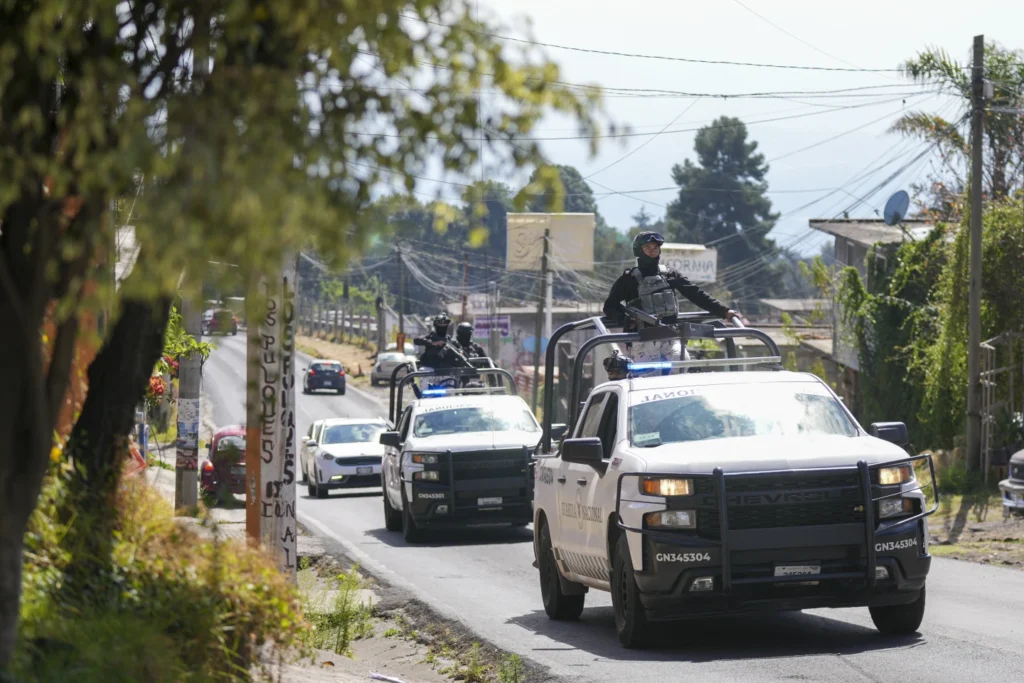
Three suspects were arrested on Monday in connection with the death of a Mexican migration agent found earlier in the day with no vital signs, state security and migration officials confirmed.

The incident, which marks a rare case of deadly violence against migration agents, occurred weeks before an anticipated crackdown on immigration following the inauguration of U.S. President-elect Donald Trump.

State investigators confirmed the agent suffered a head injury and showed signs of violence, according to a statement from public security officials in northern Chihuahua state. The agent’s body was discovered with no vital signs.

The statement identified two Venezuelan nationals as suspects taken into custody. The Mexican National Migration Institute (INM) later reported that a third suspect, a Colombian national, had also been detained.

The fatal attack occurred at a checkpoint just south of Ciudad Juarez, which borders El Paso, Texas. The agent had been checking the identification documents of foreign nationals when the assault took place, INM said.

The agent’s death comes as migrants in Mexico are bracing for stricter U.S. immigration policies expected to be implemented under the Trump administration. On Monday, hundreds of migrants gathered outside an immigration office in southern Mexico, hoping to secure safe passage to the U.S. before Trump’s inauguration on Jan. 20.

Messi’s Real Estate Trust Debuts on Spanish Market with €223 Million Valuation

A real estate investment trust (REIT) owned by Argentine soccer star Lionel Messi made its debut on the Spanish stock market at €57.4 per share, giving it a market capitalization of €223 million ($232.12 million).

Messi, currently playing for Inter Miami and a former FC Barcelona forward, is listed as chairman of the board of Edificio Rostower Socimi in official documents from the Portfolio Stock Exchange, a European alternative market.

The REIT’s sole shareholder is Messi’s family investment vehicle, Limecu Espana 2010, according to the documents. However, the trust has indicated plans to open up to new investors, according to Santiago Navarro, CEO of the Portfolio Stock Exchange, who confirmed the development to Reuters.

The trust has not yet begun trading, as the exchange, which launched in 2023 and is overseen by the Bank of Spain, only permits trading when a company seeks to sell shares or raise capital. Navarro explained that this structure allows for greater flexibility, control, and lower costs compared to traditional IPOs, with any share purchase requests subject to shareholder approval.

Edificio Rostower did not respond to inquiries regarding its stock market debut, which occurred on Monday.

The company’s portfolio includes seven hotels in Spain and Andorra, three office spaces, and five apartments in Spain, as well as additional properties in London and Paris. Established in 2013, Edificio Rostower reported a €1.7 million loss in 2023, according to records from the Portfolio Stock Exchange.

Most of the company’s assets are located in Catalonia, the region where Messi, 37, moved in 2000 at the age of 13 to join FC Barcelona’s youth academy. He lived there until 2021, when he left the club to join Paris Saint-Germain after Barcelona was unable to meet financial fair play regulations.

The eight-time Ballon d’Or winner has stated his intention to return to Barcelona with his wife and three children after retiring from soccer.

Messi’s wife, Antonela Roccuzzo, serves as vice president of the board, while other board members include Alfonso Nebot, who manages Messi’s family office, and Ramon Adell, a board member of Spanish energy company Naturgy.

In November, Spain’s government announced plans to raise the corporate tax rate for real estate investment trusts, which currently benefit from a lower tax rate compared to other businesses. However, the proposal has yet to gain sufficient support in parliament.

reuters

Former Rebels Evict Assad’s Officers From Military Housing Near Damascus

Families of military officers who served under Syria’s ousted president Bashar al-Assad are being evicted from subsidized housing at a compound outside Damascus to make room for former rebel fighters, according to residents and fighters at the scene.

The Muadamiyat al-Sham housing complex, home to hundreds of people in over a dozen buildings, was originally designated for Assad-era military officers. As Syria’s military restructures to incorporate former rebel forces and demobilize Assad-era officers, the evictions come as no surprise.

However, the swift replacement of these families by fighters who previously lived in impoverished, rural rebel-held areas highlights the dramatic shift in fortunes for supporters of both sides of the conflict.

The names of rebel factions aligned with the main Islamist group, Hayat Tahrir al-Sham (HTS), which captured Damascus on Dec. 8, are spray-painted on the entrances to the buildings, marking them for fighters from each faction.

Three fighters at the compound, along with four women living there and a local official assisting those leaving, confirmed that officers’ families were given five days’ notice to vacate.

“We will start moving our children’s schools, starting our lives over. I am very sad, my heart is broken, it’s our lives, my children’s lives,” said Budour Makdid, 38, the wife of a former military intelligence officer. Her husband has signed papers recognizing the new authorities and returned to their family home in Latakia, a former Assad stronghold, where she and their children will join him.

Makdid and other families leaving the compound must obtain a document from local authorities to remove their belongings. Khalil al-Ahmad, a local administrator, stated that around 200 requests for such documents had been made.

Ahmad, who had not been officially notified by the new administration, said residents approached him for documents several days ago.

A spokesman for HTS did not respond to requests for comment.

**Displacement and Property Rights in Post-Assad Syria**

The handling of former Assad officers and their property rights will be closely monitored as Syria’s new administration takes shape. Millions have been displaced since the civil war began in 2011, and the future of these displaced families remains uncertain.

Earlier this month, HTS leader Ahmed al-Sharaa was seen in a video asking residents of his family’s former home in Damascus to leave, allowing his own family to return. Some former military families living near Muadamiyat al-Sham, but not in the subsidized housing, are also relocating.

Eidye Zaitoun, 52, was preparing to leave her two-room apartment and move to the coast, saying her son in the military had already relocated there, leaving no reason for her to remain.

HTS fighters, who endured displacement themselves, showed little sympathy for the families leaving. One fighter remarked, “We were displaced out of homes, out of our regions on a moonless night with only the clothes we were wearing. Thank God they are now allowed to take out their belongings.”

REUTERS

71-Year-Old Catholic Priest in Belarus Sentenced to 11 Years as Crackdown on Dissent Intensifies

A 71-year-old Catholic priest in Belarus was sentenced to 11 years in prison on Monday after being convicted of high treason for criticizing the government. The sentencing of Rev. Henrykh Akalatovich marks the first time since Belarus gained independence in 1991 that a Catholic clergy member has faced politically-driven charges. 

Rev. Henrykh Akalatovich

The conviction comes amid a broader crackdown on dissent by Belarusian authorities ahead of the January 26 presidential election, widely expected to secure a seventh term for President Alexander Lukashenko. 

The Viasna Human Rights Center reported that Akalatovich, 64, denied the treason charges. The organization has listed him among the 1,265 political prisoners currently held in Belarus. 

“For the first time since the fall of the Communist regime, a Catholic priest in Belarus was convicted on criminal charges typically used against political prisoners,” said Viasna representative Pavel Sapelka. “The harsh sentence aims to intimidate and silence hundreds of other priests ahead of the January presidential election.” 

Russian President Vladimir Putin, left, and Belarus’ President Alexander Lukashenko pose for a photo during the the Commonwealth of Independent States (CIS) meeting at the Igora resort in the Leningrad Region, about 54 km (33,75 miles north of St. Petersburg in Igora, Russia, Wednesday, Dec. 25, 2024. (Alexander Kazakov, Sputnik, Kremlin Pool Photo via AP)

Akalatovich, from the town of Valozhyn in western Belarus, has been in custody since November 2023. Diagnosed with cancer, he underwent surgery shortly before his arrest. Authorities have reportedly denied him access to warm clothing and food sent by supporters, keeping him incommunicado since his detention. 

He is one of dozens of clergy members — Catholic, Orthodox, and Protestant — who have been jailed, silenced, or exiled for opposing Lukashenko’s government. Clergy who criticized the disputed 2020 election, which gave Lukashenko a sixth term amid allegations of fraud, were particularly targeted. The government has since conducted a sweeping crackdown, arresting more than 65,000 people and violently suppressing mass protests. 

Religious leaders who supported protesters or offered refuge in their churches were singled out for repressive measures. Authorities have closely monitored sermons, conducted political “preventive” talks with clergy, and scrutinized their online activities. 

Belarus has a predominantly Orthodox Christian population, making up about 80%, while Catholics represent just under 14%, and Protestants account for around 2%. 

Lukashenko, in power for nearly 30 years, has described himself as an “Orthodox atheist” and has criticized clergy members who oppose his regime. During the 2020 protests, he urged them to “do their jobs” and refrain from political activism. 

The Belarusian president remains a close ally of Russian President Vladimir Putin, allowing Russian forces to use Belarusian territory to launch attacks on Ukraine and hosting Russian tactical nuclear weapons. 

Global Population to Hit 8.09 Billion on New Year’s Day After Year of Growth

The world’s population will reach 8.09 billion on New Year’s Day following a 71 million increase during 2024, the U.S. Census Bureau reported Monday. This 0.9% growth marks a slight decrease from 2023’s 75 million person expansion.

Global demographic projections for January 2025 anticipate 4.2 births and 2.0 deaths per second worldwide. The United States will enter 2025 with 341 million residents after growing by 2.6 million people in 2024.

U.S. population dynamics for early 2025 forecast one birth every 9 seconds and one death every 9.4 seconds, with international migration adding one person every 23.2 seconds. These factors combine to increase the U.S. population by one person every 21.2 seconds.

The Census Bureau reports U.S. population growth has reached 9.7 million (2.9%) in the 2020s, significantly outpacing the 2010s’ 7.4% growth rate, which marked the slowest increase since the 1930s.

New York Convenience Store Shooting Injures 6, Including 12-Year-Old Girl and Mother

0

Six people were injured Monday evening in a shooting at a Bronx convenience store, New York, including a 12-year-old girl and her mother, after one of the intended targets allegedly used the mother as a human shield, police said.

The 40-year-old mother was shot in the stomach, while the person who grabbed her was not injured, said interim Chief of Department John Chell. The condition of the mother and the other victims was not immediately released. Chell called the incident “a brazen and heartless attack on innocent New Yorkers and cowardly intended victims.”

Police believe two gunmen opened fire at around 5 p.m. on White Plains Road, a major commercial street in the Bronx, targeting a group of people standing outside the store. Surveillance footage showed the attackers running across the street and firing as their targets fled inside. At the store counter, one of the intended targets allegedly grabbed the mother and turned her into the line of fire, Chell said.

The victims, apart from the mother, suffered gunshot wounds to their arms or legs. Five were transported to local hospitals by emergency services, while the sixth reportedly found their own way to medical care. Among the injured were four men, aged 18 to 21, Chell said.

No arrests have been made, and investigators in New York are still working to determine a motive for the shooting.