Two explosions outside Brazil’s Supreme Court Wednesday night forced the evacuation of justices and left one person dead in the square facing the courthouse, authorities said.
The first blast occurred in a car park next to the court building, with local television footage showing the explosion originated in a parked car’s trunk. A second explosion followed approximately 20 seconds later, according to local media, with police discovering a body in the square afterward. The victim’s connection to the incidents remains unclear.
Brazil’s solicitor general characterized the explosions as an “attack” on social media as police swept the area for additional explosive devices. The Supreme Court confirmed all justices were safely evacuated.
The incident occurred near Brazil’s presidential palace, with President Luis Inacio Lula da Silva having departed the premises minutes before the explosions. Local news outlet UOL reported witnessing a man near the front of the Supreme Court building with explosives, though the source of this information was not specified.
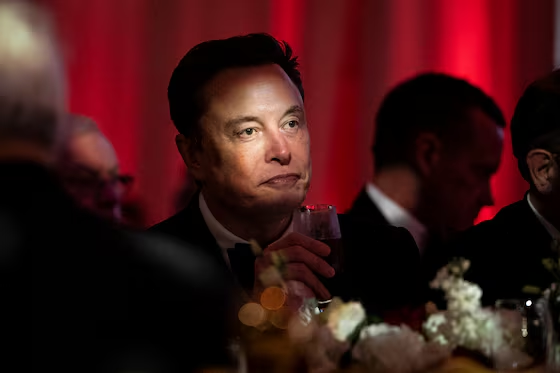
Italian President Sergio Mattarella issued a sharp rebuke to Elon Musk Wednesday after the incoming Trump administration adviser criticized Italian court rulings that blocked the government’s plan to process asylum-seekers in Albania.
“Italy is a great democratic country and knows how to take care of itself while respecting its Constitution,” Mattarella said through his spokesman, without directly naming Musk. “Anyone, particularly if as announced is about to assume an important role of government in a friendly and allied country, must respect its sovereignty.”
The clash erupted after Musk wrote on X that “these judges need to go” following a Rome court’s refusal to detain seven rescued migrants for processing in Albania. “This is unacceptable. Do the people of Italy live in a democracy or does an unelected autocracy make the decisions?” Musk added Wednesday.
The controversy surrounds Premier Giorgia Meloni’s flagship immigration policy, which would establish migrant processing centers in Albania at a cost of 670 million euros ($730 million) over five years. The courts have referred cases to the EU Court of Justice, effectively stalling the program’s implementation.
Musk, who has met with Meloni several times and is expected to lead Donald Trump’s new Department of Government Efficiency, later attempted to defuse tensions. According to X representative Andrea Stroppa, Musk spoke with Meloni Wednesday and “expresses his respect” for Mattarella and the Italian Constitution while defending his right to free expression.
The Tesla CEO has previously sparked diplomatic tensions through social media posts, including disputes with UK Prime Minister Keir Starmer, Brazilian judiciary officials, and Venezuelan President Nicolás Maduro.
Opposition parties argue the Albania project funds could better serve Italian-operated centers, while human rights groups contend outsourcing asylum processing violates international law. The facilities, which opened in October after construction delays, operate under Italian jurisdiction with Albanian security forces providing external protection.
Niger’s military junta has banned the French aid group Agency for Technical Cooperation and Development, or Acted, from working in the country amid tensions with France.
The Ministry of the Interior signed a decree on Tuesday withdrawing the nonprofit organization’s license to operate, without providing reasons for the decision. Another aid group, Niger’s Action for Well-Being, or APBE, also saw its license revoked.
Acted had been active in the West African country since 2010, mainly helping people displaced by jihadist violence and natural disasters.
Niger’s ruling military rulers took power in a coup last year, the latest of several military takeovers in Africa’s Sahel, the vast, arid expanse south of the Sahara Desert that has become a hotspot for extremist violence.
Since the coup, the Sahelian country has pulled away from its Western partners, turning instead to Russia for security. The authorities expelled both the French soldiers fighting against jihadists in the country and the French ambassador.
In September, the U.S. military completed its withdrawal from Niger, after the ruling junta ended an agreement that allowed U.S. troops to operate in the West African country.
Niger had been the West’s last reliable partner in the region in battling jihadists linked to al-Qaida and the Islamic State group.
A committee of Guinean opposition groups, civil society organizations and activists known as the Forces Vives called on Tuesday for the West African country to establish civilian rule by Jan. 1.
The junta that seized power in a 2021 coup proposed a two-year transition to elections from 2022 after negotiating with the Economic Community of West African States regional bloc, but it has shown little sign of moving to organize a vote, stoking public frustration.
The top bauxite producer has witnessed sporadic protests against the authorities and military leader Mamady Doumbouya since he took office. Some have led to deadly clashes with security forces.
In July, Guinea’s transitional authorities presented the draft of a new constitution which would potentially allow Doumbouya to participate in the next presidential election. No date has yet been set for a promised referendum on the constitution, which they said would be a precursor to any election.
“Faced with this gloomy picture, the Forces Vives of Guinea solemnly call for unity of action and the mobilization of all the nation’s living forces, both civilian and military, to demand the departure of the junta and the establishment of a civilian transition by January 1,” the group said in a statement.
Special counsel Jack Smith and his team plan to resign before President-elect Donald Trump takes office, a source familiar with the matter said.
Smith’s office has been evaluating the best path for winding down its work on the two outstanding federal criminal cases against Trump, as the Justice Department’s longstanding position is that it cannot charge a sitting president with a crime.
The New York Times first reported that Smith will step down.
The looming question in the weeks ahead is whether Smith’s final report, detailing his charging decisions, will be made public before Inauguration Day. The special counsel’s office is required under Justice Department regulations to provide a confidential report to Attorney General Merrick Garland, who can choose to make it public.
Smith’s federal criminal cases against Trump were upended by the election, as the Justice Department’s longstanding policy is that sitting presidents can’t be charged with crimes.
In late October, Trump said in a radio interview that he would immediately fire Smith as special counsel if re-elected. “It’s so easy — I would fire him within two seconds,” Trump said, adding that he got “immunity at the Supreme Court.” The next attorney general could decide not to release Smith’s final report as well.
Before Trump’s re-election last week, Smith and his team had continued moving forward in their election interference case against Trump. After Trump’s victory, however, a federal judge overseeing the case agreed to give the special counsel’s office until Dec. 2 to decide how to proceed.
The Justice Department had also charged Trump in Florida with allegedly hoarding classified documents after he left office and then refusing to give them back. But a federal judge dismissed the case in July, saying Smith’s appointment was illegal. That case remains on appeal.
When the former president was first indicted, Smith said he would move quickly to trial, but Trump’s legal team successfully sought to delay in both cases while then-candidate Trump routinely lambasted Smith at his rallies and online.
The election-interference case in Washington was narrowly focused on Trump, but an open question remains as to whether any unnamed co-conspirators referenced in the indictments face future legal jeopardy.
There’s no Justice Department norm for alleged criminal conspirators to avoid being prosecuted because they are connected to an incoming president, or because that future president is likely to pardon them.
Senate Republicans will gather behind closed doors Wednesday to elect their new majority leader, as a heated contest pits MAGA-aligned Rick Scott against establishment veterans John Thune and John Cornyn to replace the retiring Mitch McConnell.
The secret ballot election caps a leadership battle that has exposed divisions between the party’s Trump-aligned and institutional wings. All three candidates pledge allegiance to President-elect Donald Trump’s agenda, though their approaches differ significantly.
Thune of South Dakota, the current Republican whip, and Cornyn of Texas, a former whip, represent the institutional wing, each having served as second-in-command during their Bush-era Senate careers. Scott of Florida, elected in 2018, has positioned himself as the MAGA candidate, securing endorsements from right-wing commentator Tucker Carlson, billionaire Elon Musk, and Rep. Marjorie Taylor Greene.
“I think I’m uniquely positioned to really help get the Trump agenda done,” Scott told NBC News Tuesday. Despite Scott’s MAGA alignment, Trump himself has notably remained silent on the race, his influence limited by the secret ballot format.
The candidates presented their visions at a Tuesday evening forum, with both Thune and Cornyn emphasizing their fundraising prowess and ability to advance Trump’s priorities. “As Congress returns to Washington, we must prepare the Senate to advance [Trump’s] agenda legislatively,” Thune wrote in a FoxNews.com op-ed.
Cornyn promised to “Make the Senate Work Again” in a letter to colleagues, pledging to decentralize power and reinvigorate committee processes. The winner will lead Senate Republicans for the next two years after the party gained control in recent elections.
“I think at the end of the day, Thune still wins,” predicted Sen. Markwayne Mullin, R-Okla., a Trump ally. If no candidate secures a majority in the first round, the lowest vote-getter will be eliminated for a final runoff.
The leadership reshuffling includes unopposed John Barrasso of Wyoming for majority whip, while Sens. Tom Cotton of Arkansas and Joni Ernst of Iowa compete for the third-ranking position.
McConnell steps down after an 18-year tenure that made him the longest-serving Senate leader in history.
Major airlines suspended flights to and from Bali Wednesday as ash clouds from Mount Lewotobi Laki-laki volcano created dangerous flying conditions around the popular tourist destination, one week after an eruption killed 10 people.
The volcano’s weekend eruption sent ash columns 9 kilometers (6.2 miles) into the sky, prompting Australia’s Bureau of Meteorology to warn that volcanic ash might drift toward the country’s northern regions.
“Safety is always our highest priority, and our meteorology team is closely monitoring the situation,” Virgin Australia said in a statement announcing Wednesday’s flight cancellations. Jetstar extended its cancellations through noon Thursday Australian Eastern Daylight Time, while Hong Kong’s Cathay Pacific, India’s IndiGo, and Malaysia’s AirAsia also suspended services.
Ahmad Syaugi Shahab, general manager of Bali’s international airport, told Reuters that 22 international and 12 domestic flights were affected Tuesday. Singapore Airlines and its budget carrier Scoot cancelled some services, though other flights continued operating through Singapore’s airport.
The volcanic activity has also disrupted regional events, with organizers postponing a jazz festival in Labuan Bajo town, located 600 kilometers from the volcano, until next year due to safety concerns.
Indonesia, situated on the Pacific “Ring of Fire” with approximately 130 active volcanoes, has a history of aviation disruptions from volcanic activity. In 2020, ash clouds from Mount Merapi forced the closure of an airport in Solo city.
The former headteacher of a French school testified Tuesday about her failed attempts to protect Samuel Paty before the history teacher’s beheading by a Chechen refugee in 2020, revealing how a student’s lie sparked a chain of events ending in terrorism.
“I didn’t manage to protect him,” said Audrey F, who has since left France to teach in China. “It’s such an enormous waste.” She detailed to the Paris court how a 13-year-old student’s false claims about a freedom of expression lesson escalated into fatal violence.
The incident began when the student, identified as Z, had been suspended for absence and rudeness. She retaliated by falsely telling her parents that Paty had ordered Muslim students to leave while he showed “naked” images of the Prophet Muhammad. In reality, Paty had discussed three cartoons from a French satirical magazine, offering students the choice to look away if they might be offended.
The situation intensified when the girl’s father, Brahim Chnina, arrived at school with Islamist activist Abdelhakim Sefrioui, who claimed to represent French imams. They denounced Paty as a “thug” and demanded his removal. Both men now face charges of involvement in a “criminal terrorist” group and complicity in “terrorist murder,” among eight defendants on trial.
“By now I was very worried, not specifically for Mr Paty but for the school,” Audrey F testified, describing how the pair posted inflammatory videos online naming Paty and the school. Despite police protection and advice to stay home, Paty continued teaching until October 16, 2020, when 18-year-old Abdoullakh Anzorov killed him outside the school. Police shot Anzorov dead at the scene.
FILE – French President Emmanuel Macron leaves after paying his respects by the coffin of slain teacher Samuel Paty in the courtyard of the Sorbonne university during a national memorial event, Wednesday, Oct. 21, 2020 in Paris. (AP Photo/Francois Mori, Pool, File)
The murder, occurring five years after the Charlie Hebdo terrorist attack, shocked France. The student who initiated the false claims has been convicted of making slanderous accusations, while five other teenagers were found guilty of preparing aggravated violence.
“I tell myself that if there is justice, perhaps I’ll manage to move on,” said the former headteacher, adding that nothing would have happened without the online videos posted by Chnina and Sefrioui. The defendants deny the charges while acknowledging their involvement in events leading to Paty’s death.
India’s Supreme Court ruled Wednesday that authorities cannot demolish homes simply because residents are accused of crimes, establishing strict guidelines to end what critics call “bulldozer justice” that has disproportionately affected minority communities.
“The executive cannot become a judge and demolish properties. The chilling sight of a bulldozer demolishing a building reminds one of lawlessness where might was right,” the court declared, mandating a 15-day notice period before any demolition can proceed.
The landmark ruling responds to numerous petitions challenging authorities’ use of demolitions as punishment, particularly in states governed by the ruling Bharatiya Janata Party (BJP). While officials cite illegal construction as justification, opposition leaders and activists say the practice primarily targets Muslims, especially following religious violence or protests.
The new guidelines require authorities to provide detailed written notice explaining demolition reasons and allow sufficient time for occupants to respond or vacate. Officials must video record any demolition proceedings or face contempt charges for violations.
“Such highhanded and arbitrary actions have no place in a constitutional democracy,” the court stated, warning that officials “who took the law in their hands” would be held accountable.
Amnesty International welcomed the ruling as “a big win in ending the deeply unjust, widespread, unlawful and punitive demolitions, mostly targeting the minority Muslim community.” The organization noted that ruling party leaders and media had often celebrated the practice as “bulldozer justice.”
The BJP denies targeting Muslims, with state chief ministers defending demolitions as part of their tough stance on crime. However, the court emphasized that “citizens’ voices could not be silenced by the threat of demolition” and called such actions “simply unacceptable under rule of law.”
Legal observers say the ruling’s effectiveness will depend on implementation, though it marks a significant step toward preventing extrajudicial punishment through property destruction. The court has consistently criticized the practice throughout hearings, emphasizing constitutional protections for all citizens regardless of accused crimes.
An explosion at a food coloring factory killed two employees Tuesday and damaged homes across surrounding neighborhoods, marking the second fatal blast at the Louisville facility in two decades, company officials confirmed Wednesday.
The incident at Givaudan Sense Colour occurred during what workers described as “normal activity,” according to Louisville Mayor Craig Greenberg. At least 11 employees were hospitalized, some with life-threatening injuries, though officials have now accounted for all workers present during the explosion.
“We are grieving with the families, friends, and loved ones of those that were lost and injured during this very difficult time,” Givaudan said in a statement, adding that the company is cooperating with investigators while probing the cause.
The blast’s impact extended well beyond the factory grounds. Patrick Livers, whose home sits across railroad tracks from the plant, returned from work to find extensive damage after his mother called about the explosion. “The house is still standing. It’s just structural damage. If it was on a wall, it’s on the floor,” he said, describing damage throughout his street. “All the neighbors’ windows busted out, doors blown in. It looked like a small tornado went off inside the house.”
Steve Parobek, living a block from the plant, improvised repairs with pizza boxes and duct tape after the explosion shattered his kitchen window. The Louisville Fire Department leads the investigation with state and federal partners, including a Bureau of Alcohol, Tobacco, Firearms and Explosives reconstruction team.
The facility has a troubled history. In April 2003, when owned by D.D. Williamson & Co., an explosion killed one worker. Federal investigators determined that incident resulted from a missing pressure relief valve removed during the tank’s 1989 relocation. Givaudan acquired the plant in 2021.