

A crowd set fire to an Ebola treatment center in eastern Congo on Thursday after authorities stopped them from retrieving the body of a local man believed to have died from the virus, underscoring rising tensions in a region struggling to contain a fast spreading outbreak.
Witnesses and local officials said the violence erupted in the town of Rwampara, where frustration over strict health measures collided with long held cultural burial practices. The blaze forced aid workers to flee as chaos unfolded inside the facility.
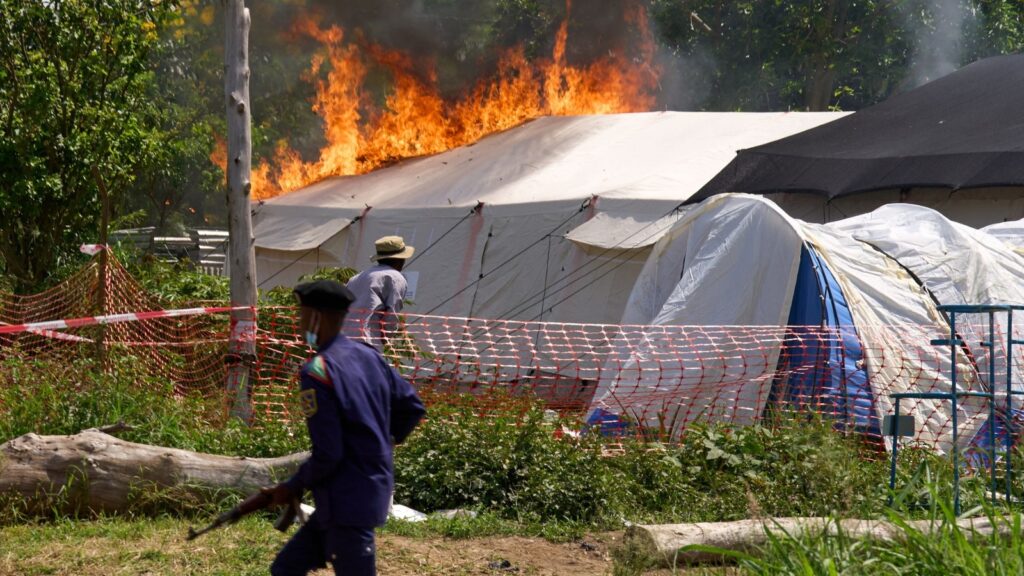
A resident who spoke by phone described how a group of young people attempted to take the body of a friend for burial before being blocked by police. The confrontation escalated quickly.
“The police tried to calm the situation, but it got out of control,” said Alexis Burata, a student who was near the scene. “The youths ended up setting the center on fire.”
An Associated Press journalist at the site reported seeing individuals break into the facility, ignite materials inside, and set fire to what appeared to be at least one body being stored there. Emergency teams evacuated the area as flames spread.
Jean Claude Mukendi, a senior police official in Ituri Province, said the unrest stemmed from a lack of understanding about safety protocols.
“Families wanted to take the body home for funeral rites, but during an Ebola outbreak, strict procedures must be followed,” he said, emphasizing that all burials must comply with public health regulations.
Health experts warn that the bodies of Ebola victims remain highly infectious, making traditional burial practices a major driver of transmission. Authorities have taken control of burials in affected areas, a measure that has repeatedly sparked resistance from grieving families.
Hama Amadou, a field coordinator with the medical aid group ALIMA, later confirmed that order had been restored and operations at the center had resumed.
The incident highlights the complex challenge facing health workers as they attempt to contain a rare strain of the Ebola virus in a region marked by displacement, weak health systems, and ongoing violence. The outbreak has spread for weeks in areas where many residents are already fleeing armed conflict, further complicating tracking and containment efforts.
Officials in Congo reported 160 suspected deaths and 671 possible cases across two provinces as of Thursday. The United Nations has also confirmed infections, including one fatal case, in neighboring Uganda. However, the World Health Organization has cautioned that the true scale of the outbreak is likely far greater.
“We are still intensifying surveillance and case finding,” said Jean Kaseya, head of the Africa Centers for Disease Control and Prevention. “Numbers will likely rise as detection improves.”
The outbreak remains centered in Ituri Province, which borders Uganda and South Sudan, raising concerns about regional spread. While global risk is currently considered low, health authorities warn that the regional threat is significant.
Efforts to control the disease have been hampered by limited medical infrastructure, reduced international aid, and ongoing insecurity. More than 920,000 people are internally displaced in Ituri alone, according to the United Nations, creating conditions that make coordinated response efforts difficult.
Violence in the region has further strained resources. Local leaders reported that an attack by militants earlier this week killed at least 17 people in a nearby village, diverting attention and security resources away from health operations.
Medical teams have also raised alarm over shortages of supplies and personnel. There is currently no approved vaccine or treatment for the specific strain driving this outbreak, and experts say it could take several months before one becomes available.
“The priority is rapid action and strong community engagement,” said Ariel Kestens of the International Federation of Red Cross and Red Crescent Societies. “The coming days are critical.”
The virus spreads through contact with bodily fluids and can cause severe symptoms including fever, vomiting, diarrhea, and internal bleeding. Early detection is key, but health officials say the outbreak went undetected for weeks after the first known death in late April, partly because initial testing focused on a different strain.
The disease has now reached a new area. Authorities confirmed the first cases in South Kivu Province near the city of Bukavu, marking a significant expansion from the initial outbreak zones.
International repercussions are already emerging. India and the African Union postponed a major summit scheduled in New Delhi, citing health concerns. Congo’s national soccer team also canceled a training camp and public event in the capital.
The United States has imposed travel restrictions on individuals who recently visited affected countries, requiring enhanced screening for returning citizens and limiting entry for foreign nationals.
The attack on the treatment center reflects a recurring pattern seen in past Ebola outbreaks, where mistrust between communities and authorities undermines containment efforts. Public health strategies, though scientifically necessary, often clash with deeply rooted cultural practices, particularly around death and burial.
In regions like eastern Congo, where state presence is limited and armed groups operate freely, that mistrust is amplified. Communities may view outside intervention with suspicion, especially when it involves removing loved ones and restricting traditional mourning rituals.
The situation is further complicated by economic hardship and displacement. With hundreds of thousands of people on the move, tracking infections becomes increasingly difficult, allowing the virus to spread quietly before detection.
The absence of a ready vaccine for this strain adds urgency to containment efforts. Unlike previous outbreaks where vaccination campaigns helped slow transmission, health workers now rely heavily on isolation, contact tracing, and community cooperation.
Unless authorities can bridge the trust gap and adapt their response to local realities, incidents like the Rwampara attack could become more frequent, threatening to derail efforts to contain the outbreak and raising the risk of wider regional spread.
AP





