

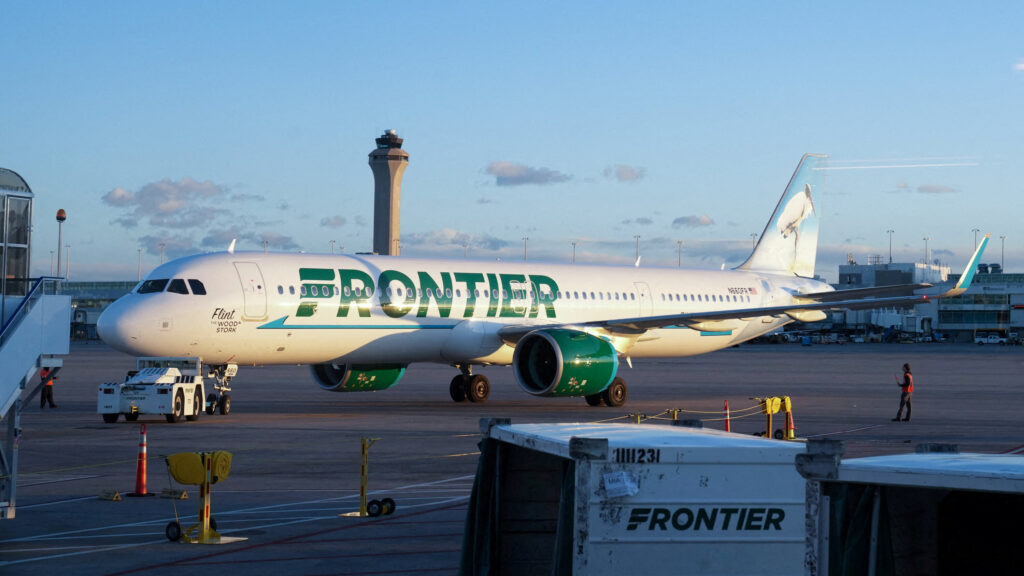
A person died after being struck by a departing Frontier Airlines jet late Friday at Denver International Airport, authorities said, in a dramatic runway incident that forced an emergency evacuation of passengers and prompted a federal investigation.
Airport officials said the aircraft, operating as Flight 4345 and bound for Los Angeles International Airport, hit a pedestrian at about 11:19 p.m. local time as it began takeoff. The collision triggered an engine fire, which crews later extinguished.
The individual, who has not been identified, had entered the airfield by climbing a perimeter fence minutes before the crash and was pronounced dead at the scene. Officials indicated the person was not an airport employee.
The Federal Aviation Administration and the National Transportation Safety Board have opened investigations into the incident.
Passengers described confusion and fear inside the cabin as the situation unfolded. Video recorded by travelers and shared online captured a loud impact followed by panic among those on board. Several passengers told local broadcaster KUSA that smoke quickly filled the cabin after the aircraft briefly lifted off before the pilots halted the takeoff.
One passenger recounted that breathing became difficult as smoke spread, while others described hearing a loud bang and seeing flames from the engine. Some said they feared for their lives as the aircraft came to a stop on the runway.
The airline confirmed the aircraft, an Airbus A321, was carrying 224 passengers and seven crew members. Pilots aborted the takeoff after the collision and initiated an emergency evacuation. Passengers exited using inflatable slides as emergency crews responded.
Airport authorities said 12 people sustained minor injuries during the evacuation, with five transported to nearby hospitals for evaluation. Emergency responders later moved passengers back to the terminal by bus.
In a statement, Frontier Airlines said it was cooperating with investigators and expressed condolences over the fatality. The carrier noted that smoke had been reported in the cabin but did not confirm whether it was directly linked to the collision.
Air traffic control recordings reviewed by The Associated Press captured the pilot informing controllers that the aircraft had struck an individual on the runway and was experiencing an engine fire. The crew also reported smoke inside the cabin and requested emergency assistance as they prepared to evacuate.
Transportation Secretary Sean Duffy said the individual had deliberately breached airport security by scaling a fence and entering an active runway area. He emphasized that unauthorized access to airfields poses serious risks and urged the public to avoid restricted zones.
Airport officials temporarily closed Runway 17L following the incident. Operations resumed Saturday morning after authorities secured the area and began preliminary reviews.
The Association of Flight Attendants-CWA praised the actions of the flight crew and first responders, saying their quick response prevented the situation from escalating further and ensured the safe evacuation of everyone on board.
The incident occurred one day after a separate fatal workplace accident involving an airline employee at Orlando International Airport, underscoring a series of recent safety concerns at major U.S. aviation hubs.
The fatal runway collision at Denver International Airport highlights a rare but deeply concerning vulnerability in airport security systems. Modern airports are designed with multiple layers of protection, including perimeter fencing, surveillance systems and patrols, yet this incident demonstrates that breaches, while uncommon, can still occur with deadly consequences.
Runway incursions involving unauthorized individuals are among the most dangerous scenarios in aviation safety. Aircraft during takeoff operate at high speeds, leaving pilots with little time to react to unexpected obstacles. Even a brief intrusion can result in catastrophic outcomes, as seen in this case.
The presence of smoke inside the cabin following the collision adds another layer of concern. While it remains unclear whether the engine fire was directly caused by the impact, such events can quickly escalate into life-threatening emergencies. The orderly evacuation suggests that crew training and emergency protocols functioned effectively under pressure, likely preventing further injuries or fatalities.
This incident may prompt renewed scrutiny of airport perimeter security nationwide. Authorities could consider additional measures such as enhanced surveillance technology, motion detection systems or increased patrol frequency, particularly in high-traffic areas. The balance between maintaining open, accessible infrastructure and ensuring strict security will likely be a key focus in the aftermath.
There are also broader implications for passenger confidence. While aviation remains one of the safest forms of travel, highly visible incidents—especially those captured on video and widely shared—can influence public perception. Transparent investigations and clear communication from regulators will be essential in maintaining trust.
The involvement of federal agencies such as the Federal Aviation Administration and the National Transportation Safety Board signals that a comprehensive review will follow. Findings from these inquiries could lead to updated safety recommendations, not only for Denver but for airports across the country.
Ultimately, the tragedy underscores how a single breach of security can ripple across multiple systems—affecting passengers, crew, emergency responders and airport operations. It also serves as a reminder of the critical importance of maintaining strict control over restricted areas in aviation environments.
AP/NBC





