

A Haitian man who entered the United States in 2022 and was granted temporary immigration status has been arrested and charged with second-degree murder after allegedly killing a mother of two with a hammer outside a gas station in Fort Myers, Florida, in broad daylight Friday.
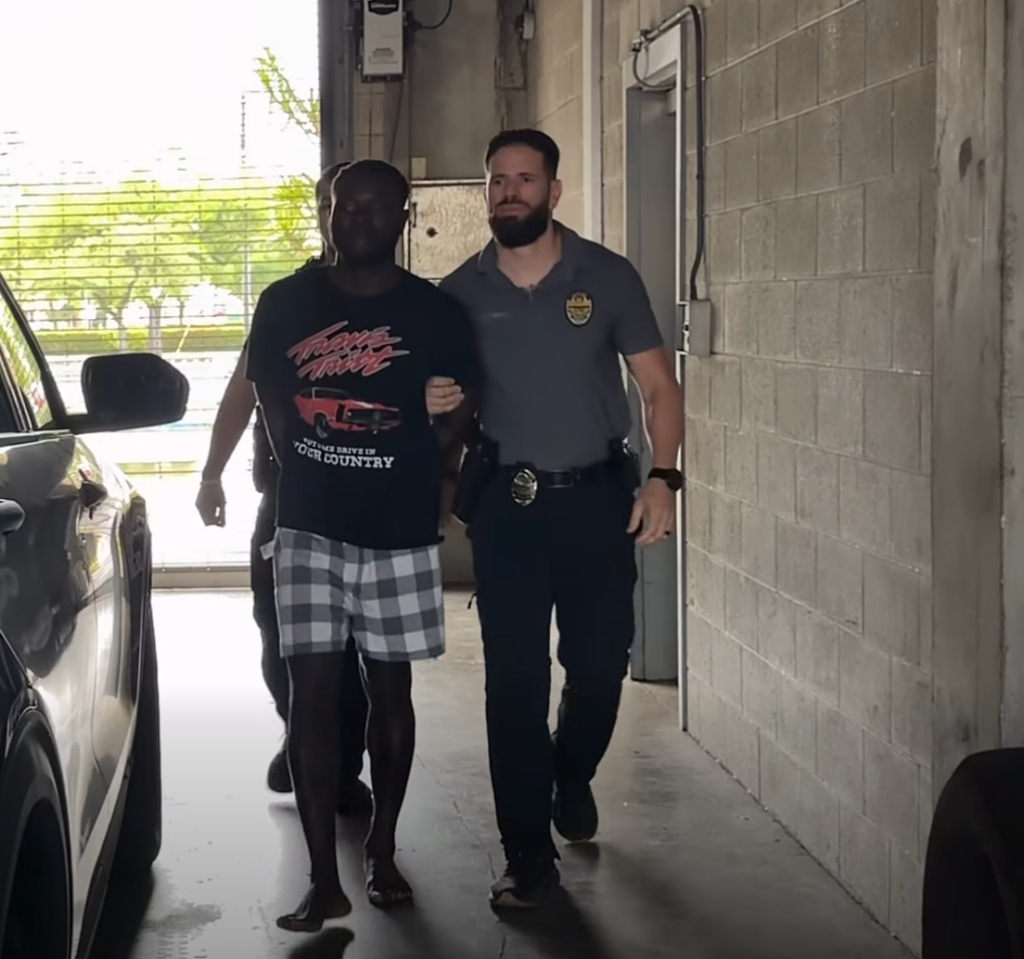
Rolbert Joachim, 40, faces charges of second-degree murder and criminal damage to property, according to Lee County Sheriff’s Office jail records. The arrest followed a violent incident captured on surveillance footage that shocked the community and immediately became focal point for political debates about immigration enforcement and border security.
Surveillance footage appeared to show Joachim smashing the woman’s car windshield, approaching her, and repeatedly striking her in the head with a hammer—killing her in full view of potential witnesses during daylight hours, according to the Department of Homeland Security. The brazen nature of the attack outside a commercial establishment during normal business hours amplified public alarm about the incident.
The woman, whose identity has not been publicly released pending family notification, was a store clerk working inside the gas station. She was also the mother of two teenage daughters, according to a report from local outlet Gulf Coast News. The victim’s family now faces devastating loss compounded by the brutal circumstances of her death.
Immigration and Customs Enforcement assisted the Fort Myers Police Department in tracking down and arresting Joachim on Mango Street in Fort Myers following the attack. The collaborative law enforcement effort resulted in his swift apprehension before he could flee the jurisdiction.

Joachim first entered the United States in August 2022 and was released into the country under the Biden administration, according to DHS records. A federal immigration judge issued a final order of removal against him later that year, but he was granted Temporary Protected Status—which expired in 2024—allowing him to remain in the country legally despite the deportation order.
“This illegal alien barbarically hit this woman in the head multiple times with a hammer,” DHS acting assistant secretary Lauren Bis wrote in a statement employing inflammatory language characterizing the suspect by immigration status rather than simply as an accused criminal. “This heinous murderer was RELEASED into the country by the Biden administration. Not only did the Biden administration release him into the country, but they then gave him temporary protected status. Their reckless immigration policies cost this woman her life.”
The statement immediately politicized the murder investigation by framing the crime as an immigration policy failure rather than addressing it primarily as a horrific act of violence requiring justice for the victim and her family. The emphasis on the suspect’s immigration history rather than the victim’s life reflected broader political strategies of attributing individual crimes to systemic policy decisions.
ICE has lodged a detainer against Joachim, and he will be deported regardless of the outcome of the criminal case—meaning even if acquitted of murder charges, he would face removal from the United States based on immigration violations. The dual track of criminal prosecution and immigration enforcement ensures consequences for his presence in the country independent of murder trial outcomes.
“The arrest of this criminal is an example of how ICE and local authorities can work together to swiftly bring criminals to justice and make our communities safer,” Bis declared, framing the case as validation of cooperative immigration enforcement rather than acknowledging the tragedy that a woman lost her life before any prevention occurred.
The case immediately generated political controversy as immigration restrictionists cited it as evidence that temporary protected status programs and border policies endanger public safety by allowing individuals with deportation orders to remain in the country. Advocates for immigrants countered that individual crimes should not be used to stereotype entire populations or justify sweeping policy changes affecting millions.
Temporary Protected Status is a humanitarian program that allows nationals of designated countries experiencing armed conflict, environmental disasters, or other extraordinary conditions to remain temporarily in the United States. Haiti has been designated for TPS multiple times due to political instability, natural disasters including devastating earthquakes, and economic collapse that have made return dangerous for Haitian nationals.
The program’s critics argue it enables individuals with removal orders to remain in the country indefinitely despite lacking permanent legal status. Supporters emphasize it provides essential humanitarian protection to vulnerable populations who would face serious harm if forcibly returned to crisis-affected nations.
The fact that Joachim received TPS despite having a final removal order raises questions about how such statuses are granted and whether adequate background checks or coordination between immigration enforcement divisions occurs. However, it remains unclear whether any prior criminal history or behavioral indicators existed that might have predicted violent behavior.
For the victim’s teenage daughters, the political debates about their mother’s killer’s immigration status provide no comfort as they confront life without the parent who worked at a gas station to support them. The reduction of their mother’s life to a talking point in immigration arguments compounds the tragedy of her violent death.
The surveillance footage that apparently captured the attack will likely prove central to prosecution efforts, providing visual documentation of the incident that could eliminate reasonable doubt about what transpired. However, the footage’s existence also means the victim’s final moments may become public spectacle as the case proceeds through judicial processes.
Lee County prosecutors will determine whether to pursue first-degree murder charges that could result in life imprisonment or whether the second-degree murder charge—suggesting intent to kill without premeditation—adequately reflects the evidence. The distinction carries significant sentencing implications should Joachim be convicted.
As the case proceeds through Florida’s criminal justice system, it will inevitably fuel ongoing political battles about immigration enforcement, border security, and humanitarian protection programs. The Trump administration has already seized upon such incidents to justify aggressive immigration enforcement measures and proposals to eliminate or severely restrict programs like Temporary Protected Status.
Whether this horrific murder represents evidence of systemic immigration policy failures requiring dramatic reforms or an isolated crime that should not drive sweeping policy changes affecting millions will likely divide observers along existing ideological lines regarding immigration. For the Fort Myers community and especially the victim’s family, the urgent need is for justice and accountability rather than political vindication.
New York Post





