

(AP/Reuters) — Iran signaled it would respond swiftly after the United States seized an Iranian-flagged vessel near a key shipping route, a move that officials in Tehran described as a breach of a fragile ceasefire and a serious escalation in already strained relations.
Iran’s military leadership condemned the operation, describing it as an unlawful act at sea and warning that a response would follow. State television carried statements from military officials who argued the seizure undermines ongoing efforts to ease tensions between the two countries.
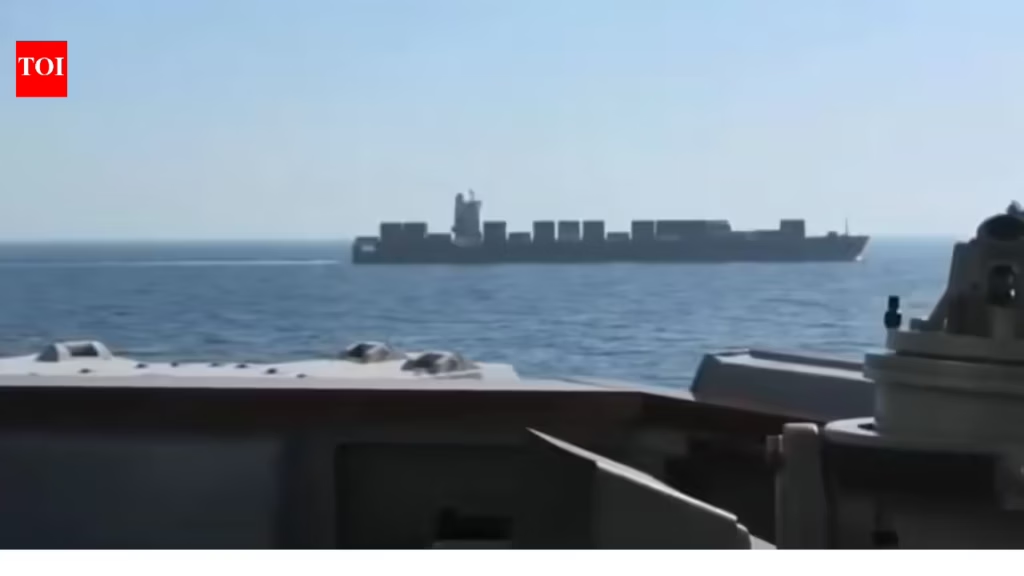
The United States said its forces intercepted the vessel after it crossed a naval blockade line and failed to comply with repeated warnings. President Donald Trump wrote on social media that U.S. forces had taken control of the ship and were inspecting its contents.
Iranian authorities pushed back strongly. First Vice President Mohammad Reza Aref said pressure on Iran’s oil exports could destabilize global energy markets, arguing that restrictions imposed by Washington were incompatible with broader expectations of maritime security.
“One cannot restrict Iran’s oil exports while expecting free security for others,” Aref wrote in a public message, adding that the global market faces a choice between equitable access and rising economic costs.
Diplomatic tensions also intensified as Iran’s foreign minister, Abbas Aragchi, conveyed concerns to Pakistan’s foreign minister, Ishaq Dar. Iranian officials described recent U.S. actions and demands as evidence of a lack of genuine commitment to diplomacy.
The confrontation has cast uncertainty over plans for a new round of negotiations expected in Islamabad. The talks were intended to build on earlier discussions aimed at extending a ceasefire set to expire within days. However, Iranian state media signaled that participation in further talks remains uncertain under current conditions.
According to reporting by Reuters, the seizure has heightened concerns that the ceasefire may collapse before its scheduled end. Iran indicated it may withdraw from diplomatic efforts altogether if pressure tactics continue, raising the risk of renewed confrontation.
At the center of the dispute is the strategic Strait of Hormuz, a narrow passage that handles roughly one-fifth of the world’s oil shipments. Both countries have imposed restrictions in the area, with the United States maintaining a blockade on Iranian ports while Iran has alternated between limiting and reopening maritime traffic.
The standoff has already begun to ripple through global markets. Energy prices surged in early trading following reports of the seizure, reflecting investor concern that supply disruptions could intensify if the situation escalates further.
Meanwhile, preparations for potential negotiations continued in Pakistan despite uncertainty. Security measures were tightened in Islamabad ahead of the anticipated arrival of a U.S. delegation. Officials in Washington indicated that Vice President JD Vance could lead the delegation, alongside senior envoys including Steve Witkoff and Jared Kushner, though final details remained unclear.
The broader conflict, now in its eighth week, has already had far-reaching consequences. Military exchanges involving the United States, Israel, and Iran have led to thousands of casualties and widespread damage across the region. The ongoing crisis has also disrupted shipping lanes, strained alliances, and heightened fears of a prolonged energy shock.
The seizure of the vessel marks a critical turning point in an already volatile situation. While both Washington and Tehran have previously issued strong warnings, direct actions such as this significantly raise the stakes by introducing immediate risks of retaliation.
From a strategic standpoint, control over maritime routes has become a central lever of influence. For Iran, restricting access to the Strait of Hormuz offers a powerful means of exerting pressure on global energy markets and, by extension, on countries dependent on oil imports. For the United States, enforcing a blockade aims to weaken Iran’s economic capacity while signaling resolve to allies.
However, these competing strategies carry substantial risks. Even limited disruptions in the strait can trigger sharp increases in oil prices, affecting economies worldwide. The current situation underscores how regional conflicts can rapidly evolve into global economic challenges.
Diplomatically, the incident complicates efforts to sustain dialogue. Trust between the two sides was already fragile, and actions perceived as aggressive can quickly erode any remaining goodwill. The uncertainty surrounding the planned talks in Islamabad highlights the difficulty of maintaining negotiations amid active confrontation.
There is also a broader geopolitical dimension. Allies and regional partners are closely watching how both countries proceed, particularly as energy security and trade routes remain critical concerns. Any escalation could draw in additional actors or prompt shifts in international policy.
In the immediate term, the likelihood of retaliation from Iran raises concerns about further incidents at sea or targeted responses against infrastructure. Longer term, the crisis illustrates the delicate balance between military pressure and diplomatic engagement, with each move carrying consequences that extend well beyond the region.
As the ceasefire deadline approaches, the actions taken in the coming days will likely determine whether tensions ease or spiral into a wider conflict with significant global repercussions.





