

Israel killed the newly appointed military chief of Hamas in an airstrike on a Gaza City apartment building Tuesday night, striking Mohammed Odeh along with his wife and two of his children as residents were shopping for the Eid al-Adha holiday, Hamas confirmed Wednesday — making him the fourth person to hold that position killed by Israeli forces since the war began and the second in less than two weeks.
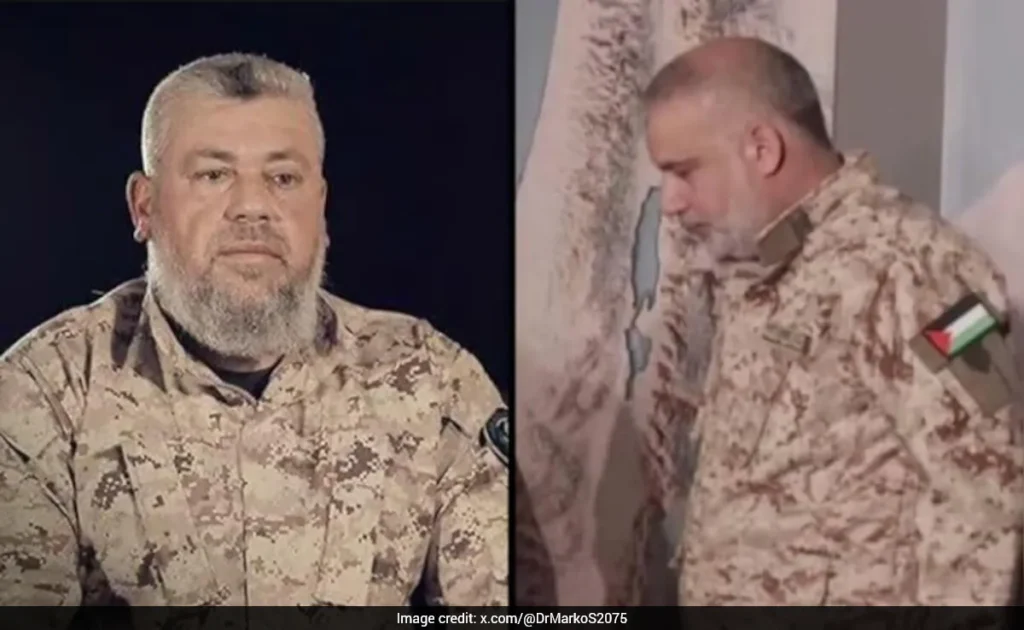
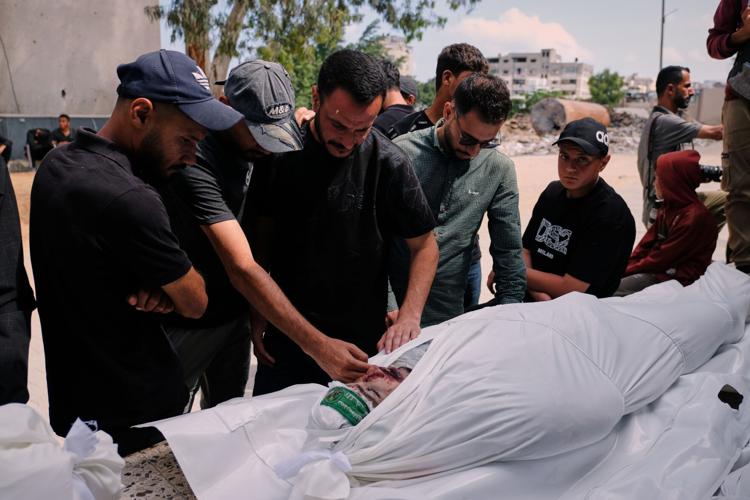
Thousands of mourners gathered Wednesday for the joint funeral of Odeh and his family members, marching from a mosque through Gaza City carrying four bodies wrapped in green Hamas flags. Mourners held posters bearing Odeh’s photograph and chanted as shots were fired into the air. Some of the posters identified him as one of the chiefs of staff of the Qassam Brigades, Hamas’s armed wing.
The Israeli military said the killing followed months of intelligence monitoring aimed at tracking Odeh’s movements and those of his operatives. Israeli Defense Minister Israel Katz announced on X that Odeh had been eliminated, writing that he had been “sent to meet his partners in the depths of hell.” Prime Minister Benjamin Netanyahu also confirmed the targeting, describing Odeh as one of the architects of the October 7, 2023 attacks on southern Israel.
Odeh had reportedly been appointed to lead the Qassam Brigades roughly one week before his death, succeeding Izz al-Din al-Haddad, who was killed in an Israeli strike on May 16. Haddad had himself succeeded Mohammed Sinwar, who also died in an Israeli strike. Netanyahu said Odeh had headed Hamas’s intelligence division at the time of the October 7 attack before his recent appointment to the top military role.
The Israeli military said Odeh was responsible for planning and coordinating Hamas’s infiltration and attack operations during October 7.
A Strike in a Crowded Neighborhood on a Holiday Eve
The attack that killed Odeh struck the Rimal neighborhood in western Gaza City at approximately 9:30 p.m. Tuesday, destroying the upper floor of an apartment building in an area filled with markets and shops. Three additional people beyond Odeh’s family were killed in the strike, and more than 20 were wounded, Gaza health officials confirmed. The attack came as Muslims across the territory were preparing for Eid al-Adha, one of Islam’s most significant holidays.
Al Jazeera correspondent Hind Khoudary, reporting from Gaza City, described the impact at the moment of the strike. “Muslims were shopping, getting ready for the Eid holiday, when the air strike took place,” she said, noting three large explosions rocked the Rimal area.
A source at al-Shifa Hospital confirmed to Al Jazeera that six people were killed and 20 others wounded in strikes on the Remal neighborhood Tuesday. Fresh Israeli strikes Wednesday evening killed at least seven more people in Gaza City, including two children and a woman, with more than 20 additional people wounded, Shifa Hospital said. The Israeli military said those strikes targeted two Hamas militants in northern Gaza.
Video from the scene Wednesday showed flames pouring from an upper-floor window as bystanders rushed to carry injured people, including children, toward waiting ambulances.
Hamas’s Shrinking Leadership
Sources close to Hamas said Odeh may have been the last living member of the armed wing’s higher leadership council. Hamas itself acknowledged he had been active with the organization for more than three decades and was part of the founding generation that helped build the movement’s military structure.
Michael Kobi of Israel’s Institute for National Security Studies said the accelerating pace of leadership eliminations was taking a real organizational toll. “This is part of the strategy of weakening Hamas, of undermining their cohesion as an organisation,” Kobi said. “When you take down experienced people, then they have a problem to run the organisation effectively.”
Abu Al-Abd Odeh, a relative of the slain commander who spoke at the funeral mosque, rejected the premise that leadership losses would extinguish Palestinian resistance. “This journey will not stop and the struggle of the Palestinian people will continue on all levels,” he said.
Katz used the killing to reiterate Israel’s broader stated objective for the Gaza war. “We pledged that Hamas will not hold civilian or military rule,” he wrote. He said a plan for what he described as voluntary migration from the enclave would also be implemented at the appropriate time. Palestinians have consistently rejected any displacement proposal, viewing such language as a deliberate echo of the 1948 events in which hundreds of thousands of Palestinians were expelled or fled during the war surrounding Israel’s creation.
Eid al-Adha in a Ruined Territory
The killing of Odeh and the broader strikes surrounding it arrived as Gaza’s population prepared to observe a holiday that in normal years means family gatherings, new clothes for children, shared meals, and communal prayer. None of those conditions exist in Gaza in 2025.
The United Nations estimates that approximately 90 percent of Gaza’s more than two million people have lost their homes over the course of the war. Most now live in tent encampments afflicted by rat infestations and pools of sewage, entirely dependent on international aid for food and clean water. Large sections of the territory’s buildings, mosques, and markets have been destroyed.
In Khan Younis and Gaza City, people gathered for Eid prayers amid bombed-out buildings. A few clusters of balloons lined one street. There was little else to mark the occasion.
“This is not Eid, we’re dead,” said Mahmoud Saqer, a displaced man from Khan Younis.
“There’s no Eid. My children were killed. Eid is only for the people who lost no one,” said Ayda Al-Banna, a displaced woman from Gaza City who prayed with her granddaughter amid the ruins.
The Numbers and the Ceasefire That Keeps Bleeding
The ceasefire between Israel and Hamas that took effect in October has not stopped the killing. At least 906 Palestinians have been killed since it came into force, according to the Gaza Health Ministry, which is run by the Hamas government but staffed by medical professionals whose detailed records are broadly accepted as credible by the international community and international aid organizations. Four Israeli soldiers have also been killed by militants during the same period.
The ministry’s cumulative death toll since October 7, 2023 stood at 72,803 as of Wednesday. Israel launched its offensive in response to the Hamas attack that killed approximately 1,200 people in southern Israel and took 251 hostage.
Israel and Hamas remain deadlocked in indirect negotiations over the second phase of the ceasefire agreement, which would require Hamas to disarm and Israeli forces to withdraw. The October agreement left Israel in operational control of more than half of Gaza, with Hamas holding a narrow coastal strip. No progress toward phase two had been
Decapitation Without Resolution
The killing of Mohammed Odeh, the fourth consecutive head of Hamas’s military wing to be eliminated by Israel since October 2023, forces a genuine strategic accounting of what Israel’s leadership targeting campaign has and has not accomplished.
On the narrow military question, the campaign has been remarkably successful by the metric it chose for itself. Israel set out to kill the people who planned and executed October 7, and it has killed most of them. Sinwar is dead. Haddad is dead. Odeh is dead. The organizational memory and operational experience that those individuals carried has been removed from Hamas’s command structure in ways that genuinely complicate the group’s ability to plan and execute complex operations.
What the campaign has not produced is the strategic outcome those tactical successes were supposed to enable. Hamas has not collapsed as an organization. It has not surrendered. It has not accepted disarmament. It has not agreed to the political arrangements Israel and the United States are seeking to impose on Gaza’s future. And it continues to find successors, however inexperienced, to fill the positions that Israeli strikes vacate.
The deeper problem is that Hamas’s resilience is not primarily organizational. It is political and demographic. As long as the conditions that produced Hamas’s support among Gaza’s population persist, which means as long as nearly two million people live in tent camps without homes, without reliable food, without functioning hospitals, and without any visible pathway to a different future, the organization will retain the capacity to recruit and reconstitute regardless of how many leaders are killed.
Netanyahu said Tuesday that Israel would target everyone involved in October 7. That promise has been largely kept against the military leadership. It has not produced a Gaza that is more stable, more governable, or closer to the political settlement that the ceasefire was supposed to create the space for. The question that the killing of four consecutive military chiefs in eight months raises is not whether Israel can kill Hamas leaders. It is whether killing Hamas leaders, in the absence of a credible political framework for what comes after, produces anything other than a list of names on a wall and more mourners in Gaza City streets.
AP/Aljazeera





