

King Harald V of Norway, Europe’s oldest reigning monarch, died Friday at 89, the royal palace said, ending a more than three decade reign that carried Norway’s monarchy from wartime exile through a modern era of economic prosperity and public tolerance. His son automatically became King Haakon VIII.
The palace said Harald died peacefully at 6:35 a.m. local time. Accounts differed slightly on the hospital’s exact name, with one report identifying it as the National Hospital in Oslo and another as Oslo University Hospital, though these likely refer to the same institution given the hospital’s historical naming. He had been hospitalized since August 17 for a bacterial infection in his blood, following earlier health scares in recent years, including a temporary pacemaker fitted during a 2024 vacation in Malaysia, later made permanent, and a skin infection treated during a February 2026 holiday on Spain’s Tenerife island.
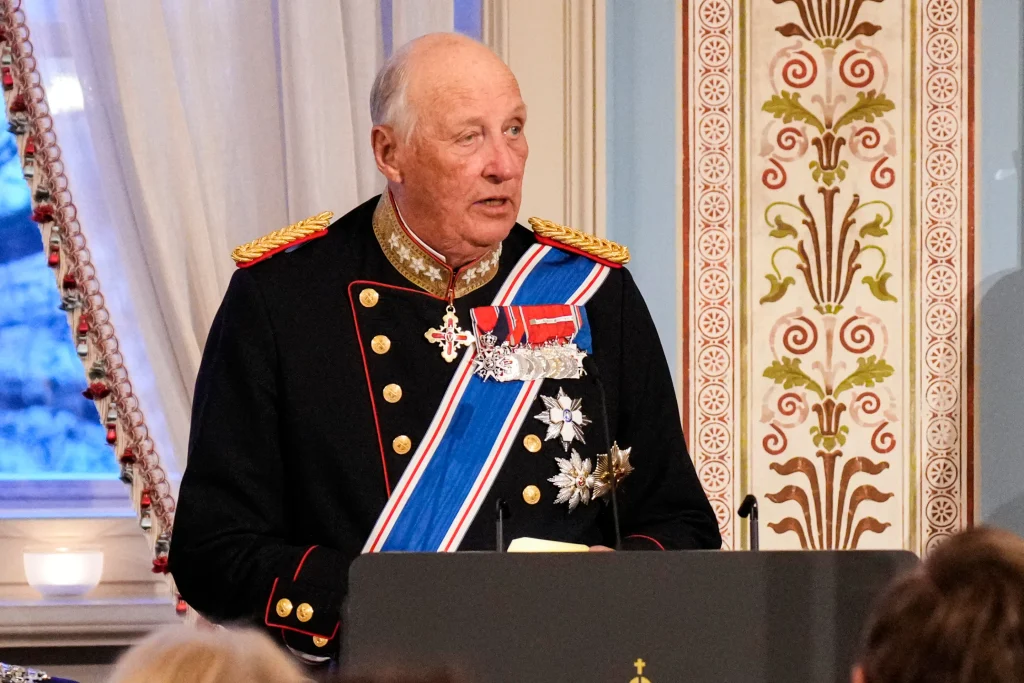
Norwegian Prime Minister Jonas Gahr Støre said the nation was in mourning and expressed deep gratitude for Harald’s decades of service. “For more than three decades as monarch, Harald V demonstrated an unwavering faith in the Norwegian people,” Støre said. “He helped us to see the best in ourselves — and in one another.”
Wartime Childhood and Exile
Harald was born February 21, 1937, in Asker, near Oslo, becoming the first Norwegian royal heir born in the country in roughly 567 years, since King Olav IV in 1370. Danish and Swedish monarchs had ruled the Scandinavian nation for centuries until Norway’s independence in 1905, when Harald’s grandfather, Haakon VII, became king following the dissolution of the union with Sweden.
Harald was three years old when Nazi Germany invaded Norway in 1940. His mother, Crown Princess Märtha, fled with him and his older sisters, Ragnhild and Astrid, first to neutral Sweden and then to the United States, while his father, then-Crown Prince Olav, and grandfather, King Haakon VII, went into exile in Britain to lead Norway’s government-in-exile. Haakon’s refusal to accede to German demands earned him lasting respect among Norwegians.
During their years in the U.S., first briefly at the White House and later for five years in Bethesda, Maryland, the family frequently met with President Franklin D. Roosevelt, whom Harald later described as like a grandfather to him. At age six, Harald carried out his first official royal duty, christening new warplanes at a Norwegian air base in Canada. The family reunited in Norway in June 1945, shortly after the war ended, and Harald attended Norwegian public schools rather than the private tutoring his father had received, later continuing his education at Norway’s military college and at Oxford University.
Marriage to a Commoner
As a young man, Harald faced pressure to marry among Europe’s noble families, but for nine years he held out for his school sweetheart, Sonja Haraldsen, the daughter of a businessman, threatening never to marry at all rather than give her up. King Olav had worried the match would weaken Norway’s still young monarchy, but Norwegians greeted the couple’s August 29, 1968, wedding with celebration and later embraced Sonja as queen. The marriage broke with royal tradition by uniting Harald with a commoner. The couple had two children, Crown Prince Haakon and his older sister, Princess Märtha Louise.
Norway’s constitution was amended in 1990 to allow firstborn children to take precedence in succession regardless of gender, though the change was not applied retroactively, meaning Haakon retained his position ahead of his older sister.
A Modernizing Reign
Harald ascended the throne January 21, 1991, following his British-born father’s death, adopting the same motto his father and grandfather had used: “All for Norway.” He spent much of his reign working to modernize the monarchy while preserving its largely symbolic role within Norway’s parliamentary democracy of 5.5 million people. “It has been my experience that the monarchy stands strong,” he once said, crediting his father and grandfather while describing the standard they set as both pressure and challenge.
Harald became known for consoling the nation during moments of tragedy, often traveling personally to disaster sites in rubber boots to meet residents who had lost homes or loved ones. His most memorable public moment came after right wing extremist Anders Behring Breivik killed 77 people in bomb and gun attacks across Norway in 2011. Speaking with visible emotion at a memorial service, Harald said he remained convinced that freedom was stronger than fear.
In 2016, Harald delivered an unexpected and widely shared speech embracing tolerance, declaring that Norwegians included girls who love girls, boys who love boys, and people of many faiths and backgrounds, including immigrants from countries such as Afghanistan, Pakistan and Poland. The speech, viewed by millions online, was seen as a notable public embrace of LGBTQ rights, religious diversity and immigration from a reigning monarch.
An avid sailor like his Olympic champion father, Harald competed in multiple Olympic Games and skippered his yacht to a world championship title in 1987, though he never matched his father’s Olympic gold medal. He maintained a lifelong interest in nature conservation, and at age 76 fulfilled a longtime dream by spending four days living among the Yanomami people deep in Brazil’s Amazon rainforest.
Harald weathered a wave of public criticism in 1998 after reports that he had accepted a 4 million crown yacht, worth about $400,000, as a birthday gift from industrialists, and that palace renovations had cost the government 500 million crowns. Calls at the time for him to abdicate at Norway’s typical retirement age of 67 went nowhere, and opinion polls showed strong public support for him to remain on the throne. He later joked in an interview that he intended to remain king for life unless he went, in his words, completely bonkers.
Recent Family Scandals
Harald’s reign saw comparatively few of the scandals that affected Sweden’s and Britain’s royal families, though his daughter, Princess Märtha Louise, stepped back from royal duties after drawing attention for saying she could communicate with angels and later becoming engaged to an American man who identifies as a shaman.
More serious controversy struck in early 2026, when Crown Princess Mette-Marit, married to Harald’s son Haakon, faced renewed scrutiny over her past connections to the late convicted sex offender Jeffrey Epstein, raising questions about her judgment though she was not accused of wrongdoing herself. Mette-Marit apologized for the situation, part of a broader apology to those she said she had disappointed. Around the same time, her son from a previous relationship, Marius Borg Høiby, who holds no royal titles, was convicted in June on two of four rape counts and one count of domestic violence following a seven week trial, and was sentenced to four years in prison; both Høiby and prosecutors have appealed the sentence. Two days after that verdict, the palace announced Mette-Marit had undergone a successful lung transplant, without specifying when the procedure occurred. She later returned home to recover and celebrated her and Haakon’s 25th wedding anniversary in August.
Public support for the monarchy dipped to 60 percent in February 2026, down from 70 percent the previous month, according to a Norstat poll for public broadcaster NRK, before recovering slightly to 64 percent by May. Despite the family’s difficulties, Harald himself remained the royal family’s most popular figure, rated 9.2 out of 10 in the February poll as the member who best represented the monarchy.
In January 2024, following the abdication of Denmark’s Queen Margrethe, Harald’s second cousin, Harald reaffirmed his own commitment to serve for life, saying the oath he took upon ascending the throne was permanent. He said in an earlier interview that Europe’s monarchies should not retreat from the openness they had embraced, remarking that once a gate has been opened, it becomes very difficult to close.
Succession
Harald’s son, Crown Prince Haakon, 53, becomes Norway’s fourth king since independence from Sweden in 1905, reigning as King Haakon VIII with Mette-Marit, also 53, as queen.
Reporting drawn from the Associated Press and Reuters





