

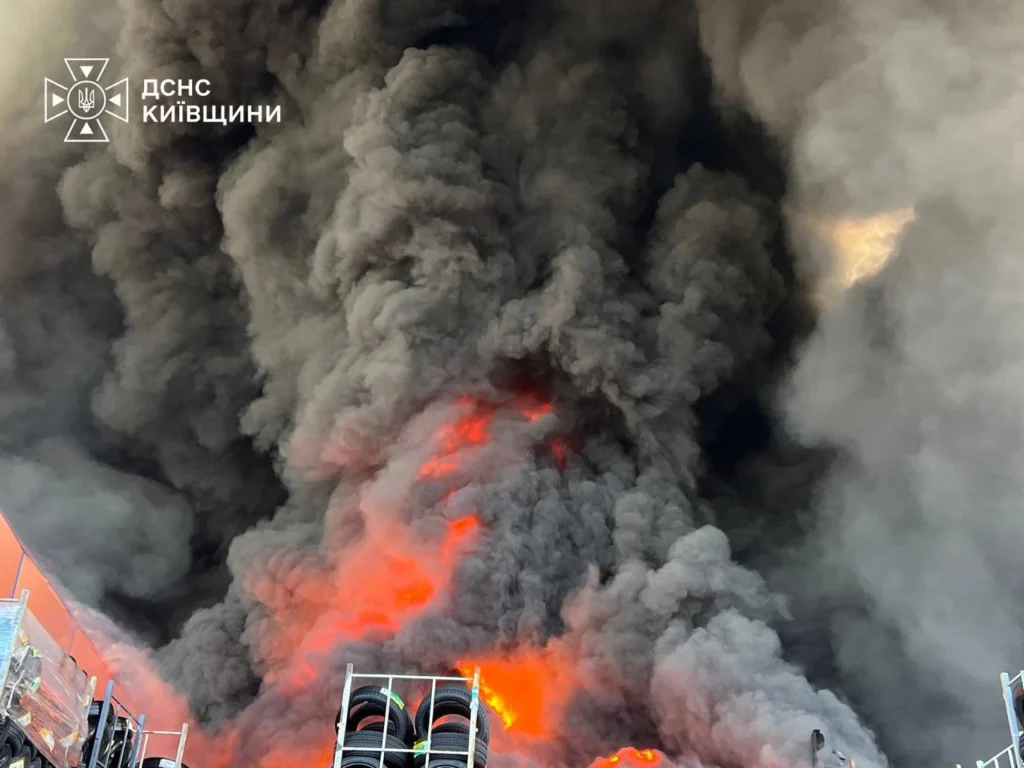
A Russian drone struck a Ukrainian military warehouse storing ammunition west of Kyiv late Friday, triggering massive explosions and fires that killed at least 37 people in what officials called the deadliest single attack of the war this year.
The strike hit the village of Myla in the Bucha district around 8:10 p.m., according to Ukraine’s Prosecutor General’s Office, sparking a large fire followed by a chain of detonations involving shells, mines, other ammunition and drones stored at the site. President Volodymyr Zelenskyy said the facility belonged to Ukraine’s Defense Forces and never should have been located there. “A terrible situation and terrible negligence on the part of those who stored explosives right next to people,” Zelenskyy said.
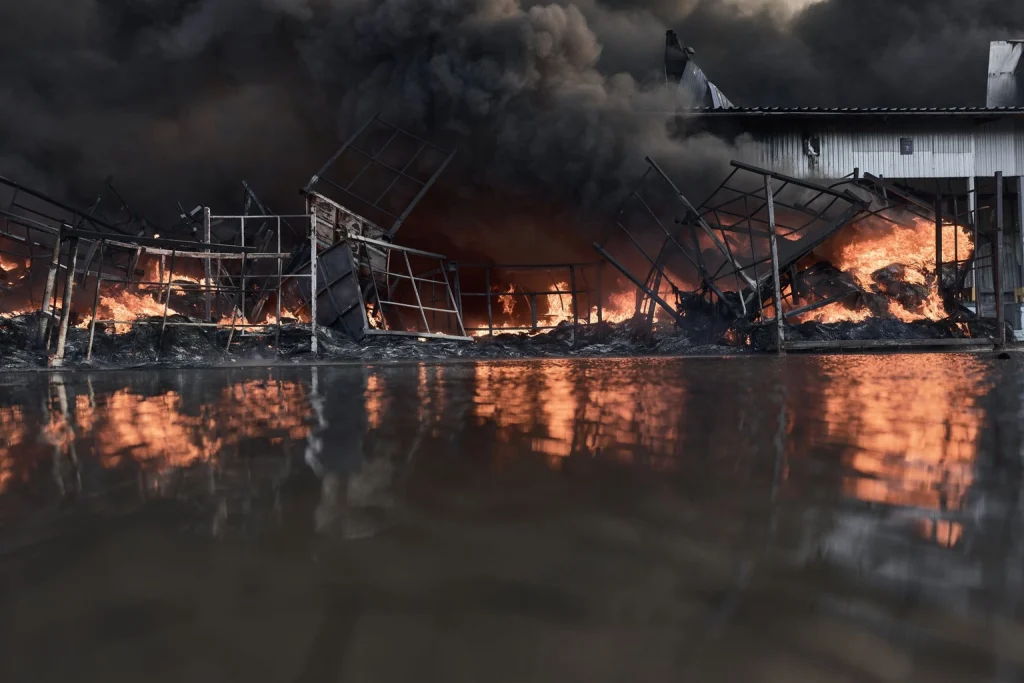
Kyiv Oblast Governor Tymur Tkachenko said the toll could still rise, and Ukraine’s interior minister said four people remained missing as of Saturday afternoon. The Kyiv Independent reported 42 people were injured, including four children.
What We Know So Far
Accounts differed on the number of residential buildings damaged, with the Associated Press citing at least 50 damaged homes while the Kyiv Independent reported at least 130 residential buildings damaged in the attack and subsequent detonations, a significant discrepancy that had not been resolved as of the latest reporting. A nearby care facility for elderly residents and people with disabilities also sustained damage. The AP reported that 34 of those killed were residents of that care home, citing Tkachenko. Evacuation figures also varied slightly, with some reports citing more than 370 people evacuated and the Kyiv Independent citing a more specific figure of 381 people evacuated, including 59 children.
Among those killed was Taras Didych, head of the neighboring Dmytrivka community, who died after rushing to help as one of the first responders on scene. Tetiana Biletska, a local business owner, said Didych had stayed in the area during Russian occupation earlier in the war and was widely respected for helping residents throughout that period.
More than 300 Ukrainian emergency service workers responded to the attack, according to Zelenskyy, with crews continuing to extinguish fires, clear debris and conduct search and rescue operations into Saturday morning. Ukraine’s Security Service said the facility was struck by a Russian Geran-4 jet-powered drone. Russia’s Defense Ministry said separately that it targeted a warehouse in Myla storing components and launch boosters for long-range drones, and that it also struck the ports of Mykolaiv and Izmail along with a logistics center and warehouse facilities storing parts for Ukraine’s Flamingo cruise missiles in the Kyiv region.
Local residents described the attack’s chaos. Oleksandr Vodolaz said he initially had no idea weapons were stored at the site when the detonations began around 8 p.m. Veterinarian Nataliia Kuznietsova, sheltering with her team at a nearby clinic, said windows blew out and the building shook as explosions continued even after the air raid alert had been lifted, though she said no staff or patients at the clinic were injured despite the building’s interior being heavily damaged. Resident Stefania Torska described running from a rising wall of flame that her grandson later compared to lava, saying she narrowly escaped being caught by the fire before reaching her own gate. Biletska said explosions came every 20 to 30 seconds and then nearly continuously as she sheltered in a neighbor’s basement for about 90 minutes.
What Authorities Are Saying
Zelenskyy said Ukrainian law forbids storing ammunition near residential areas and that criminal proceedings had already been opened. “Those who allowed this to happen must be held accountable for their decisions,” he said. Ukraine’s Security Service opened a pretrial investigation under criminal code provisions covering Russia’s act of aggression and negligent handling of military service.
Prime Minister Serhii Koretskyi said the attack echoed a similar tragedy in July without the country having learned its lesson, calling repeated mistakes at this stage of the war criminal negligence and calling for severe punishment of those responsible. He said the government would allocate emergency reserve funds to compensate those affected in the Bucha district and said Ukraine needs to adapt its economic and infrastructure response to what he described as Russia’s evolving attack tactics aimed at paralyzing economic activity in major cities.
Tkachenko declared August 30 a day of mourning across Kyiv Oblast for the victims.
Why This Matters
Friday’s attack marks the second time in two months that a Russian strike has triggered secondary detonations at an improperly located ammunition site, following a July 6 attack on the Kyiv suburb of Vyshneve. Death toll figures for that earlier incident varied significantly across sources, with one account citing 10 deaths, another citing 22, and a third citing eight deaths and 29 injuries, a discrepancy that remained unresolved even in retrospective references to the incident. Regardless of the exact toll, Ukrainian law strictly prohibits storing military or industrial ammunition within cities or near residential areas, and the Vyshneve strike had already exposed apparent violations of that rule at a facility belonging to a company within the state-owned defense conglomerate Ukroboronprom. Zelenskyy said in July that two Ukroboronprom officials had approved that facility’s unlawful location and would be held accountable, and the company later announced it had dismissed two managers along with other officials whose actions may have contributed to the incident, without naming them.
The recurrence of this exact failure just weeks later has intensified political pressure on Ukrainian authorities to address systemic gaps in ammunition storage compliance, with Ukraine’s Defense Ministry calling Saturday for a full audit of weapons storage locations nationwide. The 37 confirmed deaths from Friday’s strike surpassed the 31 killed in a July 2 strike on Kyiv, which had previously stood as the deadliest single attack of the year, underscoring an escalating pattern of high casualty strikes even as the underlying storage violations remain only partially addressed.
The attack also came amid a broader, sustained Russian air campaign that Ukrainian officials say is designed to overwhelm Kyiv’s air defenses through sheer volume. Sirens sounded for a third consecutive day Saturday as Russia targeted nine other regions overnight in addition to the capital, and separate drone strikes killed a 14 year old girl in the Boryspil district and a 2 year old girl in Kyiv itself, struck by a downed drone. Zelenskyy said Kyiv aims to increase its own long-range drone strikes on Russian territory to 1,000 launches per day, up from a current average of more than 300, targeting Russian military industry, energy facilities and large online retailers as part of an effort to pressure Moscow’s war funding.
What Happens Next
Search and rescue operations were continuing as of Saturday, with authorities cautioning the death toll could still climb given the four people still listed as missing. Ukraine’s Security Service investigation into potential negligence charges is ongoing, and officials have not indicated when findings might be made public.
Given the unresolved discrepancies in both the Vyshneve death toll and the scale of residential damage from Friday’s attack, further official clarification is likely as recovery efforts conclude and formal casualty counts are finalized. Ukrainian officials are also expected to detail the promised nationwide audit of ammunition storage sites in the coming weeks, a process that will likely face scrutiny given that a similar review following the Vyshneve attack did not prevent Friday’s strike.
Reporting drawn from Reuters, the Associated Press and the Kyiv Independent




