

American and Nigerian forces killed the second-in-command of the Islamic State group globally in a joint operation in the Lake Chad Basin on Friday night, eliminating a Nigerian-born militant leader who had spent years organizing the terror network’s finances and plotting attacks against the United States while evading capture in the African interior.
President Donald Trump announced the mission in a late-night post on Truth Social, describing it as a precisely executed strike against what he called the most active terrorist in the world.
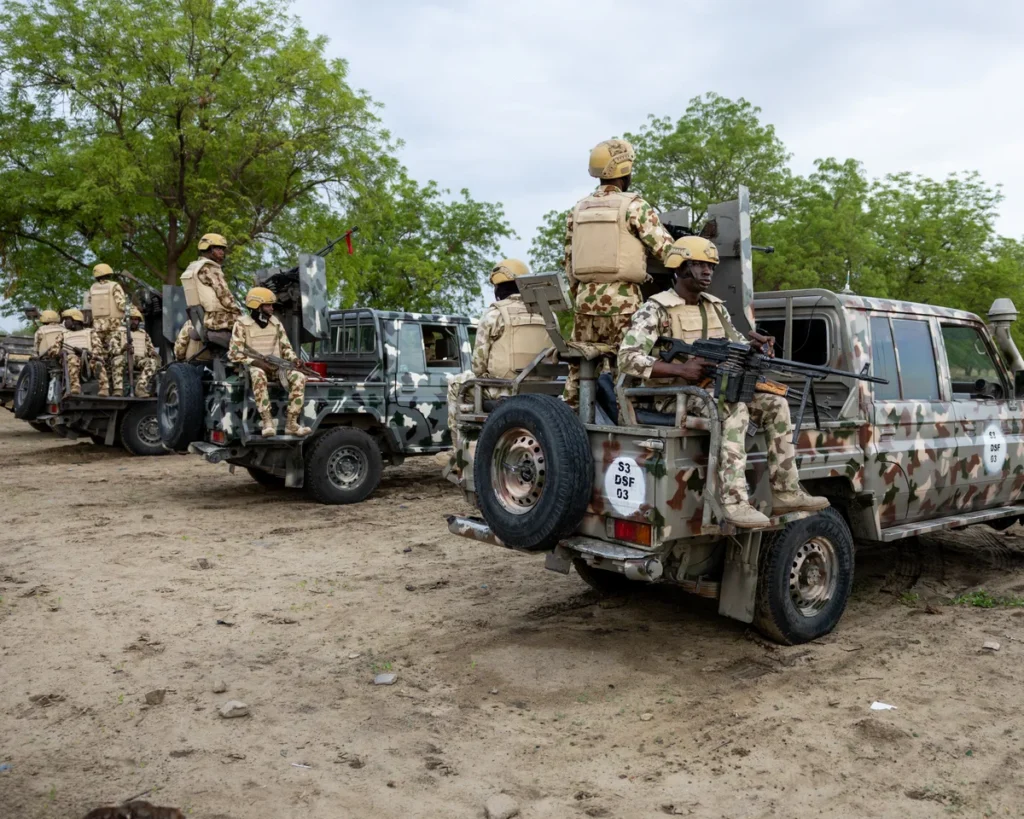
“Tonight, at my direction, brave American forces and the Armed Forces of Nigeria flawlessly executed a meticulously planned and very complex mission to eliminate the most active terrorist in the world from the battlefield,” Trump wrote. “Abu-Bilal al-Minuki, second in command of ISIS globally, thought he could hide in Africa, but little did he know we had sources who kept us informed on what he was doing.”
Nigerian President Bola Tinubu confirmed the operation Saturday in a personally signed statement, saying early assessments confirmed the killing of al-Minuki, also known as Abu-Mainok, along with several of his lieutenants during a strike on his compound in the Lake Chad Basin region.
“Nigeria appreciates this partnership with the United States in advancing our shared security objectives,” Tinubu said. “I extend my sincere gratitude to President Trump for his leadership and unwavering support in this effort.”
He praised the personnel on both sides for their professionalism and courage and said he looked forward to “more decisive strikes against all terrorist enclaves across the nation.”
Who al-Minuki Was
Abu-Bilal al-Minuki was born in Nigeria’s Borno State in 1982 and rose through the ranks of the Islamic State’s West African operations over more than a decade of violent activity across the Sahel and Lake Chad region. The Counter Extremism Project, which monitors militant organizations globally, said he took control of the Islamic State’s West Africa branch after the group’s previous regional leader, Mamman Nur, was killed in 2018.
Al-Minuki was considered the operational core of Islamic State’s West Africa Province. A U.S. official familiar with the operation told the Associated Press that he was the key figure in the organization’s financing and internal coordination and had been actively plotting attacks against the United States and American interests abroad. The official spoke without authorization to discuss sensitive details and requested anonymity.
The Biden administration designated al-Minuki a specially designated global terrorist in 2023 through the U.S. Federal Register, subjecting him to American sanctions. The Counter Extremism Project noted he was believed to have fought in Libya when Islamic State was active in North Africa more than a decade ago before returning to the Lake Chad Basin where he built and managed the group’s West African network.
Trump said al-Minuki would “no longer terrorize the people of Africa, or help plan operations to target Americans,” and added that with his removal, the Islamic State’s global operation was “greatly diminished.”
A Growing U.S.-Nigeria Security Partnership
Friday’s operation did not come without groundwork. In December, Trump directed U.S. forces to conduct strikes against Islamic State-linked militants in Nigeria, though few details of those missions were made public. In February, Washington deployed approximately 200 troops to Nigeria in an advisory and training capacity to assist the Nigerian military against Islamic State and al-Qaeda-linked insurgencies spreading across West Africa. In March, the U.S. also deployed surveillance drones to the region following Trump’s public accusations that Christians were being targeted in Nigeria’s security crisis.
Nigerian military officials had characterized the American troop presence earlier this year as operating strictly in a non-combat advisory role. Friday’s joint strike represents a step beyond that framing, with both governments openly acknowledging combined combat action resulting in the deaths of al-Minuki and multiple lieutenants.
Trump explicitly thanked Nigeria’s government for its partnership in the operation, a notable gesture given his previous criticism of Abuja over what he characterized as insufficient protection of Christian communities from Islamist militants in the northwest. Nigeria has consistently rejected those characterizations, maintaining that its security forces target armed groups without religious discrimination.
Tinubu’s statement framed the operation as a defining example of what effective bilateral security cooperation could achieve and signaled his intention to press forward with combined operations against remaining militant networks.
Nigeria’s Multilayered Security Crisis
The killing of al-Minuki addresses one dimension of a security environment in Nigeria that has no single source and no straightforward solution. Nigeria is simultaneously managing at least two Islamic State-affiliated groups, a separate Boko Haram network, banditry-driven kidnapping operations across the northwest, farmer-herder conflicts in the northcentral belt, and now, as Friday’s school attacks in Oyo State demonstrated, the southward creep of organized armed violence into regions historically insulated from insurgency.
The Islamic State West Africa Province, or ISWAP, of which al-Minuki was a central figure, has been the more operationally sophisticated of the two IS-linked organizations operating in Nigeria’s northeast. A second IS-affiliated network known regionally as Lakurawa has concentrated its activity farther west in Sokoto and Kebbi states. Both have sustained pressure on military formations and civilian communities in the Lake Chad region despite years of Nigerian military operations.
The collapse of the Islamic State’s territorial caliphate in Syria and Iraq in 2017 accelerated the decentralization of the group’s global operations into affiliate networks in Africa, the Sahel, and Southeast Asia. West Africa’s IS affiliates have emerged as among the continent’s most active and lethal, filling power vacuums in ungoverned border zones that span multiple countries and resist single-nation military responses.
Friday’s strike reinforces the U.S. strategic posture across the Sahel, where Washington has been recalibrating its counterterrorism presence as French influence has receded and Russian military contractors have expanded their footprint in several countries. Nigeria, as Africa’s largest economy and most populous nation, represents a counterterrorism partner of particular strategic value to Washington in that context.
What One Strike Can and Cannot Achieve
The killing of a senior militant leader is operationally significant and immediately consequential for the targeted organization. Al-Minuki was not merely a figurehead. His role in financing and coordinating the Islamic State’s West African operations made him irreplaceable in the short term. Disrupting those functions will slow planning cycles, complicate funding flows, and create internal competition for succession that historically generates additional vulnerabilities for intelligence services to exploit.
But counterterrorism history across multiple theaters, from Afghanistan to Somalia to the Sahel, offers a consistent caution: decapitation strikes disrupt organizations without dismantling them. Mamman Nur was killed in 2018. Al-Minuki filled his role. Someone will attempt to fill al-Minuki’s role. The speed and quality of that succession will depend on how much intelligence was gathered in Friday’s operation and how aggressively follow-on actions target the transitional period when leadership structures are most fragile.
The more durable question is whether the military partnership Trump and Tinubu celebrated Saturday translates into the kind of sustained, intelligence-driven operational tempo that degrades militant networks over time rather than producing headline-generating strikes that are tactically real but strategically insufficient on their own.
Nigeria’s northeast has been a counterterrorism theater for more than a decade. Communities in Borno State have endured Boko Haram and ISWAP attacks, mass kidnappings, displacement, and famine-level food insecurity for years. The killing of al-Minuki matters to those communities, but what they need is governance, economic activity, and security that reaches their villages before the next group of motorcycle-riding gunmen does.
Friday’s joint operation shows the U.S.-Nigeria partnership can hit high-value targets with precision. The harder test is whether it can build the sustained presence and community-level security architecture that makes those targets rarer in the first place.
AP/Reuters/Punchng





