

A Nigerian national living in Lynn, Massachusetts, has been charged with unlawfully voting as a noncitizen in the 2022 midterm elections and the 2024 presidential primary, the Justice Department said, part of a broader nationwide crackdown on noncitizen voting ahead of this year’s midterms.
Gladys Adaeze Okafor, 56, was arrested and is expected to appear in federal court in Boston. According to charging documents, Okafor was born in Aba, Nigeria, and obtained lawful permanent resident status in December 2022, but is not a U.S. citizen and has not applied for citizenship.
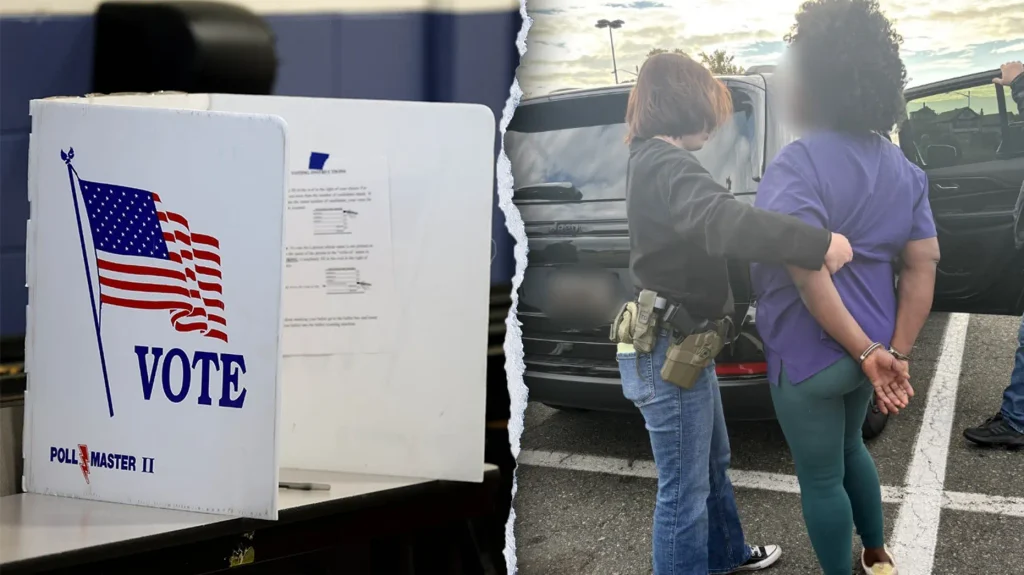
Prosecutors allege Okafor submitted a voter registration card in July 2022 certifying under penalty of perjury that she was a U.S. citizen, after which the city of Lynn registered her to vote and she cast a ballot that fall. She allegedly submitted a second registration form in October 2023, again checking the U.S. citizen box, and went on to vote in the 2024 presidential primary.
What We Know So Far
Reports differed on the potential financial penalty Okafor faces. The Justice Department’s own announcement cited a fine of up to $100,000, while a separate report cited a maximum fine of $10,000, a discrepancy that had not been resolved as of the latest reporting. Both accounts agreed the charge carries a maximum of one year in prison and one year of supervised release, and that Okafor could face deportation upon completion of any sentence.
U.S. Attorney Leah Foley and Homeland Security Investigations acting Special Agent in Charge Jeff Grimming announced the charge, with Assistant U.S. Attorney Julissa Walsh of the Major Crimes Unit prosecuting the case. The announcement follows Foley’s creation in March of a district wide Benefit and Voter Fraud Team in Massachusetts, established in response to what her office described as widespread fraud uncovered across the state.
Texas Cases Target Seven Noncitizens
Separately, federal prosecutors in the Northern District of Texas announced charges against seven people accused of illegally voting, attempting to vote, or falsely claiming U.S. citizenship in connection with the 2018 or 2024 elections. Six defendants were indicted September 10, and a seventh was charged by criminal complaint the following day; all seven had been arrested or surrendered by Tuesday, according to the Justice Department.
The defendants include:
- Helen Sayen Adams, 67, a Nigerian citizen and green card holder accused of falsely claiming citizenship on a Texas voter registration application before voting in Tarrant County in November 2024.
- Rocio Thrasher, 38, a Mexican citizen and lawful permanent resident accused of a similar false citizenship claim before voting in the same election.
- Khalwinder Singh Bhengura, 69, an Indian citizen and lawful permanent resident accused of falsely claiming citizenship when registering to vote and later on a Texas driver’s license application before voting in 2024.
- Celestin Katubadi, 20, a citizen of the Democratic Republic of Congo, and Carlos Salas Barrios, 41, a Mexican citizen, both accused of casting provisional ballots in 2024 despite ineligibility; prosecutors said both ballots were ultimately rejected by election officials.
- Joshua Nmelichukwu Akpom, a Nigerian citizen and lawful permanent resident since 2016, charged with making false statements during his naturalization process by denying he had previously registered to vote or voted, despite records showing he registered in 2017 and voted in 2018; prosecutors said the underlying voting allegation falls outside the statute of limitations.
- Moises Anwar Arellano-Alba, a Mexican national previously ordered removed from the U.S. in July, accused of falsely claiming citizenship on a driver’s license application and voting in Dallas County in 2024; he surrendered to authorities after initially being sought as a fugitive.
U.S. Attorney Ryan Raybould said federal elections belong to American citizens, adding that those who vote or falsely claim citizenship while not eligible violate federal law and undermine confidence in elections. HSI Dallas acting Deputy Special Agent in Charge Judy Pardo said election integrity remains a national security priority for the agency.
Texas Secretary of State Robert Howden said his office referred 117 cases to the state attorney general for investigation after using the federal SAVE database to check the eligibility of all 18 million registered Texas voters. Of about 2,724 people initially flagged as potential noncitizens, more than 550 were subsequently confirmed to be U.S. citizens and returned to the voter rolls, an outcome Howden attributed to gaps in synchronization between state and federal records.
Broader Context
The Texas and Massachusetts cases add to a growing number of noncitizen voting prosecutions nationwide. The Department of Homeland Security last week announced the arrest of Anthony Tyrone Higgs, a Bahamian national and lawful permanent resident in Georgia, after Homeland Security Investigations determined he had illegally voted in the 2020 election; DHS said Higgs has prior convictions for armed robbery, domestic violence and assault on a police officer and has been placed in removal proceedings. Earlier this month, the Justice Department also charged five people in Pennsylvania, New Jersey and Wisconsin over alleged illegal voting or fraudulent registration during the 2022 or 2024 elections.
The Justice Department’s National Fraud Enforcement Division, created in April, supports President Trump’s Task Force to Eliminate Fraud, chaired by Vice President JD Vance, which targets fraud, waste and abuse within federal programs broadly.
Documented instances of noncitizen voting have historically been rare. A Reuters review of the Heritage Foundation’s own election fraud database found only 24 recorded instances of noncitizen voting between 2003 and 2023 nationwide. Federal elections prohibit noncitizen voting everywhere in the country, though some jurisdictions, including Washington, D.C., and a limited number of municipalities in California, Maryland and Vermont, permit noncitizens to vote in certain local elections.
Why This Matters
The scale of the administration’s current enforcement push, spanning coordinated federal, state and local investigations across at least four states, reflects a significant expansion of resources devoted to noncitizen voting cases ahead of the 2026 midterms, even though the documented historical rate of such voting remains extremely low relative to overall turnout. Texas alone recorded more than 11.4 million ballots cast in the November 2024 general election, meaning the seven Texas defendants represent a small fraction of the state’s electorate.
The Texas Secretary of State’s finding that more than 550 flagged voters were ultimately confirmed as citizens illustrates a recurring challenge in this kind of enforcement effort: verification databases used to flag potential noncitizens are not always synchronized with current citizenship records, creating a risk that eligible citizens could be temporarily removed from voter rolls or wrongly scrutinized during the investigative process, even as officials describe the additional review as necessary due diligence.
The prosecutions also carry direct immigration consequences beyond the criminal charges themselves, with several defendants, including Okafor, facing potential deportation upon completion of any sentence, layering federal criminal exposure on top of existing immigration status for those convicted.
What Happens Next
Okafor is expected to proceed through arraignment and pretrial proceedings in Boston federal court following her appearance. The seven Texas defendants will similarly proceed through the federal criminal process, with the six indicted defendants facing charges in U.S. District Court and the seventh proceeding through the criminal complaint process; no trial dates have been announced.
If convicted, unlawful voting by an alien carries a maximum of one year in prison per count, while knowingly making a false citizenship claim to register or vote can carry up to five years per count, and Akpom’s alleged false statements during naturalization carry a similar five year maximum. Actual sentences would depend on the specific charges of conviction, federal sentencing guidelines and other statutory factors. As with all pending charges, each defendant is presumed innocent unless proven guilty beyond a reasonable doubt in court.
Reporting drawn from the U.S. Department of Justice, Fox News and Newsweek





